Best AI Agents in 2026: What Actually Works (With Real Comparisons)


.png)

Finding the best AI agents in 2026 is not easy: most guides are already outdated and describe primitive chatbots. We have collected only up-to-date information, filtering out non-working tools. The market today is highly polarized: from free open-source solutions to enterprise platforms costing $500+/month. In this guide, we will cover:
- Classification of autonomous systems;
- Top tools for coding, business, and QA;
- Powerful frameworks for custom development;
- Criteria for choosing software for your specific tasks.
This guide will help you implement tools that can really reduce your workload, rather than merely simulate activity.
What Are AI Agents? (And How They Differ from Assistants)
The fundamental change in 2026 is moving from software that talks to software that performs. While many people still refer to these two terms as synonymous, the technical distinction is critical to any digital transformation strategy. A standard assistant is reactive — it waits for a prompt, processes information, and then provides a text or visual output. An autonomous assistant, on the other hand, is proactive: it does not just propose a solution but performs a set of steps to accomplish a particular goal.
Key Capabilities of Modern Autonomous Systems
To be a true “digital worker” in today’s ecosystem, a tool must have these four attributes:
- Goal-setting & planning: The ability to take a high-level goal and break it into a series of executable steps;
- Tool usage: The ability to integrate with external tools via API, allowing it to work with a CRM, database, or browser;
- Persistent memory: The capacity to retain context and learn from previous experiences;
- Multi-step workflows: The ability to perform complex loops where it observes the result of an action and changes its next step accordingly.
Types of AI Agents: A 2026 Classification
Understanding the types of AI agents available is important in determining the best type of AI for your business:
- Task-specific: Limited scope, e.g., ad spend optimization or real-time cyber threat detection;
- Conversational: Advanced support systems (like Intercom’s Fin) that resolve complex customer inquiries by accessing backend data;
- Autonomous: High-level entities like Devin that can build entire software features from a single natural language description;
- Multi-agent systems: Collaborative environments where specialized models (e.g., a “Researcher,” a “Writer,” and a “Fact-Checker”) work together to complete large-scale projects.
Expert Tip: An assistant answers questions. An agent completes tasks without constant supervision.
Understanding what AI agents can do is only the first step. The real challenge is identifying where they can create measurable business value. Our AI workflow automation guide explores practical use cases and explains how companies can automate processes gradually and effectively.
Best AI Agents for Coding & Development
The choice of the best AI agents for coding today depends not so much on the quality of the model (they all use top-tier Claude 3.7 or GPT-5), but on “agentic” capabilities — the tool’s ability to independently modify the file structure, run tests, and fix its own errors.
- Cursor Composer: In 2026, this is the gold standard. The Composer feature allows the agent to literally “rewrite” the application architecture in real time, working with dozens of files simultaneously. The best choice for those building complex systems;
- GitHub Copilot Agent: Ideal for standard tasks: writing tests, migrations, and documentation. Its strength lies in the GitHub ecosystem and its enormous knowledge base;
- Devin / PlayCode Agent: While Devin is oriented toward the corporate sector, PlayCode Agent ($9.99/month) has become a favorite among web developers — it lets you watch the process of writing React/Vue code in the browser in real time;
- Windsurf: Stands out for its ability to “think” ahead. Its deep integration with project context enables it to find and fix bugs that other systems simply overlook.
Expert Tip: For production code, always review agent output — autonomy doesn’t mean zero oversight.
Best AI Agents for Software Testing
Quality Assurance itself has seen a tectonic shift. Rather than creating test scripts, QA engineers are now creating autonomous systems that understand business logic. Utilizing the best AI agents for software testing allows for 90% regression coverage without writing a single line of code manually. These tools don’t just click buttons — they understand user intent and can automatically update tests when the interface changes (self-healing).
- TestSprite: Stands out with the concept of “AI tests AI”. Ideal for teams that already use code generation and need ultra-fast verification. Thanks to MCP server integration, the system sees changes in real time;
- Diffblue: The standard among agents for enterprise Java. The tool fully takes over unit test writing by analyzing bytecode;
- Qodo (formerly CodiumAI): Focuses on code quality before the code is even pushed to the repository, analyzing the context of the entire codebase;
- Functionize: Uses NLP to create scenarios — a tester can simply describe the task in words, and the system will build an execution path that won’t break when element IDs or CSS classes change.
Note: Testing agents reduce manual QA time by 40–60%, but require initial setup.
Best AI Agents for Business Automation
Business automation has finally moved far beyond simple “if this, then that” rules. Modern agents are full-fledged digital employees that don’t just move data from one table to another, but make decisions based on context, learn from your documents, and interact with customers independently.
- Zapier Central: The best choice for connecting all your services. It does not wait for a trigger but analyzes data in all connected Live Data sources (Notion, Google Docs) and acts autonomously;
- Salesforce Agentforce: “Heavy artillery” for those who live in the Salesforce ecosystem. The Flex Credits model means you pay for specific actions — lead qualification, deal closing — making costs transparent for large departments;
- Jasper: Jasper’s marketing agents possess “brand memory” — they know your style, target audience, and past campaigns, generating content that requires practically no edits;
- Reclaim.ai: Your digital secretary. Automatically finds time for deep work, reschedules meetings in case of conflicts, and prevents burnout based on your habits;
- Intercom Fin: The flagship in customer service. Thanks to proprietary RAG models, Fin delivers answer accuracy of 95%+ and works directly with your knowledge base.
Expert Tip: Start with one high-impact workflow before deploying digital workers across your organization.
Best AI Agent Frameworks for Building Intelligent Systems
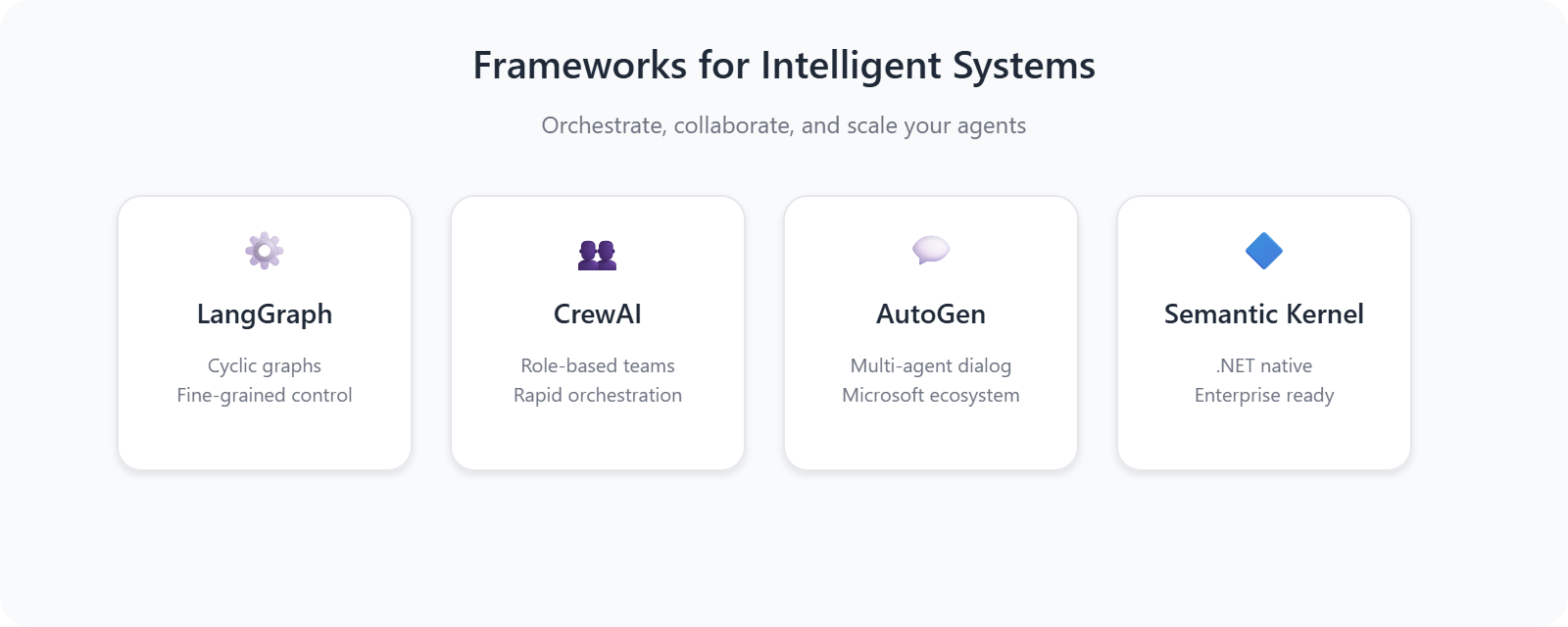
Off-the-shelf software often lacks the custom logic required for complex business needs. Today’s market offers robust orchestrators capable of uniting multiple models into cohesive teams. At Xmethod, we’ve identified the top libraries that cover 99% of modern enterprise requirements.
LangGraph (by LangChain)
At the moment, this is perhaps the most powerful tool for those who need precise control. Unlike the linear chains of the past, this orchestrator allows building cyclic graphs — critically important because real-world tasks often require returning to a previous step to correct errors or clarify data. Despite its high learning curve, the flexibility in state management makes it a favorite for complex engineering systems.
CrewAI
If you want to build a team of “virtual employees” with specific roles (e.g., Researcher, Editor, Manager), CrewAI is the optimal choice. Based on a “role-based interaction” model, you can implement a process quickly without worrying about code details. A ready-made template library for common business processes is maintained by the community.
AutoGen (Microsoft)
The standard for creating dialogic systems where multiple autonomous agents communicate with each other to solve a problem. One of the best AI agent frameworks for those working in the Microsoft ecosystem or needing complex collaborative task logic.
Semantic Kernel
The ideal solution for teams deeply integrated into the .NET stack. This Microsoft tool makes it easy to embed intelligent features into existing enterprise applications while ensuring a high level of security and type safety.
OpenAI Agents SDK
The simplest path for a quick start. If your stack is fully tied to OpenAI solutions, this SDK minimizes boilerplate code, allowing you to launch a prototype in just a few hours.
The choice of tooling should be driven by the architectural requirements of the project. We often combine approaches — using LangGraph for the core system and CrewAI for managing high-level scenarios — which provides a balance between power and development speed.
No-Code vs. Code: What Are the Best Tools for Building AI Agents
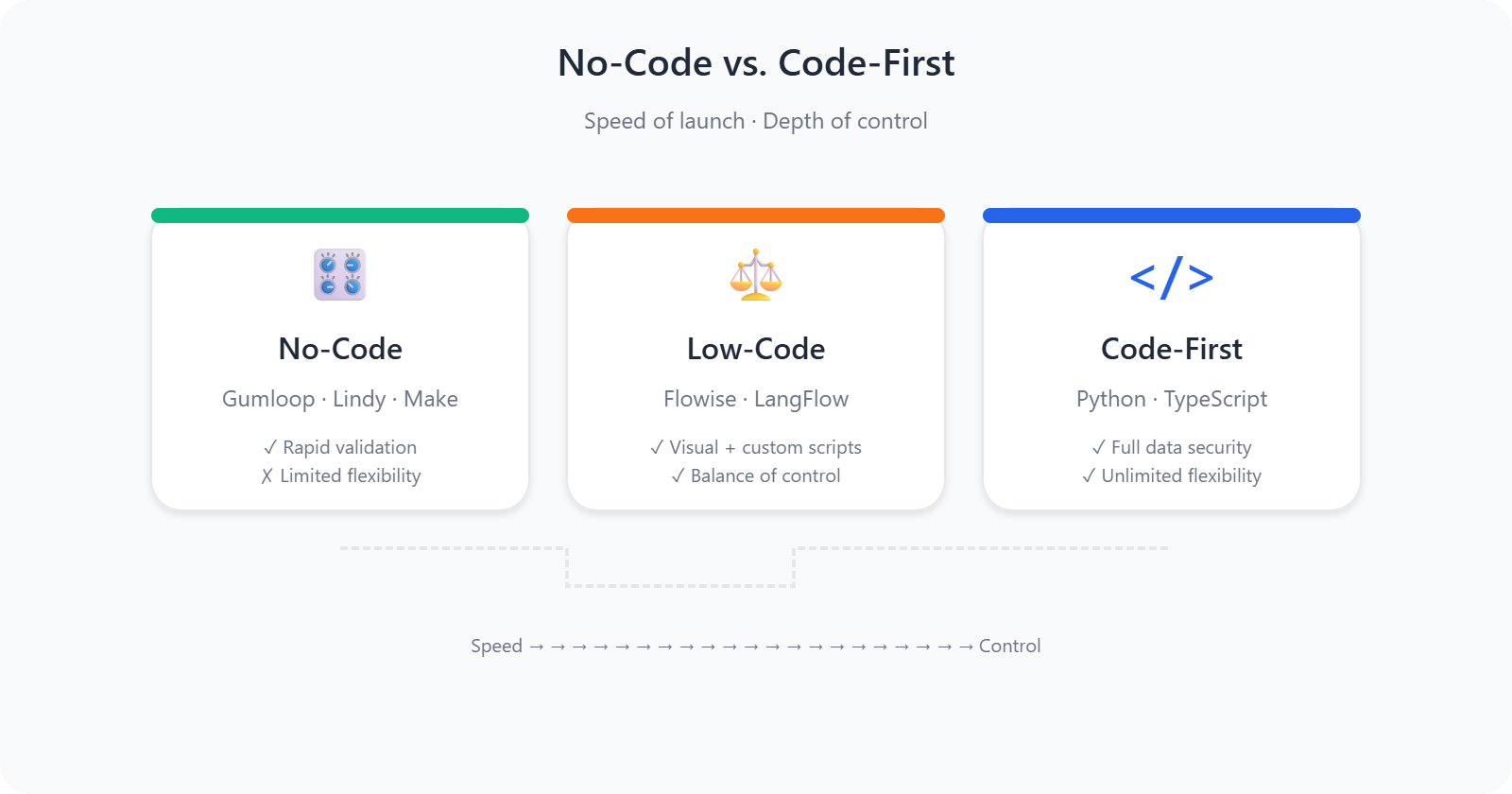
The answer depends on what matters most to you: speed of launch or depth of control. The tooling is split across three levels:
- No-Code (Gumloop, Lindy, Make): The best choice for rapid hypothesis validation. Assemble logic through visual blocks or natural language dialogue. Ideal for creating a quick autonomous workflow — though high cost-per-step when scaling and limited flexibility with non-standard APIs are notable drawbacks;
- Low-Code (Flowise, LangFlow): The “golden middle”. Build graphs in a visual interface while retaining the ability to insert custom scripts. Significantly accelerates the design of complex reasoning cycles without sacrificing control;
- Code-First (Python, TypeScript): Direct script development. The only option for Enterprise (fintech, healthcare) where full data security and independence from third-party cloud providers are critical.
Expert Tip: No-code is great for prototypes, but code-first gives you full control over data and logic.
Building AI agents internally isn't the right choice for every company. If you're weighing the build-versus-buy decision, our comparison of AI development companies explains what external partners can offer and how to choose the right implementation team.
How to Choose the Right AI Agents Software for Your Business
Selecting the right platform today is not just about choosing the best neural network — it’s about testing the strength of your future digital infrastructure. To avoid critical mistakes during implementation, follow this algorithm:
- Define your primary goal vector: Need automation? Focus on action reliability. Need insights? Look for systems with powerful analytical modules and deep memory (RAG);
- Check integration depth: A smart system is useless if it “lives in a vacuum.” Ensure the software supports key tools out of the box: Slack, CRM (Salesforce/HubSpot), and corporate databases;
- Data protection & regulatory alignment: In 2026, this is foundational. High-tier safety credentials and regional privacy compliance are the absolute minimum. Critical for the European market;
- Total cost of ownership (TCO): The actual cost includes both monthly subscription and token usage. In complex reasoning cycles, resource usage increases exponentially;
- Scalability: How easily can you add another dozen autonomous agents? Assess how scalability affects performance and price as data volumes increase;
- Human-in-the-loop: The system must allow a human to take control at critical moments — especially in financial transactions or direct customer communication.
Properly selected software will become your main growth lever, while a hasty decision will turn into a “black hole” for your budget and your engineers’ time.
Technology alone rarely creates business value. Successful companies connect AI initiatives to measurable outcomes and prioritize use cases strategically. Our enterprise AI strategy guide explains how organizations can move from experimentation to sustainable adoption.
Final Verdict: Building Your Modern Automation Stack in 2026
Autonomous systems have moved from being experimental to being fundamental infrastructure by 2026. The hunt for the best AI agents is no longer based on hype but on a strategy that seeks a balance of flexibility and data security.
At Xmethod, we advocate a simple principle: start small, scale fast. Identify a single high-impact bottleneck — such as software testing or lead qualification — refine the autonomous logic, and then expand your digital workforce. The era of reactive assistants is over; the age of “Agent-first” operations is here.
Frequently Asked Questions
What are the available AI agents?
There are four primary types prevalent in the current ecosystem, including task-specific (narrowly specialized) systems, conversational support systems, fully autonomous engineering entities, or scalable multi-assistant structures in which various modules work together to complete a single task.
Can these autonomous systems replace developers?
No. In 2026, they have become "force multipliers". These tools can take care of up to 80% of routine work, such as boilerplate, tests, and migrations, but structural oversight, system integrity, and nuanced business logic still demand professional human expertise.
How much do the top-tier solutions cost?
The price range varies widely, from free open-source libraries to $20-$30 per month for each user’s subscription. For big businesses, enterprise solutions with dedicated support can cost between $500/month.
Is it safe to use them with sensitive data?
The cloud services should be certified with a proven enterprise safety standard and comply with the stringent privacy requirements in the region. Nevertheless, a code-first approach is better in terms of maximum data sovereignty. This enables personal models to work fully within a closed internal perimeter with no information flowing out of your organization.
What is the most appropriate framework to use as a newcomer?
In fact, it is a matter of comfort with your code. CrewAI is your preferred beginner-friendly library if you like structured roles. Still, to get a more practical visual approach and avoid getting lost in Python scripts, LangFlow is certainly worth observing.