MVP Development: Guide, Costs & Startup Differences


.png)

According to CB Insights statistics, 42% of startups fail simply because the market does not need their product, and founders realize this far too late. To avoid burning the budget on creating a so-called “perfect” solution in a vacuum, experienced entrepreneurs start with MVP Development, and in this guide, we will break down not only the technical side but also the real economics of the process that separates a successful business from an expensive hobby.
What is a Minimum Viable Product (MVP)?
It is not just a “raw” version of a product thrown together in a rush, and it is not a chopped-off piece of functionality that makes you feel embarrassed in front of users. Minimum viable product development is the creation of a version of a product with the minimum necessary set of features sufficient for early users (early adopters) to solve their problem and provide feedback.
The concept, popularized by Eric Ries in the Lean Startup Method, is built around the Build-Measure-Learn Zyklus (Create-Measure-Learn). The essence of the approach is described with absolute precision in the original source:
The MVP is not necessarily the smallest possible product, but it is the fastest way to go through the build-measure-learn feedback loop with the least possible effort.
— Eric Ries, Lean Startup (2011)
The main goal here is learning, because the earlier you understand the flaws in your hypothesis, the cheaper it will be to fix them. It is important to understand that “minimum” does not mean “unfinished.” If you are building a car, then an MVP is not a wheel and not a car body without an engine, but a skateboard. It already takes you from point A to point B, even if without comfort. When developing MVP software development, it is critically important to follow these principles:
- Focus on one main function that solves the user’s core pain point;
- Speed of entering the market, to get ahead of competitors and start collecting data;
- Minimal resource expenditure to validate the geschäftsidee without unnecessary investments.
Thus, we replace blind faith in an idea with a controlled hypothesis validation process. This allows the team to painlessly filter out non-working scenarios before they consume the budget and to focus resources exclusively on those directions that have proven their viability in real market conditions.
MVP vs. Prototype vs. Proof of Concept: What is the difference?
These terms are often mixed together, with any draft being called an “MVP,” yet there is a huge gap between them in goals, budgets, and outcomes. To help you avoid burning resources for nothing, let’s break these concepts down clearly:
- Proof of Concept (PoC): This is a technical check (“is this even possible?”). It is needed to confirm that your idea is feasible at the code level;
- Prototyping: This is a visual check (“what does it look like?”), the creation of a clickable UX/UI mockup that cannot be sold;
- MVP product development: This is a market check (“Do people actually need this?”). The only format that implies real sales and business metrics.
To help you better understand the difference and avoid spending your budget on full-scale development where only a clickable mockup is needed, we have prepared a comparison of key characteristics.
Ignoring these differences leads to a classic survivor’s fallacy; founders get carried away polishing the product while forgetting to ask the market. As experts from the Für-Gründer.de portal rightly point out, the consequences of such a strategy are often fatal:
The result is often devastating: Many founders spend months perfecting their solution in detail, only to find on the day of release that there is simply no demand for their innovation.
— Für-Gründer.de: Startups fail due to incorrect market assessment
This is exactly why choosing the right tool at the start determines the fate of the project. If your goal is to impress an investor with visuals, create a prototype. But if you want to validate product-market fit and start building a business, you need a full-fledged MVP capable of generating data in real-world conditions.
The difference between MVP and startup
Many founders mistakenly believe the terms are synonyms or that a successful MVP startup launch automatically makes them entrepreneurs. This is a dangerous misconception. A startup is a temporary organization created to search for a repeatable and scalable Geschäftsmodell in conditions of high uncertainty.
In this context, MVP development is the process of creating a tool, an object through which this organization tests its hypotheses. An application by itself, even if written perfectly, is not a business. Without proper marketing, sales, support, and clear unit economics, your code will remain just code.
At the same time, the successful launch of a minimal version is only the first step on the long path of turning an idea into a company. A common mistake founders make is focusing exclusively on software development MVP, forgetting that the product must be sold. MVP development challenges lie not only in the realm of technology but also in the team’s ability to listen to the market and quickly adapt to customer feedback.
Why should you develop an MVP? (Advantages)
The key reason we suggest starting specifically with an MVP is risk minimization and capital protection. In a world where the Google Play Store already has over 3 million apps, the cost of a mistake is simply too high. Instead of investing a year of your life and hundreds of thousands of euros in a pig in a poke, the MVP software development strategy allows you to test hypotheses with minimal losses and avoid creating software that nobody needs.
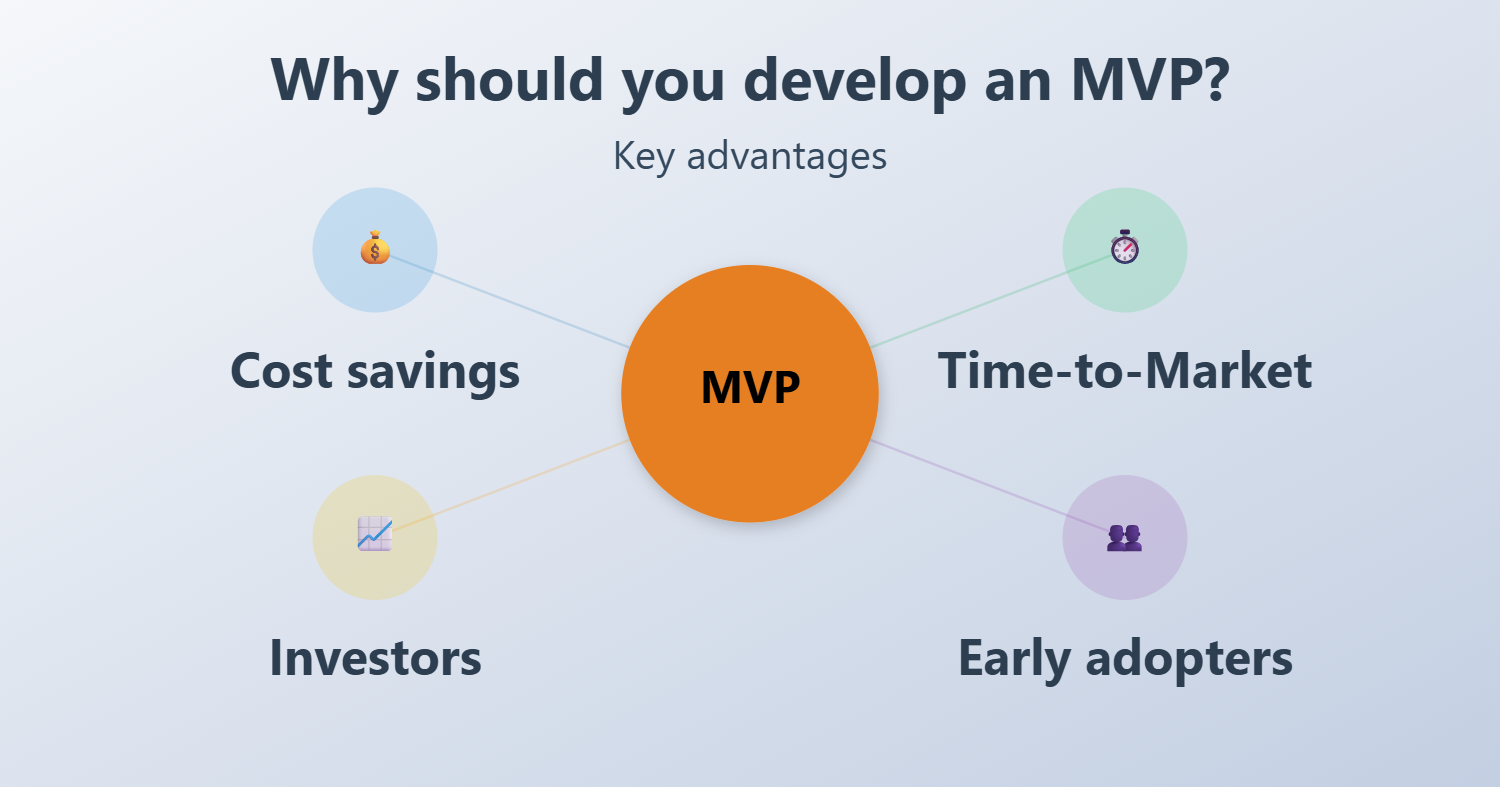
As Bitfactory experts note, development should follow the KISS principle (keep it simple, stupid), which opens several strategic doors for a business:
- Cost savings: You do not spend money on faulty development and unnecessary features, cutting off everything that does not bring direct value right from the start;
- Time-to-Market: Often, 2–3 months are enough to go from an idea to release, giving you a head start over competitors who polish their products behind closed doors for years;
- Investors: Raising a funding round (seed stage) is significantly easier when you have a working product and initial metrics rather than just a beautiful presentation;
- Early adopters: An early launch allows you to build a base of loyal users who will forgive bugs in exchange for solving their core problems and providing you with valuable feedback.
One way or another, launching an MVP is the only way to obtain reliable market fit in real combat conditions. You stop reading tea leaves and start operating with facts.
How much will it cost to develop an MVP in 2026?
This is the most uncomfortable question for many studios, and they usually dodge it with an evasive “it depends...” At Xmethod, we prefer transparency. While it's impossible to name an exact figure without a detailed specification, we want to provide realistic price ranges for the DACH market in 2026 so you can plan your budget effectively.
It’s important to understand the cost structure — code is only the tip of the iceberg. In high‑quality MVP product development, the technical implementation (programming) typically accounts for about 40–50% of the budget. The rest of the investment goes into business analysis, UI/UX design, project management (PM), QA testing, and infrastructure setup. Based on our experience and current market rates, we can identify three main pricing categories:
- Low-Code/No-Code MVP (5,000€ – 15,000€): An ideal option for simple idea validation without complex logic, where ready-made builders are used, allowing the product to be assembled in just a few weeks;
- Custom Web MVP (20,000€–45,000€): Full custom development of a web application (SaaS, marketplace) with unique design, scalable architecture, and API integrations;
- Complex Mobile MVP (50,000€+): Native development for iOS and Android; projects in Fintech, AI, or IoT that require high security, a complex backend, and compliance with regulatory standards.
The choice of contractor also impacts the final estimate and risk levels. Freelancers might offer a rate 2–3 times lower, but you take on the risks of micromanagement, missed deadlines, and a lack of guarantees. An agency, on the other hand, provides a coordinated team and legal responsibility for the result, which is critical for a serious business.
Step by step guide to your own MVP
However, the journey from idea to first launch does not involve chaotic coding but rather a well-structured approach to MVP development strategy that eliminates uncertainties at each step. At Xmethod, we have defined a product development cycle into which you can break your journey to avoid common pitfalls for a beginner.
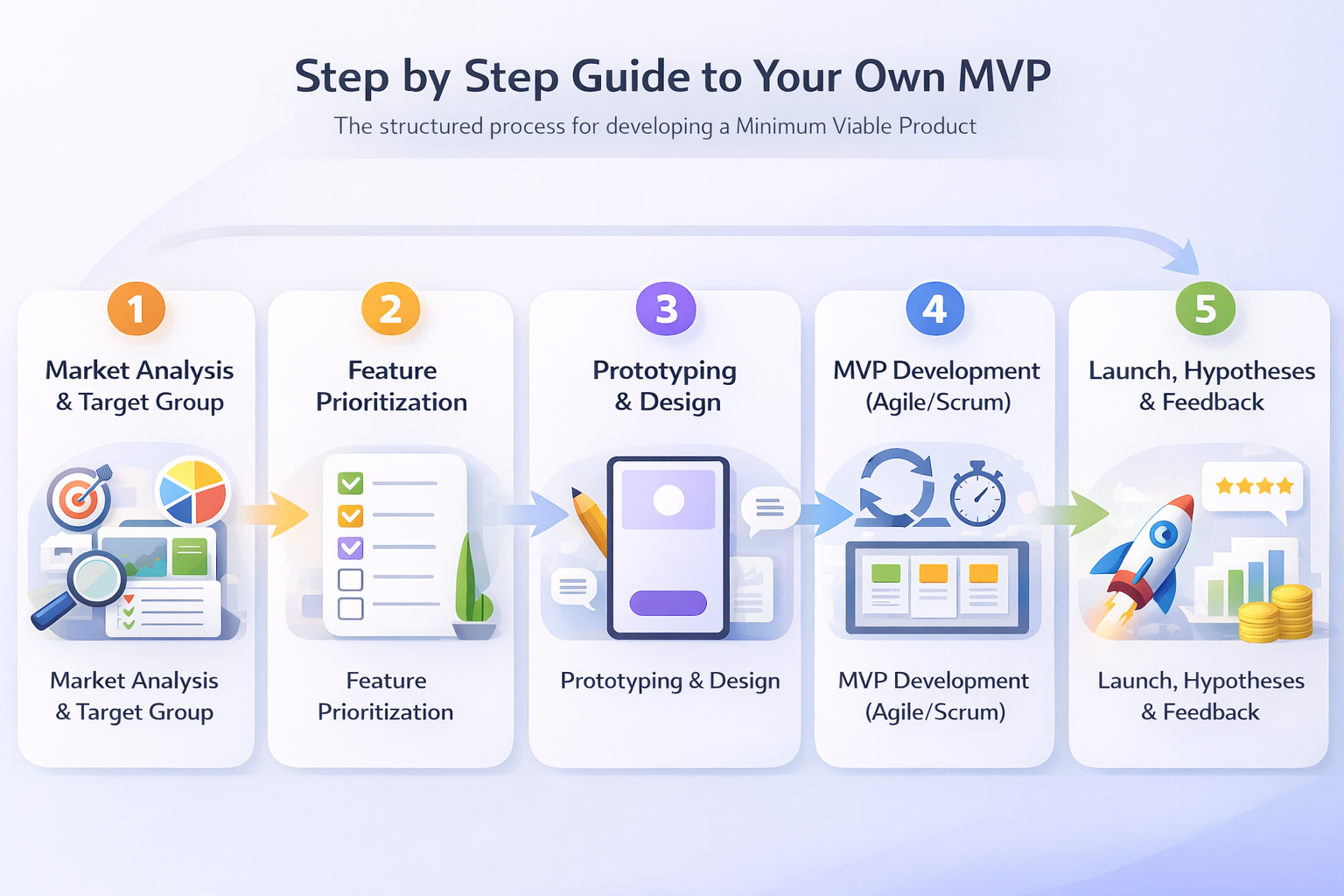
1. Market analysis & target group
Even before you begin to code your first line, it’s essential to ensure that you have a problem worth solving. This may be achieved through competitive research and interviews with potential consumers to better understand who your intended audience would be, including what they are willing to pay. This is where we begin to craft a value proposition—the value offer that sets us apart from among tens of competitors. It's pointless to build another Uber if we do not have a clue as to how it's going to be different from what already exists.
2. Feature Prioritization (MoSCoW)
The most agonizing phase for founders in the MVP development process is removing the functionality. For this purpose, we apply the MoSCoW prioritization technique (Must have, Should have, Could have, Won't have). Your task is to prioritize and retain the essence – the basic functions. The Impact Guide for startups explains this as follows:
The focus must be strictly on the so-called 'must-haves'. Your MVP should initially include only those functions that are essential for the core solution and provide the greatest value.
— Impact Guide on MVP development
The rest of what is in “Should” or “Could” is ruthlessly sprinted off to the backlog. This is where you can see what is really important and not end up loading development efforts or costs in the first phase.
3. Prototyping & Design
Visualization helps to spot logical loopholes quite effectively. Wireframes and clickable prototypes enable us to check the UX even before development begins. Minimum viable product design doesn't have to be elaborate, but it must be intuitive and easy to use. At this stage, a visual prototype is developed that can be presented to investors or a focus group to get feedback without splurging money on developers.
4. MVP Development(Agile/Scrum)
Once the design is approved, the magic of code begins. Choosing the right methodology for MVP development is paramount. Xmethod works exclusively with agile development, dividing the process into short 2-week sprints. This preserves flexibility; if the market shifts or user feedback shows we’re off track, we can pivot quickly without catastrophic losses.
The tech aspect also involves selecting the architecture. Even for an MVP, we establish a scalable architecture and work with modern cloud infrastructure. This ensures that when your startup suddenly scales from 100 to 100,000 users, the system won't crash, and you won't have to rewrite everything from scratch.
5. Launch, Hypotheses & Feedback
A release is not a finish line, but the starting gun for real experiments. Simply pushing the product live is not enough. Your main task here is hypothesis testing in real conditions.
An MVP launch must answer a specific question. Even before development begins, introduce a culture of validation:
- Formulate a hypothesis: “If we add feature X, the Conversion Rate will increase by 5%”;
- Define a Baseline: The starting point, because to understand the effect, you need to know your current metrics. Without this, there is a high risk of mistaking random fluctuations for success;
- Run the test: This may be A/B testing or direct observation of user behavior.
Only after this do metrics come into play. As experts from the Impact Guide emphasize, it is important not just to collect data (output) but to measure real changes (outcome). To keep you from drowning in a sea of numbers, we have highlighted the key metrics and KPIs necessary for hypothesis validation.
Based on this data, you make data-driven decisions about which feature to add next and which one to remove. Your goal is to confirm or refute product-market fit. If the metrics show that the hypothesis is incorrect, do not be afraid to change course. Experiments exist precisely so you can fail cheaply and quickly, finding the right path to growth.
Common mistakes when creating an MVP
Even with a map in hand, you can still take the wrong turn. We have seen hundreds of projects and identified the top pitfalls founders repeatedly step on. The first and main enemy is perfectionism. The desire to “polish just this one button” delays the release for months, even though the user may not need that button at all.
Among other critical mistakes, the following stand out:
- Feature Creep: Endless expansion of functionality during MVP development. When in the middle of a sprint, you decide to add “one more small feature,” you break both deadlines and budget; strict scope reduction is your best friend;
- Ignoring feedback: The most expensive mistake is falling in love with your idea so much that you stop hearing customer feedback that contradicts your vision;
- Saving on design: An MVP can be simple, but it must not be ugly or confusing. Poor UX will kill conversion, and you will receive false data suggesting that the product is not needed, when in reality, it is simply inconvenient to use.
By overcoming these obstacles to MVP development, you significantly increase your chances of surviving the startup “valley of death.”
Conclusion: Start your project with Xmethod
MVP software development is the foundation of your future business, a balance between speed, budget, and quality. Walking this path alone is difficult; there are too many technical and strategic nuances to consider if you want to avoid becoming part of the failure statistics. Building a minimum viable product requires a cool head and experienced hands.
The Xmethod team specializes in MVP development and launching digital products. We do not just write code; we help you validate the business model, guide you through the stages of risk analysis, and build a product ready for scaling. Stop putting your idea on the back burner.