AI Process Optimization: The Practical Guide to Efficient Workflows



Many mid-sized companies face similar problems: complex processes, cost pressure, and rising customer expectations. Often, workflows were merely adjusted rather than holistically rethought. The result: media disruptions, manual work, and limited efficiency.
Classic methods such as Lean or Six Sigma have already brought noticeable improvements to many organizations. The "low-hanging fruit" has often already been picked. Further optimization steps become more complex, more expensive, and deliver only limited effects. At the same time, the pressure to work faster, more efficiently, and in a more data-driven way keeps rising.
This is exactly where AI process optimization comes in, combining existing data, intelligent algorithms, and automation to make workflows not only faster but also significantly smarter. More and more companies are using it – from document processing to production control. But where does it really pay off? And how do you get started pragmatically?
In this guide, I'll show you exactly what intelligent automation is, which use cases are worthwhile for your company, and how you can get started pragmatically in 30/60/90 days.
What does AI process automation mean in concrete terms?
Artificial intelligence process optimization is the systematic improvement of business processes with the help of learning algorithms and data-driven analysis. It's not about a magic black box – but about a clear, repeatable workflow:
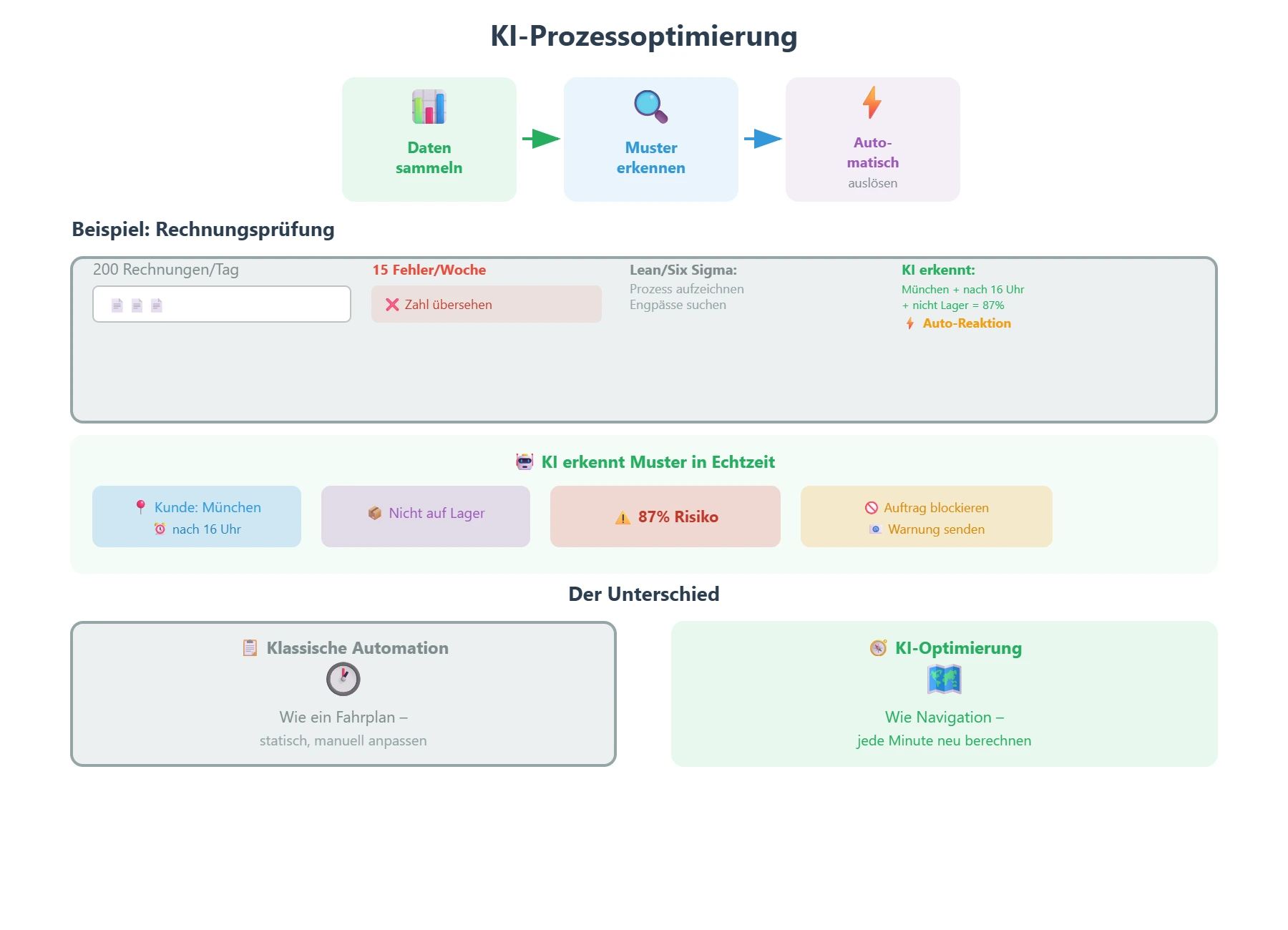
Collect data → Identify patterns → Trigger actions automatically
Imagine: your team processes 200 invoices a day. Every week, 15 errors occur – usually because someone overlooks a number or a delivery date wasn't updated. Lean or Six Sigma help: you map the process, look for bottlenecks, change instructions. But what if the errors don't come from people – but from invisible patterns in the data?
Artificial intelligence sees that. It recognizes: "If the customer is from Munich, the order arrives after 4 p.m., and the item is out of stock – then the probability of error is 87% higher." And it reacts: it blocks the order, alerts the warehouse employee, sends an email to the customer – automatically and in real time.
Classic workflow automation is like a timetable – which you have to redraw again and again. Process optimization through artificial intelligence is like a navigation system that recalculates the route in real time – and not just once, but every minute.
You don't need experts for intelligent automation. You need a repeatable process – and data that's clean. Measure what's happening. Then let neural networks find the "why." If process optimization leads to custom software development, understanding the software development cost will help you plan your investment.
Expert tip: Don't start with the most complex idea. Choose a clear, measurable workflow – such as processing customer inquiries or approving orders. Ask: Where is time lost? Where do errors occur? Your starting point isn't the technology, but the process.
Classic process optimization vs. AI-supported approaches
Classic methods such as Lean or Six Sigma are based on process recordings, workshops, and fixed rules. They make inefficiencies visible, but reach their limits when complex, data-driven patterns come into play. They mostly show what is happening – but not always why.
Data-driven approaches complement this structure by analyzing real-time data from ERP or CRM systems. This is how an insurer recognized that 68% of certain inquiries originated from one region – caused by a form error. While classic AI process optimization works with static rules, machine learning models adapt dynamically to new data and make processes capable of learning.
In practice, it becomes clear: companies that combine both – a clean process structure plus intelligent use of data – achieve the most sustainable results. Artificial intelligence is no substitute for clear process thinking. But it is the accelerator when it comes to speed, scaling, and prediction.
Why process optimization with AI pays off (benefits)
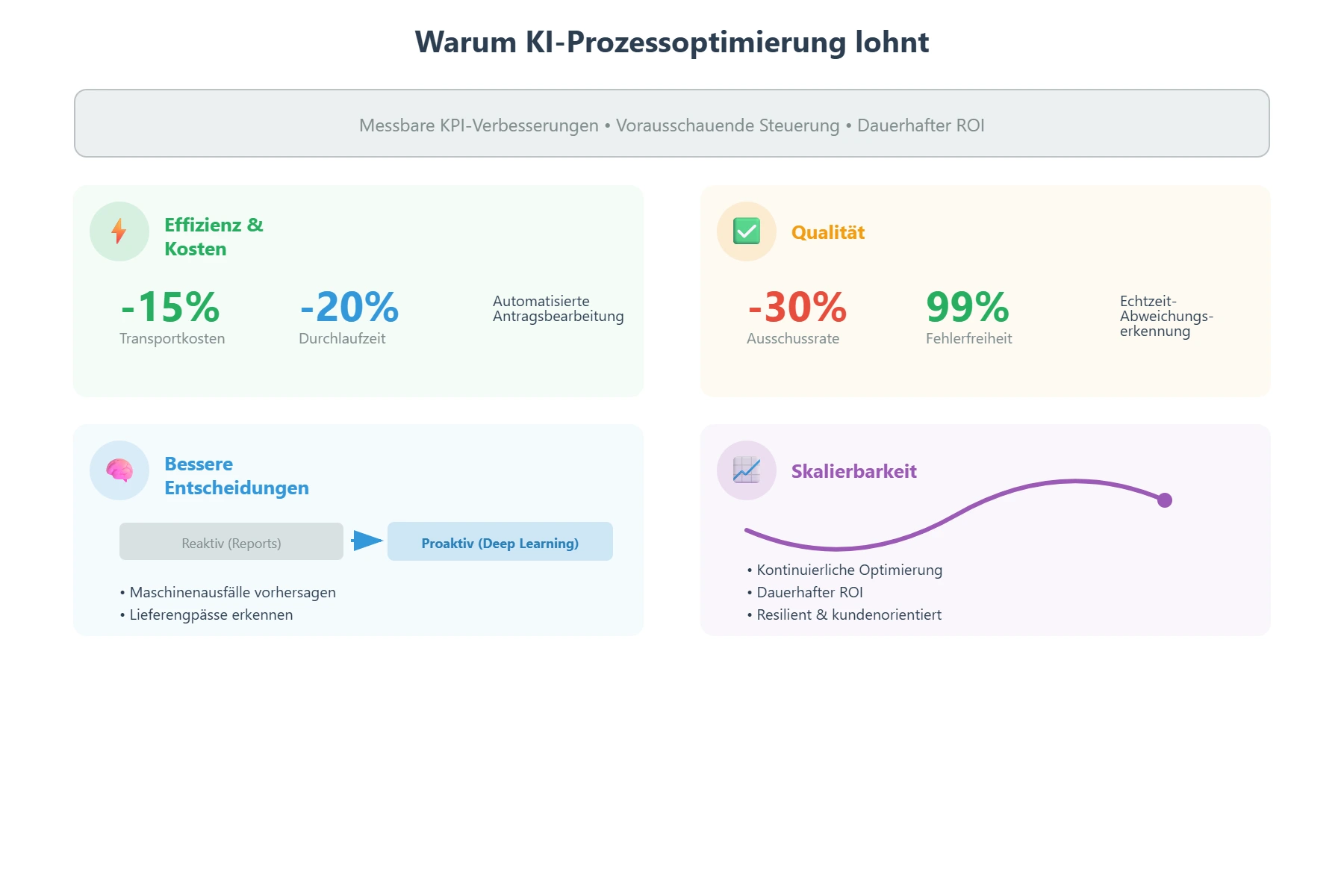
Investing in process automation pays off through measurable improvements in key KPIs. Unlike purely manual analyses, machine learning not only identifies weak points faster, but also predicts the optimal solution path. An overview of the key benefits:
- Efficiency gains & cost reduction: Data-driven decisions radically reduce manual steps. An example from logistics: through algorithm-based route optimization, companies reduced transport costs by up to 15% and at the same time shortened throughput times by over 20%. In administration, intelligent systems automate the processing of standardized applications, sustainably reducing the process costs per transaction;
- Quality improvement: Artificial intelligence detects deviations in real time, long before they turn into costly errors. In manufacturing, this means a reduction in the scrap rate of up to 30%. In invoice processing, automated process optimization automatically identifies discrepancies, thus increasing accuracy to over 99%;
- Faster and better decisions: Instead of reacting to past reports, deep learning enables forward-looking control. It predicts, for example, machine failures or supply bottlenecks and generates recommendations for action. This leads to a noticeable increase in service levels, for example in delivery reliability.
The decisive lever lies in scalability. Once implemented, an AI solution continuously optimizes and thus delivers a lasting return on investment. It makes processes not only faster and cheaper, but also more resilient and customer-oriented.
Typical areas of application for automated process optimization
The intelligent automation of business processes is applied in almost all areas of a company. The lever is particularly large where large amounts of data, recurring workflows, and operational decisions come together.
1. Production & manufacturing
In manufacturing, the focus is on increasing Overall Equipment Effectiveness (OEE). Algorithm-based systems analyze machine data in real time, optimize production schedules, and reduce downtime. Predictive maintenance forecasts failures early and minimizes unplanned downtime.
Example: A mid-sized manufacturer of precision parts significantly increased its OEE through data-based production planning and noticeably reduced rework.
2. Supply chain & logistics
Logistics processes are highly data-driven. AI improves demand forecasts, optimizes inventory levels, and enables dynamic route planning that takes traffic or time windows into account. This increases delivery reliability while reducing costs at the same time.
Example: A logistics service provider relies on AI-supported process optimization for route planning. The system automatically takes into account traffic conditions, weather, and delivery time windows.
3. Back office & document processes
Repetitive administrative tasks are ideal for automation. Data-based document processing automatically recognizes content from invoices or contracts and significantly accelerates approval processes.
Example: A healthcare company drastically reduced the manual effort involved in recording medical invoices.
4. Customer service
In the service area, AI process optimization enables intelligent ticket routing and the automated answering of standard inquiries. Chatbots handle simple cases around the clock, while complex inquiries are forwarded with priority.
Example: A telecommunications provider significantly shortened the processing time for prioritized tickets through data-driven routing, while simultaneously relieving its service team.
Step by step to process optimization through AI
Introducing AI into processes works best step by step. My guide shows you concretely how to build a lean MVP – from the initial analysis to full scaling.
Phase 1 – Analyze and evaluate processes
Goal: Identify the most promising processes for optimization.
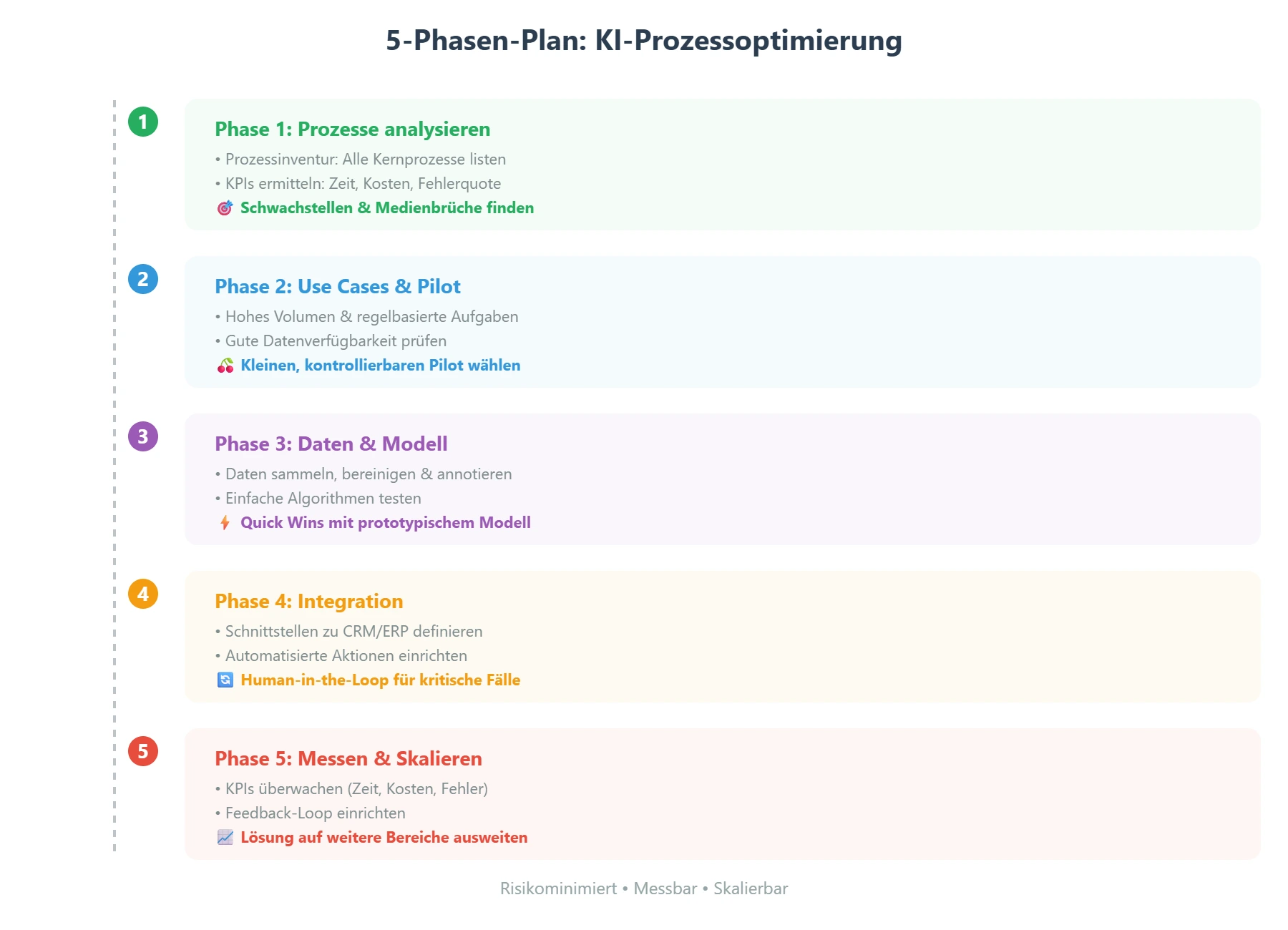
- Conduct a process inventory: Create a complete list of all core processes in the company;
- Determine key figures: Evaluate each process based on measurable KPIs such as throughput time (in hours/days), cost per transaction (in euros), and error rate (in percent);
- Identify weak points: Pay particular attention to manual, repetitive work and media disruptions that cost time and represent sources of error.
Example: An analysis may reveal that the manual processing of around 500 invoices per month takes about 10 minutes per transaction and occasionally leads to errors – typical starting points for optimization.
Phase 2 – Select AI use cases and define a pilot project
Goal: Focus on a concrete, promising application case.
- Apply selection criteria: Choose processes with:
- High volume: Many repetitive transactions (e.g. >1,000/month);
- Recurring, rule-based tasks: Clear if-then logic;
- Good data availability: Sufficient historical data in digital form;
- Clearly delineate the pilot project: Define a small, controllable process segment as a test field.
Example: An ideal pilot project for AI-supported process optimization is the automatic classification of incoming customer inquiries, since hundreds of emails arrive daily that can be sorted according to fixed criteria.
Phase 3 – Prepare the data basis and develop a model
Goal: Create a solid data basis and develop an initial prototype model.
- Collect and clean data: Aggregate historical data (e.g. old invoices, ticket histories) and clean it of errors and duplicates;
- Annotate data: For supervised learning procedures, data often has to be labeled manually (e.g. "invoice type A", "urgent ticket");
- Test a simple model: Start with simple algorithms (e.g. decision trees, logistic regression) to achieve initial results and quick wins. If necessary, use ready-made cloud services (AWS SageMaker, Google AutoML).
Example: For ticket classification, 5,000 historical emails are collected, categorized by category (order, complaint, general), and fed into a machine learning model for text recognition.
Phase 4 – Automation and integration into workflows
Goal: Seamless embedding of the data-driven results into existing business processes.
- Define interfaces: How do the model's results (e.g. a prioritization level) get into the existing system (e.g. CRM, ERP)?
- Set up automated actions: Configure rule-based actions such as automatic ticket routing, generation of preliminary responses, or alerts for anomalous values;
- Plan for human-in-the-loop: Implement a human review loop for critical cases or uncertain predictions to increase acceptance.
Example: The AI model classifies incoming emails and passes them on to the CRM system with a priority label, where they are automatically assigned to the responsible team.
Phase 5 – Measure results and scale the solution
Goal: Verify success and extend the optimization to additional areas.
- Monitor KPIs: Measure success against the original key figures (e.g. reduction of processing time by 30%, lowering the error rate to 1%);
- Set up a feedback loop: Continuously gather user feedback to improve the model;
- Document lessons learned: Record challenges and success factors for subsequent projects;
- Plan for scaling: Based on the insights and data gained, identify the next processes for optimization.
Example: After a successful pilot run over three months, the intelligent classification is extended to all communication channels, and a similar project for workflow automation in accounting is initiated.
This structured approach shows how AI for process optimization can be systematically introduced – with minimized risk, measurable, and scalable.
Expert tip: Plan with clear decision milestones right from the start. Before starting, define at which KPI values the pilot counts as a success – and when you should stop or readjust. This way, you avoid endless projects and create entrepreneurial clarity.
Prerequisites, risks, and typical mistakes
The successful introduction of data-driven decisions for process optimization requires clear prerequisites. You must first create structure – in data, systems, and people. Without these foundations, projects are often doomed to fail.
Data quality & silos
Data quality and access are the decisive basis. Poor data inevitably leads to unusable AI results. Many companies fail due to isolated data silos in different departments that prevent a consolidated view. A clear data strategy that encompasses collection, cleaning, and annotation is therefore indispensable for project success.
Technical infrastructure
Technical infrastructure forms the backbone for implementation. Difficulties often arise at the interfaces to outdated legacy systems that do not support modern API connectivity. Without a scalable cloud or automation platform, learning models cannot be productively integrated into existing workflows. This hurdle often requires significant upfront investments in the IT landscape.
Change management & acceptance
Change management and acceptance within the team are often underestimated. Fears of job loss or a lack of understanding of the technology can block its introduction. A transparent dialogue about goals and early involvement of employees in the design process are essential. Unrealistic expectations regarding the capabilities of artificial intelligence must be actively managed.
Common mistakes in practice
Avoid these typical pitfalls to keep the project from being jeopardized:
- Technology focus without process understanding: An AI solution is purchased without understanding the process to be optimized down to the last detail;
- "AI everywhere" approach: Instead of a targeted pilot, an attempt is made to optimize all processes at once, which leads to overload;
- Missing or unclear KPIs: Success is not defined in a measurable way, so no concrete benefit can be demonstrated;
- Neglect of continuous learning: After go-live, the intelligent model is not regularly retrained with new data and quickly becomes outdated;
- Underestimating the operational effort: Ongoing operation, monitoring, and maintenance of the data-driven solution require permanent resources.
A structured approach that addresses these prerequisites, risks, and sources of error from the very beginning is the decisive factor for sustainable artificial intelligence process optimization. It transforms deep learning from a hype technology into a reliable lever for efficiency and competitive advantages.
30/60/90 day plan: how companies start pragmatically
A quick, pragmatic entry into AI process optimization works best according to the MVP principle: small steps, measurable results, a fast learning curve. With a clear 30/60/90-day plan, companies can start right away without overloading resources.
30 days – Select processes and capture the current state
In the first four weeks, the focus is on transparency. Choose 2–3 core processes that are highly relevant to time, cost, or quality. Document the current workflows, capture key figures such as throughput time, error rate, or processing costs. Roughly assess the data situation: Which data is available, where are the silos?
In parallel, all relevant stakeholders should be involved – from the process owner to IT. Goal: create a clear basis for decisions and acceptance within the team.
Result after 30 days: Transparent process map, KPI baseline, aligned stakeholders.
60 days – Define an AI pilot and test it as a prototype
In phase two, you define a small, clearly delimited, model-based use case. Examples: predicting throughput times, automatically prioritizing tickets, or detecting deviations in manufacturing. Data is connected, prepared, and an initial prototype is created.
This is not about perfection, but about quick wins. Even simple models often deliver 70–85% prediction accuracy and show where AI provides the greatest added value for process optimization.
Result after 60 days: a working pilot, initial key figures, feedback from the departments.
90 days – Measure results and decide on scaling
After three months, the focus is on analyzing the pilot. Compare KPIs before and after the pilot starts: throughput time, error rate, processing costs, or service level. Calculate a robust business case: Which effects justify further investment?
Based on the results, you make the decision about scaling to additional processes, expanding the model, or deeper integration into workflows.
Result after 90 days: a robust business case, a scalable plan for additional processes, initial measurable effects through algorithmic optimization.
Expert tip: Use low-code/no-code tools for the prototype. Platforms such as Microsoft Power Platform or UiPath make it possible to integrate algorithm-supported functions without deep programming knowledge. This way, you test the benefit faster and involve process experts directly. The focus remains on the business problem, not on the technology.
Conclusion: Are your processes ready for AI?
Targeted process optimization through artificial intelligence is not an end in itself and not a trend topic. It is an effective tool for achieving clearly defined goals: more efficiency, lower costs, higher quality, and better decisions. Studies show that data-driven companies work more productively and profitably – but only when technology is used in a targeted and structured way.
The decisive step, however, comes before the technology. First understand processes, identify bottlenecks, and create a clean data basis. This is how AI process optimization can unfold its full potential – with a clear business case and measurable KPIs.