MVP Development: The Ultimate Guide to Costs, Process, and Startup Strategies



According to a study by CB Insights, 42% of startups fail due to “no market need.” In other words: Many founders build something—often with a great deal of effort—and only realize later that no one asked for it. And that costs time, money, and nerves.
The most common reason for these failures is that founders often work “in a vacuum”: You think the idea is good—and you start building without talking to real people who actually have the problem. That way, you invest months in a solution that, in the end, no one wants to use.
The solution? A Minimum Viable Product. It is the cheapest, fastest, and most honest way to find out whether your idea has a market—before you invest in extensive MVP software development. You're not testing whether your app looks great. You're testing whether someone is willing to use it and pay for it. That's the only test that counts.
In the following, I'll go into the practical, technical, and strategic aspects of MVP development so that you understand why it's the crucial foundation for any startup's success. I'll also clarify the difference between an early product version and an actual startup. I'll show you how to not only build an MVP, but how to use it correctly to learn instead of guess. Because in the end, what matters is not what you've built, but what someone truly needs.
What is a Minimum Viable Product (MVP)?
A Minimum Viable Product is not the version you “improve” later. It's the version that lets you answer a single question: Would people really use this?
In MVP software development, the goal is to learn as quickly as possible. You're not building for yourself, an investor, or the future, but for the first user. And the most important thing? Not what they say or do, but what they simply don't do.
Erik Ries, the founder of the Lean Startup method, describes it very clearly: A Minimum Viable Product is the simplest version that makes it possible to test market questions as quickly as possible. Not after six months of development or the first design review. But now. With the least amount that works.
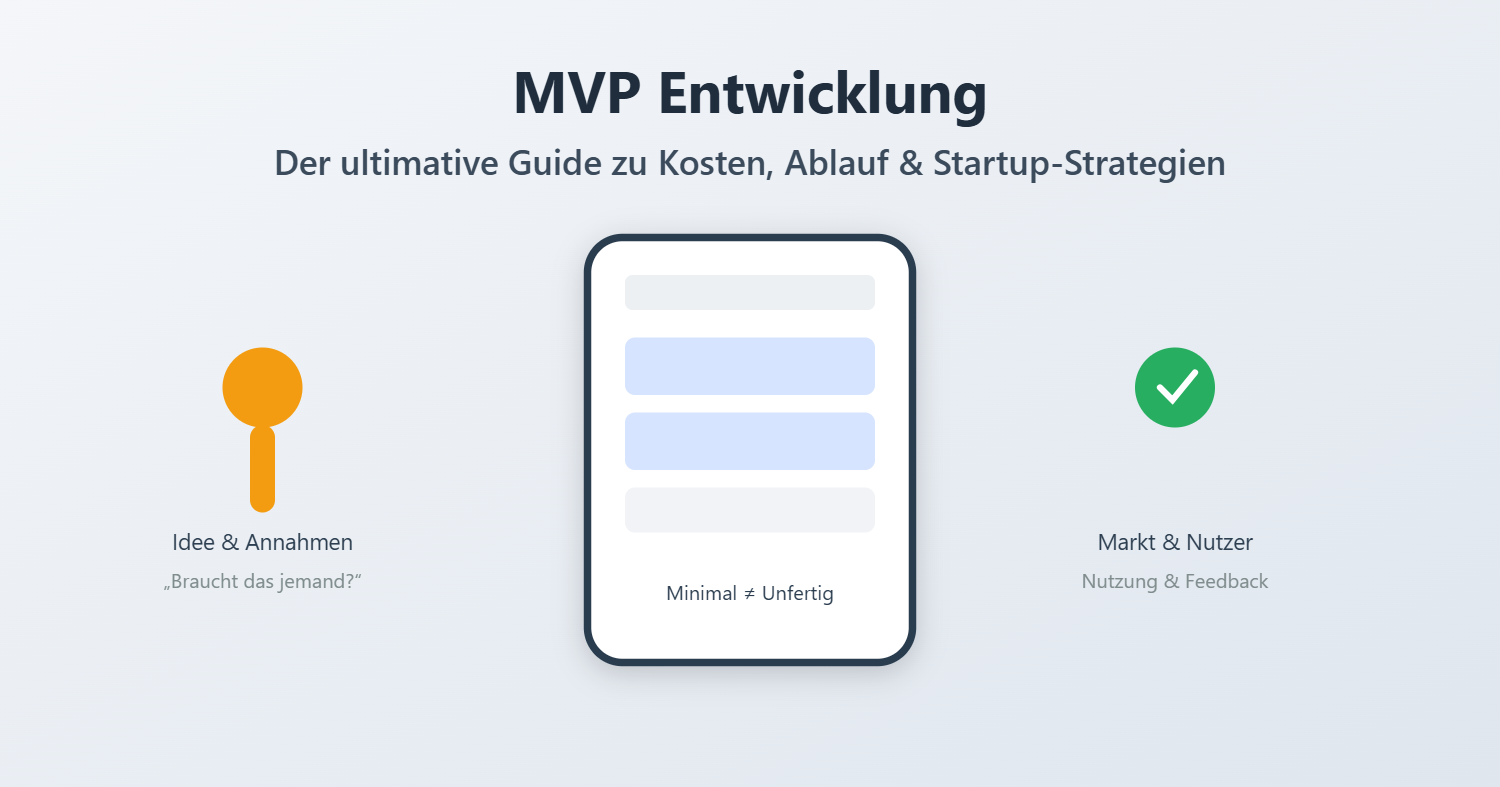
Minimal ≠ Unfinished.“ A Minimum Viable Product is not “incomplete.” It is focused and does exactly what is necessary—and nothing more.
A bad MVP is a product with 20 features, 18 of which no one needs.
A good MVP is a product with 2 core features—and 1 of them is vital.
Not sure which path is right for your project?
Schedule a free 30-minute consultation with our experts—we'll help you find the best strategy for your business.
Schedule a call →MVP vs. Prototype vs. Proof of Concept: What's the difference?
MVP, prototype, and Proof of Concept (PoC)—these are not synonyms. Anyone who doesn't know their differences doesn't build in the right place—and then is mistaken about the reason for failure.
| Term | PoC | Prototype | MVP |
|---|---|---|---|
|
🎯
Goal
|
Verify technical feasibility | Visual and functional representation | Conduct market validation |
|
👥
Target audience
|
Developers, CTOs | Designers, product managers | End customers, investors |
|
✅
Result
|
Is the technology possible? | What does it look like? | Is it necessary and desired? |
|
💰
Costs
|
€2,000 – €10,000 | €5,000 – €20,000 | €25,000 – €60,000+ |
A PoC is the first technical attempt to verify the feasibility of a concept, while the prototype represents the visual and functional design of a product. The MVP, on the other hand, is the first marketable version that is tested with real users to measure actual demand. All three phases play an important role in the product development process, but each pursues different goals.
The difference between an MVP and a startup
It's important to understand that these are two different things. A Minimum Viable Product is not an end product, but a question in the form of code and an interface: Does what we're hoping for actually work? A startup, on the other hand, is the machine that asks this question—and changes when the answer isn't right. An MVP startup combines both elements: a focused product and an organization that learns quickly from the insights gained.
- MVP: A product developed to test specific assumptions. It is a tool for market validation;
- Startup: A temporary organization aimed at developing a scalable business idea. It is the process in which the early product version is used to validate the business hypotheses.
Many founders make the mistake of thinking that launching an MVP automatically means they've built a functioning company. However, this early version is only the first step. Without marketing, sales, and a solid business strategy, even the best MVP software development remains just code, but not a company.
Expert tip: An early product version is a product, a startup is an organization. The first helps you test your hypotheses, but the second needs much more: a scalable business strategy, marketing, sales, and finding a product-market fit.
Why should you develop an MVP? (Benefits)
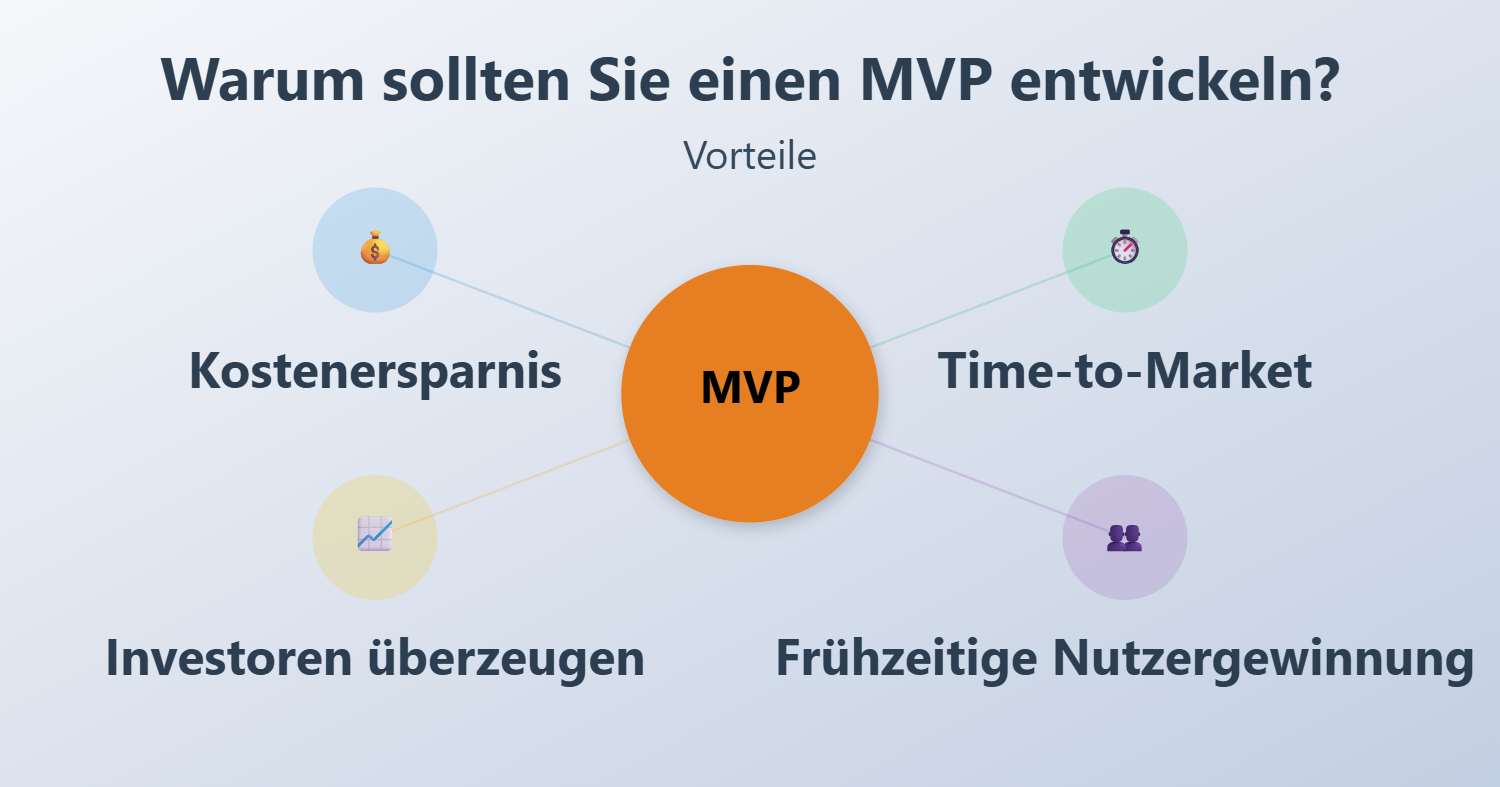
A Minimum Viable Product offers numerous benefits, especially for founders who want to validate their ideas before investing significant resources in full MVP product development. Here are some of the most important benefits:
- Cost savings: Building only what truly matters avoids months of work on features no one wants. Most features die quietly—and namely, before anyone ever saw them;
- Fast time to market (Time-to-Market): With a clear focus, a functioning product can be brought to market in 3-4 months—not after a year in which you've convinced yourself that everything needs to be perfect;
- Convincing investors: An idea on a PowerPoint slide is nothing. A functioning version that real users use—that's a signal. It shows: Here, no one is dreaming, but testing;
- Early user acquisition: The first users are not test subjects. They are the first to notice whether what you've built actually solves something or just looks nice.
This is a good way to get to market faster, and the only strategy that prevents you from ultimately building something better than anyone needs.
How much does MVP development cost in 2026?
Now we come to the point that every founder needs to know: How much does it cost? Here, I explain the most important cost factors, give realistic price expectations for the German market, and help you calculate the financial outlay.
Key cost factors for MVP development
The costs for MVP development don't depend on how good the presentation is, but on the complexity, the platform (web, iOS, Android), and the team's location. In Germany and the DACH region, it's more expensive than in Eastern Europe or Asia, but it's not just about the country: Whether freelancer, small agency, or in-house team—each option has its prices and its pitfalls.
Here are the decisive factors that influence the price:
- Complexity of the product: The more functions and features the first marketable version is supposed to contain, the higher the price will be. A tool with three buttons and a form costs differently than an app that processes real-time data, uses AI, or talks to banking systems;
- Platform: A web app is cheaper than a native app. Not because it's simpler, but because it has fewer detours. iOS and Android need separate code, push notifications, offline logic—that adds up quickly;
- Location of the development team: Prices in Germany or the DACH region are generally higher than in Eastern Europe or Asia. Nevertheless, the quality of the work and the proximity to your company can justify the higher price;
- Team composition: Freelancers are cheap, but they're not always available. A small agency is flexible, but often without a process. A large agency is expensive—but it has structure.
A clear understanding of these factors helps to plan the budget for early product development realistically while at the same time developing a high-quality, viable solution. Anyone who doesn't weigh this up isn't building the product—they're building a risk.
Estimates of MVP costs for the German market
Here are typical price ranges for various MVP types on the German market to give you a realistic idea. These are empirical values that can deviate upwards or downwards depending on the previously mentioned factors.
| MVP type | Cost range | Typical application |
|---|---|---|
|
🌱
Low-Code / No-Code MVP
|
€5,000 – €15,000 | Landing page + form + Zapier automation (e.g. booking system without backend) |
|
🏗️
Custom Web MVP
|
€20,000 – €45,000 | React/Node.js web app with user account, payment integration (Stripe), email workflow |
|
⚙️
Complex Mobile MVP (Fintech, AI, IoT)
|
€50,000+ | App with real-time data, biometrics, compliance (e.g. credit scoring, health app) |
The structure of the expenses
Many think: “I only pay for the development.” Wrong. Many assume that development costs only cover the programming. That's a mistake. About 40% of the budget actually flows into programming. The remaining 60% is distributed across the invisible but decisive elements:
- Design: UX/UI design and prototyping are crucial for user acceptance. A well-thought-out interface reduces later support effort and increases the conversion rate. For a solid design with prototypes and tests, expect €10,000–€20,000. The more complex the processes, the more work—and the more costs;
- Project management (PM): An experienced project manager coordinates the team, deadlines, and requirements. Without a PM, the risk of delays and errors increases considerably. Cost: €2,000 – €8,000, depending on project duration and scope;
- Quality Assurance (QA): Testing is not an “afterwards.” It is part of the development process. €3,000 to €10,000 for manual and automated testing—otherwise the MVP ends up in the App Store with bugs;
- Server and infrastructure: Hosting, domain, cloud services (e.g. AWS, Azure), API keys, security certificates—all of this is part of the MVP. Cost: €2,000 – €8,000 per year, depending on the number of users and the technology.
Ignore design? Then you have a Minimum Viable Product—but not one that users use. No PM? Then it takes twice as long—and costs more.
Freelancer vs. Agency vs. In-house development
An important factor for the costs is the choice of the team you work with.
| Option | Advantages | Disadvantages | Risk |
|---|---|---|---|
|
👤
Freelancer
|
Cheap, flexible | No security, no coverage during illness, poor communication | High—especially with complex MVPs |
|
🏢
Agency
|
Experience, processes, team, support, quality assurance | More expensive than freelancers | Low—you know what you get |
|
🏠
In-House Team
|
Long-term control | Very expensive (salary + infrastructure + HR), long onboarding | Very high—especially in the seed phase |
Start with an agency that specializes in MVP development. Not with a developer you found on Fiverr. And certainly not with an in-house team you don't yet need.
Not sure which path is right for your project?
Schedule a free 30-minute consultation with our experts—we'll help you find the best strategy for your business.
Schedule a call →Step by step to your own MVP
Minimum Viable Product development follows a clear process. Here's a practical checklist that guides you through the entire procedure.
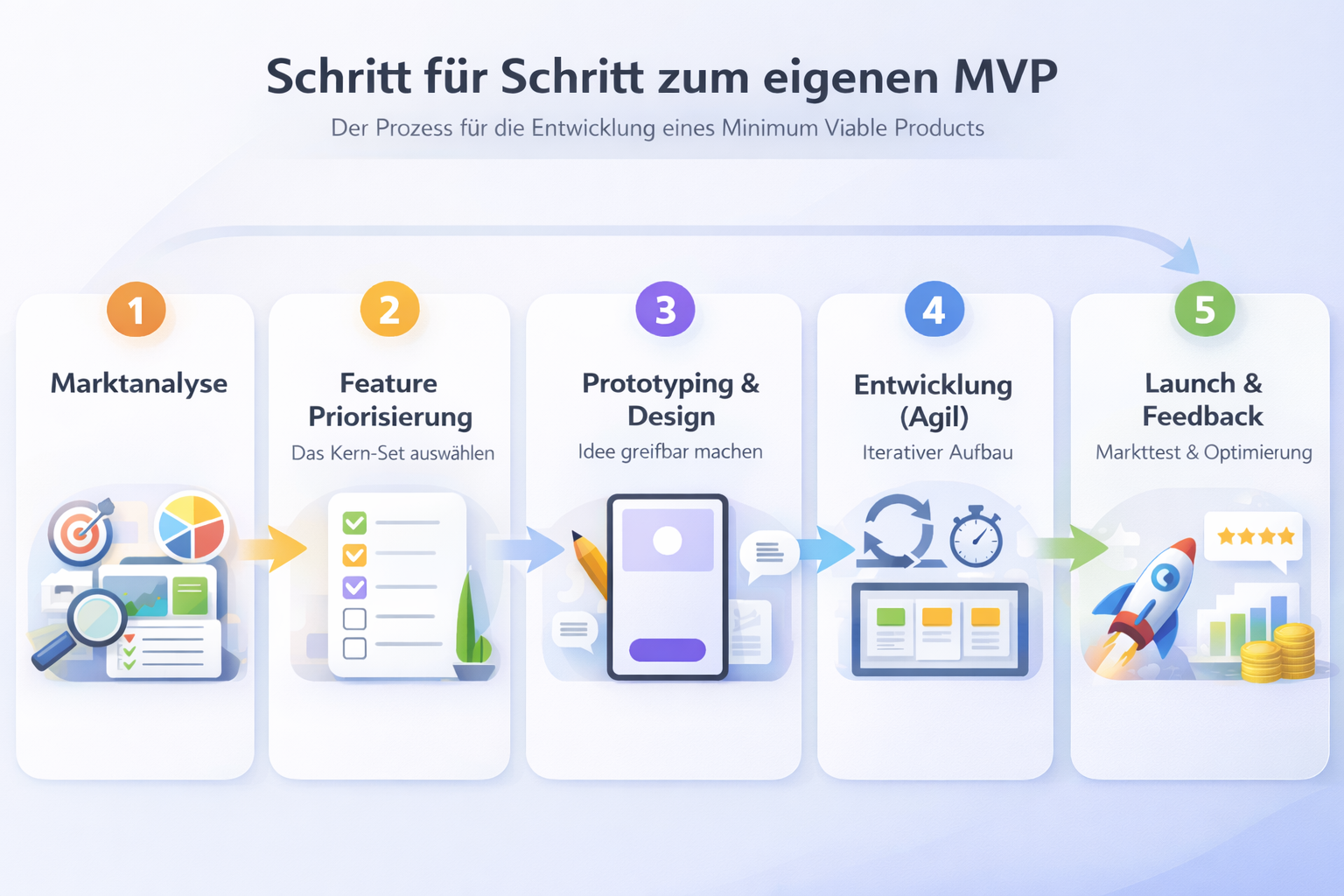
1. Market analysis: Understanding what is really needed
Before you write even a single line of code, ask yourself: Is this a problem someone really has—or just an idea you've thought up? A well-founded market analysis costs time, but it saves you much more: the effort of building something that, in the end, no one wants.
- Define your target audience precisely: Age, location, behavior, income;
- Conduct user interviews: At least 15;
- Identify the user problems: Not the solution you've thought up.
“I want an app for cat owners” → too broad.
“I want an app that helps cat owners in Berlin find an emergency vet within 15 minutes” → precise.
A Minimum Viable Product that isn't based on real pain points dies—no matter how good it looks.
2. Feature prioritization (MoSCoW): Focusing on the core
Not everything that is desirable is necessary. An MVP is not a “mini-product with everything”—it's the smallest thing that still works. The MoSCoW method helps to set priorities clearly—without emotions or ego:
- Must-have: The 1–3 functions without which everything collapses (e.g. registration, payment, core service);
- Should-have: Desirable, but not critical (e.g. profile picture, notifications);
- Could-have: Nice, but not necessary (e.g. theme switch, social sharing);
- Won't-have: Not now—maybe later.
When you create your MVP, focus on the must-have functions first. A product with 3 real must-haves and nothing else brings more feedback than one with 15 functions—and no focus.
3. Prototyping & design: Making the idea tangible
Before the actual development starts, your idea should be experienceable visually and functionally. A prototype helps to understand user flows and verify assumptions—without any finished code at all.
Simple wireframes or click dummies (e.g. with Figma) are often sufficient. What's important is that users can test the central process, for example from search to booking. Test the prototype early with 5–10 people from your target audience and observe where things get stuck.
Adjustments at this stage are quick and cheap. Later, during development, the same changes become significantly more expensive. A good prototype prevents expensive mistakes and secures the problem-solution fit.
4. Development (Agile/Scrum): Iterative, not perfectionist
The development of your Minimum Viable Product should not be planned as a “big bang”—but as a continuous process that delivers value step by step. Agile development makes it possible to continuously incorporate new insights from usage without losing sight of the product vision or the roadmap.
- Define sprints: Divide the development into 1–2-week sprints—the end of each sprint delivers a functioning feature;
- Write user stories: Use a backlog with clear stories: “As a [user] I want [function] so that [benefit]”;
- Clear responsibility: Work with a Scrum Master or product manager who keeps the focus on the MVP core;
- Consistent scope control: Avoid “scope creep.” Each new requirement is only addressed in the next sprint—not immediately.
A product that goes live in 8 weeks with 3 functioning features is more valuable than a “perfect” product that still hasn't launched after 6 months. It's not about perfection—it's about hypothesis validation and the build-measure-learn cycle.
5. Launch & feedback: The beginning of learning
The launch is not a conclusion, but the first step in your product development cycle. An MVP doesn't become “finished,” but is continuously improved—based on real user data and feedback.
Start with a limited user group (100–500 users), define clear KPIs in advance (e.g. conversion, retention, drop-off rates), and complement measurable usage data from tools like Analytics, Hotjar, or Mixpanel with direct user feedback. Build in a simple feedback loop: “How helpful was that?” with 1–5 stars + a comment field. Simple feedback mechanisms often provide valuable insights.
Even the best MVP software development that doesn't respond to customer feedback remains an assumption. An MVP that consistently measures, learns, and adapts has the best chances and becomes the market leader.
Common mistakes in MVP creation
Even experienced founders make typical mistakes when developing a Minimum Viable Product:
- Perfectionism: The attempt to make the first product perfect delays the launch or prevents it altogether;
- Ignoring user feedback: This way, you miss out on valuable opportunities for improvement;
- Feature creep: The constant expansion of functionalities during development leads to delays and unnecessary costs;
- Cutting corners on design and UX: An MVP should be minimal, but still clear, understandable, and user-friendly.
A functioning MVP needs focus, speed, and real feedback. Anyone who avoids these mistakes learns faster, saves resources, and reaches product-market fit sooner.
Conclusion: Start your project with Xmethod
MVP development is not just a technical step—it's the first real test of your business idea. It saves resources, helps you find the right target audience, and shows you early on whether your solution really works.
Xmethod accompanies you in this—with many years of experience in building MVPs. We help you set the right priorities, avoid unnecessary effort, and get a realistic cost estimate. So that you don't guess—but know what comes next.
Let's take the first step together—smart, fast, without being overwhelmed. [Schedule a free consultation]