Software Development Cost in 2026: What You'll Actually Pay (With Real Benchmarks)
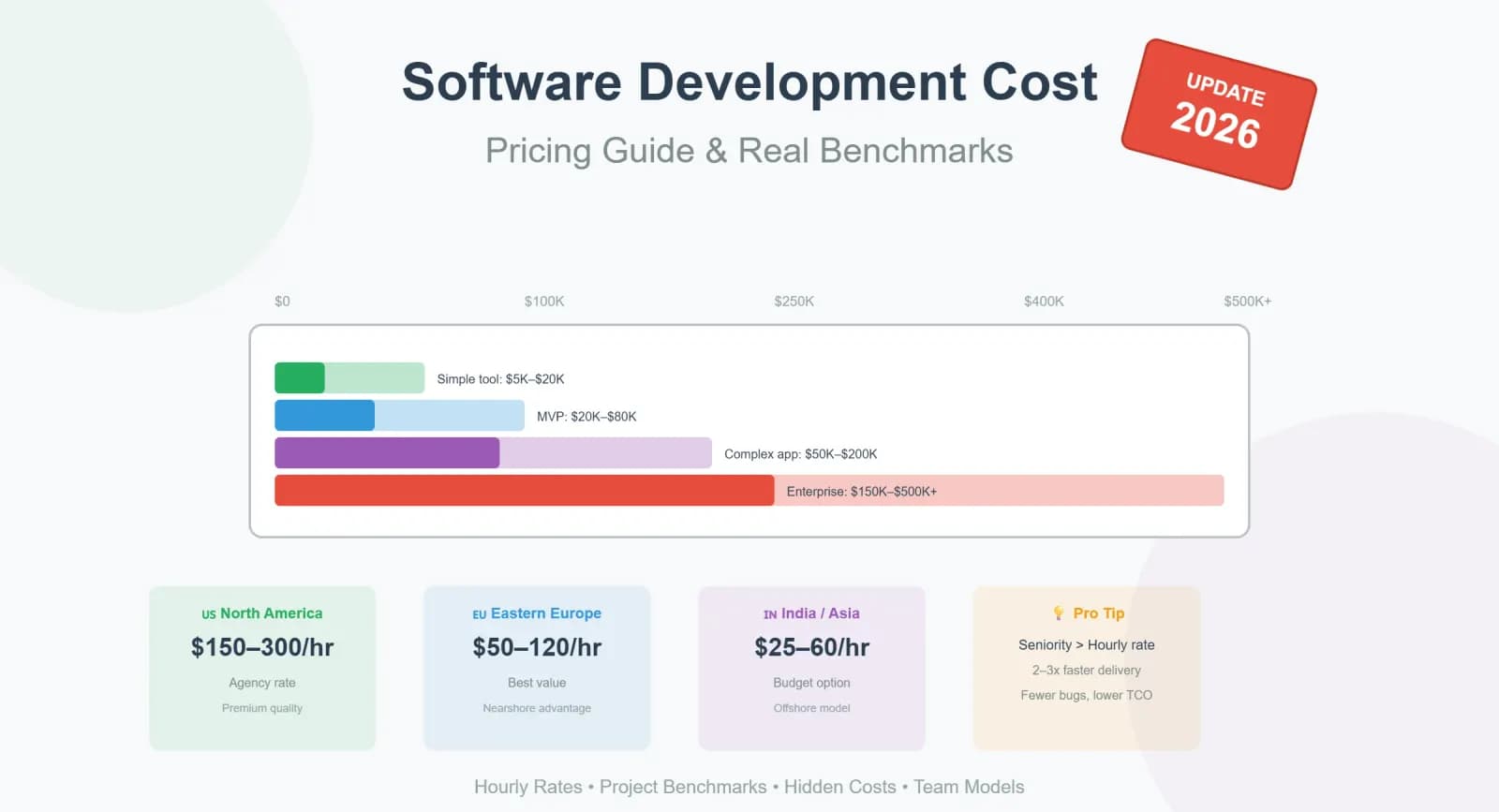

When introducing an IT product, any company would love to know the specific software development cost right now, and the answer given by most agencies — that it's all based on the task — is frustrating in its vagueness. The price of custom software development may range from $10,000 to create a simple tool and up to $500,000 or more to create a large-scale enterprise solution. We are now going to cover the concealed expenses, pricing mechanisms, staff arrangements, and market rates to give you financial guidelines.
Factors Affecting Software Development Cost
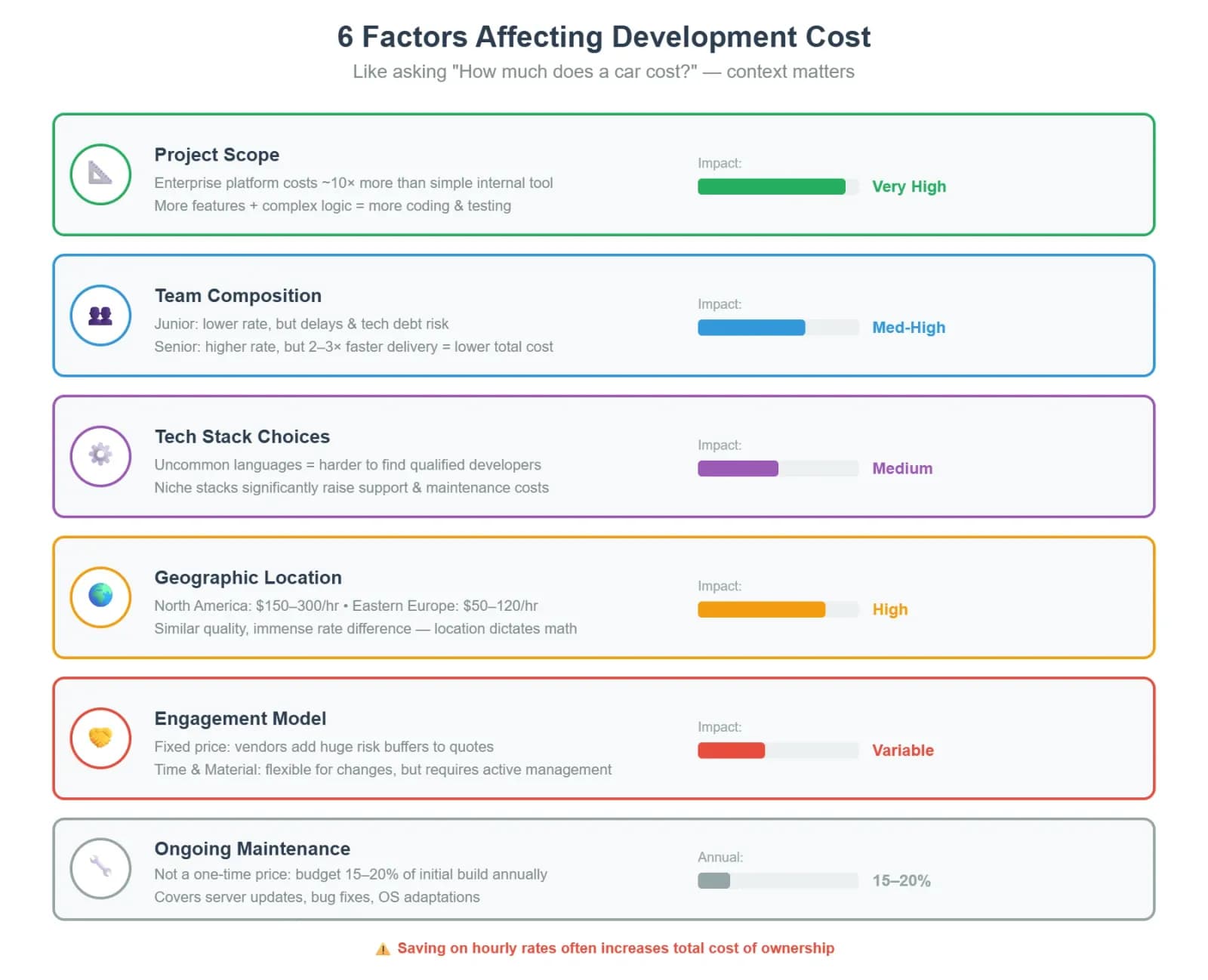
When one wonders how costly development is, without context, it is the same as asking how much a car costs without knowing whether it is a minivan or a supercar. We shall look at the main issue factors affecting software development cost:
- 1Project scope: The multi-user Enterprise platform would cost 10 times that of a simple internal tool. Larger sets of features and more complicated business logic require additional coding and testing.
- 2Team composition: The junior developer's hourly rate is a problem because it leads to delays and tech debt. The senior developer's higher hourly rate saves the overall building budget by delivering faster.
- 3Tech stack choices: Uncommon languages or particular tech stacks for a web app will make qualified personnel harder to find and will significantly raise the price of support.
- 4Geographic location: Your agency's location dictates the math. The hourly rate difference between North America and Eastern Europe or India is immense, despite comparable quality.
- 5Engagement model: A fixed price forces vendors to add huge risk buffers, whereas time & material provides flexibility for change requests.
- 6Ongoing maintenance: Building custom solutions isn't a one-time price. Expect to budget 15–20% of the initial build annually for server updates and bug fixes.
An attempt to save through low hourly rates can be detrimental. It usually causes total architectural rewrites and missed deadlines. Disregarding the experience of the engineers adds to your total price of ownership.
Expert Tip: Seniority matters more than hourly rate — a senior developer often completes work 2–3 times faster with fewer bugs.
Software Development Hourly Rates by Region (2026)
The geographic position of the performers is the first aspect that should be taken into account. The projected spend of hiring senior developer-level specialists in North America will involve entirely different budgets than those involved in working with Indian talent.
| Region | Freelancer rate | Agency rate | Senior specialist rate |
|---|---|---|---|
| North America | $80–$150 | $150–$300 | $180–$350 |
| Western Europe | $60–$120 | $100–$200 | $130–$250 |
| Eastern Europe (nearshore) | $35–$70 | $50–$120 | $80–$150 |
| India/Southeast Asia (offshore) | $15–$40 | $25–$60 | $40–$80 |
Crucially, a low hourly wage rate is seldom an indicator of low overall pay. "Cheap" offshoring can be a cover for enormous indirect losses, such as communication breakdowns across time zones, unending revisions, and poor code quality. Projects that a local engineering firm can complete in hours can grind to a halt for days, wiping out any initial price savings.
To offset this, companies are forced to over-invest in quality assurance, which steadily drives up the price of product creation. The key is to strike a balance between knowledge and price to ensure that bad architecture does not impact scalability.
Expert Tip: Nearshoring to Eastern Europe offers strong value — similar time zones, high technical skill, and rates 30–50% lower than Western Europe.
How Much Does Software Development Cost by Project Type?
Trying to calculate custom software development cost, the most logical starting point is the format and scale of the future product. The requirements for an internal landing page and a banking application lie in completely different dimensions, which radically change the approach to estimation. The table below compiles average market benchmarks to help you get oriented at the start.
| Project Type | Budget | Timeline |
|---|---|---|
| Simple internal tool / basic web app | $5,000–$20,000 | 1–3 months |
| MVP / SaaS prototype / customer portal | $20,000–$80,000 | 3–6 months |
| Complex web or mobile application | $50,000–$200,000 | 6–12 months |
| Enterprise system | $150,000–$500,000+ | 12+ months |
The range of figures looks impressive, so we suggest breaking down each category in detail:
- Simple internal tool / basic web app: Includes a standard interface, basic data collection forms, and a simple architecture, where the final check is most often inflated by custom animations and non-standard API integration (a typical example is a corporate expense calculator);
- MVP/SaaS prototype/customer portal: MVP creation contains only the critically important feature set for idea validation, and expenses can skyrocket due to complex custom design or integration of dozens of payment gateways (a typical example is an early version of a SaaS platform for restaurant table booking);
- Complex web or mobile application: A full-fledged product that requires real-time data synchronization, where building such a mobile app becomes significantly more expensive when adding video calls, geolocation, or machine learning algorithms (a typical example is a telemedicine service or food delivery platform);
- Enterprise system: A global solution covering an ERP system, deep CRM programming, and the interconnection of numerous independent modules, where the main price growth triggers lie in the migration of legacy databases and strict security compliance requirements (a typical example is a unified supply chain management platform for a corporation).
At the same time, all the indicated ranges remain only preliminary guidelines. To form an accurate creation budget and avoid sudden surprises, absolutely any project requires a full-fledged discovery phase. Only after creating detailed specifications, working through user stories, and approving the architecture is it possible to fix the real custom software development cost, because implementation without a plan always ends up costing many times more.
Cost Breakdown by Development Phase
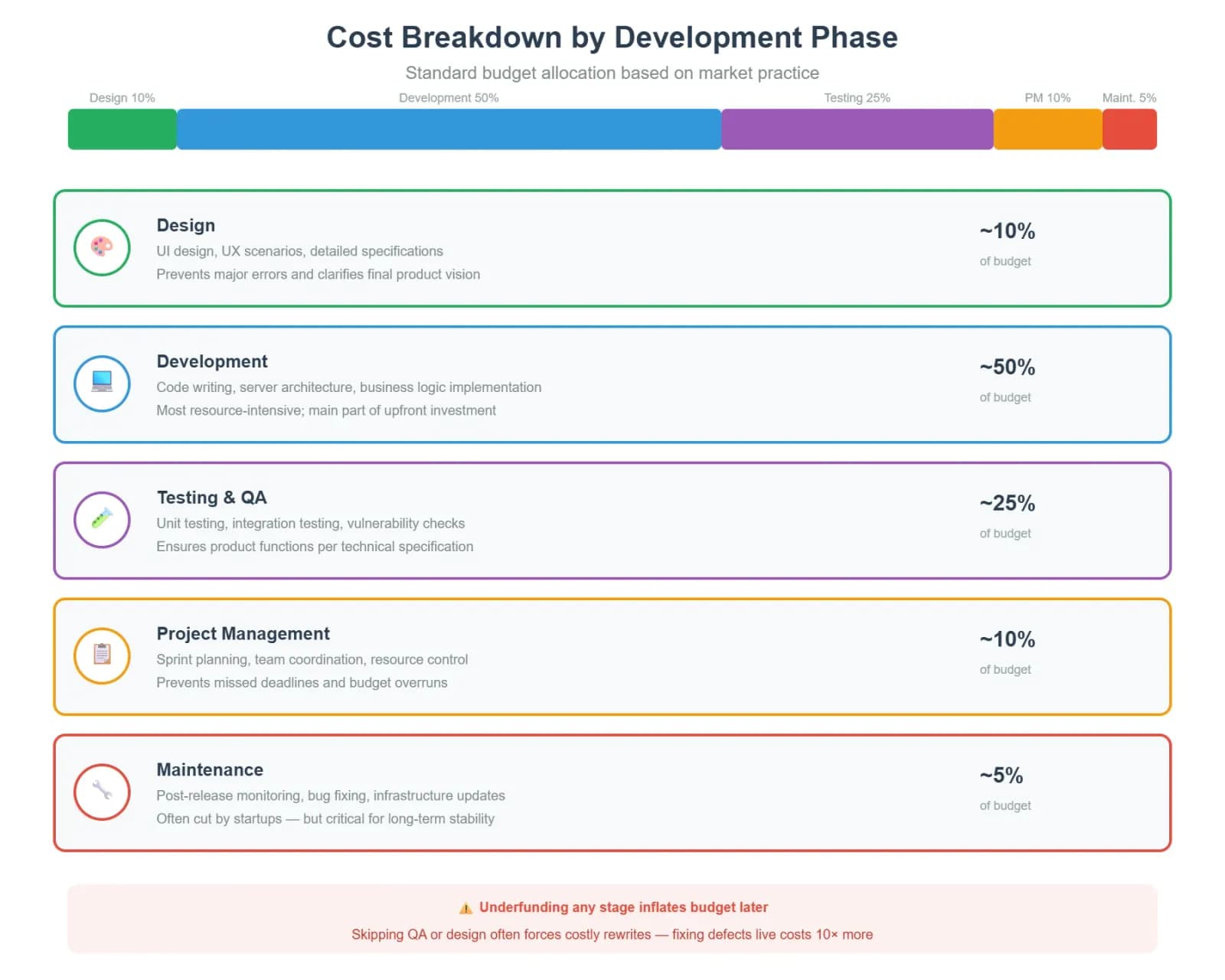
When distributing the budget, it is important to understand exactly which processes your funds are going toward. Based on market practice, the standard software development project cost estimation structure breaks down into five key stages, each of which requires proper attention.
Design (~10%)
At this point, the user interface is designed, and the UX scenarios are developed. Developing a detailed specification will help you understand the final product and prevent any major errors in the future.
Development (~50%)
This is the most resource-intensive process, which includes actual code writing and building the server architecture. The main part of the upfront investment is allocated here, as developers implement all the intended business logic.
Testing (~25%)
This stage involves unit testing, integration testing, and overall quality assurance. The primary objective at this stage is to make sure that the final product is vulnerability-free and functions only as per the technical specification.
Project Management (~10%)
Even the best engineers can miss deadlines or exceed the budget without proper management. This stage covers sprint planning, team coordination, and strict resource control.
Maintenance (~5%)
Post-release ongoing maintenance is vital for monitoring, bug fixing, and infrastructure updates. However, startups often try to lower the cost estimation software development by cutting these "non-essential" phases.
Underfunding any stage inevitably inflates the budget later. For instance, skipping design often forces a total code rewrite if the concept proves unviable. Quality assurance is especially vulnerable to cuts, which is a fatal mistake. Releasing a raw product risks your reputation and creates massive technical debt. Fixing defects in a live environment costs dozens of times more than preventive debugging before deployment.
In-House Team vs. Agency vs. Freelancers — Which Is Right for You?
The choice of cooperation format fundamentally changes the financial model of the entire IT product. When hiring specialists, you are investing not just in writing lines of code, but in the level of responsibility, scaling speed, and long-term reliability.
| Team type | Cost | Control | Flexibility | Risk | Best for |
|---|---|---|---|---|---|
| In-house team | ~$150,000–$250,000+/year for 3 devs | Absolute | Low | Moderate | Long-term product companies |
| Agency | ~$120,000–$160,000/year outsourced team equiv | Moderate | High | Low | MVPs and complex projects |
| Freelancers | ~$80,000/year equiv., but fragile | Low | High | High | Small, defined tasks |
Reducing the budget too early leads to a loss of control. Hiring people forces you to become the technical director, robbing you of time to expand the business. On the other hand, having an internal team provides perfect synchronization but no maneuverability, since you have to pay for the idle time of the developers between releases.
Let’s consider the key advantages and disadvantages of each hiring approach:
- 1Building an in-house team ensures total immersion of employees in the corporate culture and maximum protection of intellectual property, while being accompanied by huge expenses for recruiting, taxes, and workplace organization;
- 2Engaging a software agency guarantees well-established agile engineering and the highest level of quality assurance without the need to personally control every sprint, and outsourcers can easily scale the team to meet current needs;
- 3Hiring freelancers allows you to radically reduce the initial creation budget for testing quick hypotheses, although it carries critical risks of the performer suddenly disappearing along with the source code.
If your choice falls on outsourcing, it is important to understand that the contractor market is extremely heterogeneous. The classification of agencies by price segment directly affects the final estimate and the level of service provided.
Enterprise-Class Development Companies
This is the top tier of the IT industry, working with Fortune 500-level corporations and large government entities. Hourly rates here start from $400 and can reach $900, which guarantees impeccable reliability, but makes this segment completely unprofitable for small and medium-sized businesses.
Mid-Market Consultancies
The optimal balance between price and quality for startups and growing companies, where the hourly rate varies between $120–$250. Such teams provide deep technical expertise and can easily handle the engineering of complex SaaS platforms.
Small Boutique Agencies
Small niche teams with pricing rates of $90-$160 per hour, which in most cases specialize in a small niche such as developing a particular mobile app or designing custom UX/UI. They are very good for local work, but because of their small staff, they may encounter problems if a particular project needs sudden scalability.
Hidden Costs in Software Development (What Most Guides Don't Tell You)
Founders usually only consider coding prices and not the operational expenses. The actual capital outlay of software creation is the spending of an entire ecosystem of payments after the launch:
Discovery and Requirements Phase
Missing this essential step leads to massive losses in the future. Effective planning involves paying system architects upfront.
Infrastructure and Hosting
AWS and GCP bills grow with server load. This ongoing maintenance is a critical, permanent expense.
Third-Party Licenses and APIs
Tools like Stripe or Twilio speed up launch but require transaction fees. Unoptimized API integration will quickly drain your revenue.
Security Compliance
Meeting international data protection standards and industry-specific privacy rules requires expensive audits and legal services. Ensuring robust information security is an obligatory expense.
Post-Launch Bug Fixes and Updates
Real-world usage always reveals defects. Regular bug fixing and OS adaptations require continuous funding.
Team Onboarding and Knowledge Transfer
Handing source code to an in-house team means paying for an adaptation period where productivity temporarily drops.
Scope Creep
Adding features mid-project instantly drains your programming budget. Endless change requests inflate timelines and shatter original estimates.
Expert Tip: Plan for a 20–30% budget buffer above the initial estimate — scope changes are inevitable in most projects.
Software Development Cost Estimation for Your Project
It can be quite realistic to have a reasonable budget prediction within the timeframe of the start of work, provided that you do not rely on guesswork and take the process in a systematic way. A software development project cost estimation should be done using a solid, step-by-step estimation algorithm to be able to conduct it properly.
Step 1: Deep Requirements Detailing
The more precise the data provided by the agency is, in terms of input data and scenarios, the more precise the final estimate will be. A shallow definition of the concept will always lead to a shallow budget, and thus, the definition must be as elaborate as possible.
Step 2: Prioritization and MVP Approach
All the necessary features can be classified into critical and secondary features. By employing the conventional method of MVP building, you can cut down on initial expenses and check the mechanics with real users.
Step 3: Collecting and Comparing Vendor Proposals
Request at least three independent project quotes from different IT companies to get an objective market snapshot. By the way, always compare not only the final figure in the commercial proposal, but also the included project scope, the qualifications of the engineers, and the number of allocated hours.
Step 4: Accounting for Ongoing Operational Expenses
The final product release is only the beginning of its full life cycle in real business. Be sure to include in your long-term financial model ongoing maintenance, stable cloud hosting payments, and regular minor system updates.
Step 5: Building a Financial Safety Buffer
Safe planning requires a mandatory addition of 20% to 30% to the contractor’s initial estimate to cover unforeseen changes. This is exactly why experienced founders always keep reserve capital, understanding that new requirements will inevitably appear during the product’s evolution.
Expert Tip: A paid discovery phase (typically $3,000–$10,000) pays for itself — you get an accurate spec and can compare apples-to-apples quotes.
Conclusion: Getting an Accurate Software Development Cost Estimate
The final software development cost cannot be determined by a single template, as the price is always dictated by the scale of the idea, the location of specialists, the level of the team, and quality standards, while the cheapest proposal very rarely brings real value to the business. At Xmethod, we help companies to thoroughly define technical requirements and obtain completely transparent, maximally accurate creation estimates without surprises.
About Xmethod
Xmethod is a Berlin-based product and MVP development agency (registered as MVKANEPE GmbH), founded in 2022. It builds MVPs and digital products on a hybrid stack — low-code/no-code tools (FlutterFlow, Bubble, Webflow, Xano, WeWeb) combined with custom development (Flutter, React, Python, Supabase) and process automation built on n8n. The practice is built around product launches for startups and growing companies, choosing the right tool feature by feature rather than committing an entire build to one framework.
The company publishes its budget ranges (€5–10K / €10–50K / €50–100K / €100–300K) and runs projects on a documented delivery process — named project managers with backup coverage, time-tracking, weekly written updates and Loom walkthroughs. It holds a 4.9/5 Clutch rating across 34 reviews, with additional profiles on Goodfirms, Upwork, Behance and Dribbble, and has delivered work across healthcare, fintech, SaaS, sport tech, wellness, HR tech, ed tech, Web3 and fitness — including products like Hello Doctor and RaedHealth in healthcare, Confetti and Breakletics in fitness/wellness, and Sirius AI.
Frequently Asked Questions
More from the blog
 MVP
MVPSoftware Outsourcing in 2024: A Comprehensive Guide
Discover software outsourcing benefits, models, and strategies. Learn offshore development, team augmentation, and best practices for CTOs in 2024.
 Low-code
15 Best eLearning Development Companies for Custom LMS and Learning Apps
Compare 15 eLearning development companies for LMS, mobile apps, and EdTech products. See our ranking criteria, strengths, and best-fit use cases.
 AI
AIBest Website Design Companies in 2026: Top 10 Agencies Compared
Looking for the best website design companies? Explore 10 agencies ranked by service range, tech flexibility, speed, PM quality, and pricing.
Let’s discuss your project
Free and non-binding — book a slot straight away or drop us a message.
Dennis Polevik
CEO
Free intro call with Xmethod
- Free, no obligationNo obligation and no cost
- Straight with the teamStraight with the team, no sales reps in between
- A concrete next stepYou leave with a concrete next step
Dennis Polevik
CEO
Let's discuss your project
What happens next?
- Reply within 1 business dayWe review your project and get back to you within 1 business day
- Short call on your goalsWe hop on a short call to align on scope and goals
- Clear proposal, no obligationYou get a clear proposal — no obligation, no pressure