Software Development Costs 2026: What Does Custom Software Really Cost?



When companies ask about software development costs, they usually want a clear figure. But without context, any number is unreliable. It's like asking, "How much does a car cost?" – without specifying the make, features, or intended use.
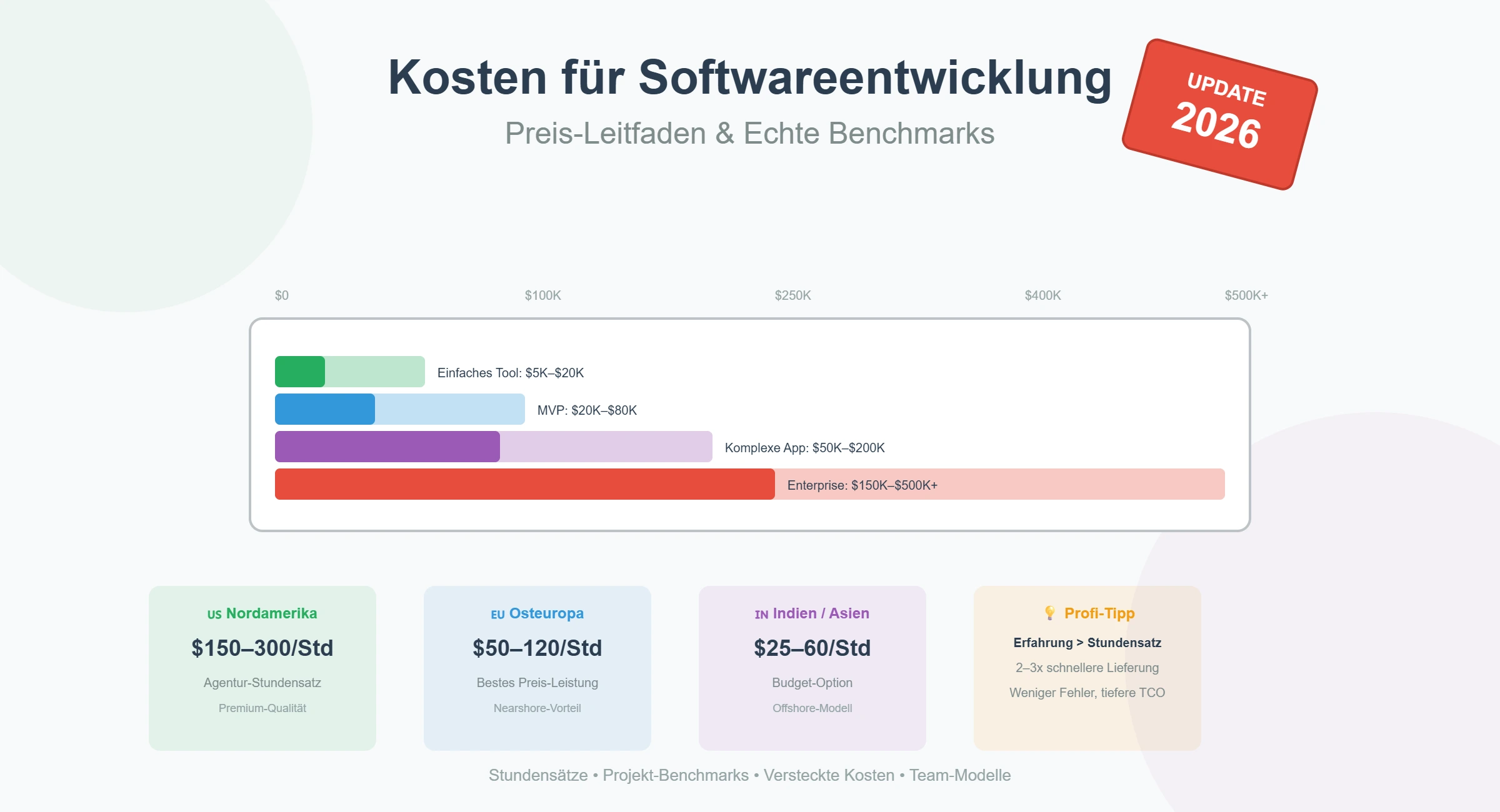
In 2026, project budgets typically range from around €5,000 for smaller internal tools or targeted automation solutions to over €200,000 for complex enterprise platforms with multiple interfaces, sophisticated role models, and extensive integrations. The range is wide – not because providers calculate "arbitrarily," but because requirements, team size, and technical demands vary greatly.
As an expert in Custom Software Development and process automation at Xmethod, I have been supporting mid-sized companies and startups with exactly this kind of budget planning for years. In this guide, I'll explain which factors influence the price, what typical projects realistically cost, and how you can plan a reliable budget – without unpleasant surprises during the course of the project.
What influences the costs of software development?
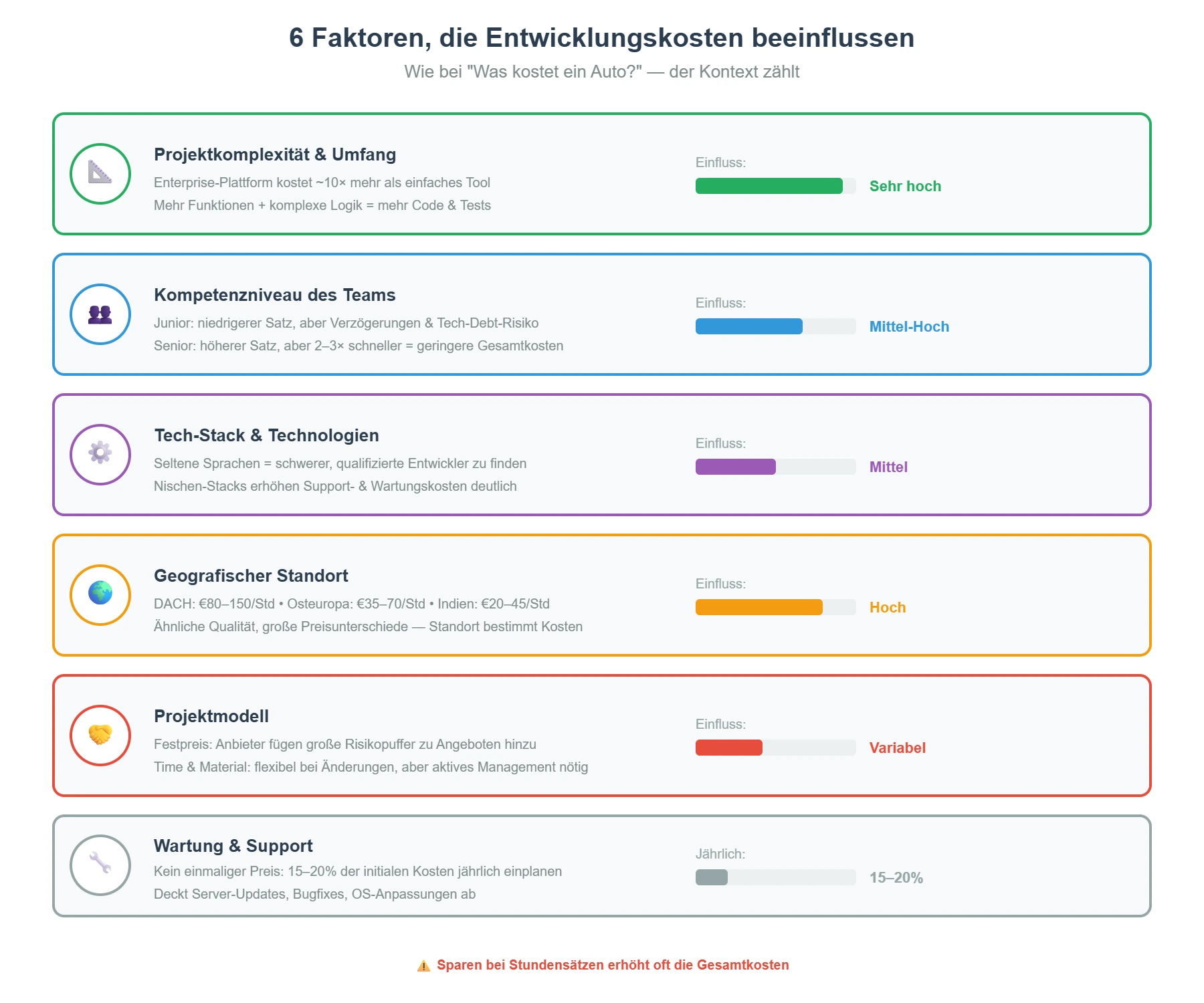
The cost of developing software depends on several factors. Anyone who wants to plan a realistic budget should know the most important influencing variables. Here are the key factors that determine the price of custom development:
- Project complexity & scope: The scope and complexity of the project are decisive. A simple tool or an automated solution usually costs significantly less than a multifunctional, multi-user platform with integrations. Here the price difference can be up to 10 times as large. The more features and interfaces, the higher the investment;
- Team skill level: The experience and qualifications of the team play an important role. Junior developers work at lower hourly rates but often require more time. Senior developers are more expensive, but they work faster and can make the project more efficient in the long run. It is therefore often cheaper to use an experienced team;
- Tech stack & technologies: The choice of tech stack has a direct impact on the effort estimate. Some technologies or frameworks are faster to implement, while others require more development time due to their complexity. In addition, the chosen stack also affects the long-term maintenance and support of the custom solution;
- Geographic location of the team: The location where the development team works always affects price and quality. In the DACH region (Germany, Austria, Switzerland), hourly rates are usually higher than in Eastern Europe or India. Lower prices may come with differences in communication and quality standards;
- Project model: The chosen model for project implementation also plays an important role in budget planning. A fixed-price model offers a fixed calculation, while a time & material model or working on a sprint basis allows for more flexibility and often a more precise adaptation to changes during the project, but can also bring unforeseeable expenses;
- Maintenance & support: After a project goes live, regular expenses arise for maintenance and support. Updates, bug fixes, and new features must be planned for in the long term, which requires additional investment.
This way, you can estimate the effort more realistically, assemble the right team, and choose a project model that takes into account both your quality requirements and your budget.
Hourly rates at a glance: DACH, nearshore, offshore
Software development costs in 2026 are strongly influenced by the geographic location of the team. This affects not only the price, but also the quality, speed, and communication during the course of the project. Here is an overview of typical hourly rates in the most important regions.
| Region | Freelancer | Agency | Senior Consultant |
|---|---|---|---|
| DACH | €75–120/h | €90–150/h | up to €180/h |
| Eastern Europe / Nearshore | €40–80/h | €60–100/h | — |
| India / Offshore | €20–50/h | — | — |
A low hourly rate does not automatically mean a cheap project. Often a low price is compensated by more working hours, repeated communication loops, and frequent adjustments, which can increase the investment. The costs of software development are therefore not just the sum of the hours, but also the efficiency of the collaboration and the quality of the end product.
Expert tip: Nearshoring in Eastern Europe can offer an excellent balance between price and quality. However, make sure to check reference projects and ensure that the team has good communication skills. This way you avoid expensive misunderstandings and delays later on.
Typical project costs: What does which software cost?
Before you set a budget, it is important to understand that software development costs depend heavily on scope, complexity, and the technologies used. However, there are rough price ranges that can serve as a guideline. The exact project price only emerges after a detailed requirements analysis.
| Project tier | Description | Price range (€) | Example projects |
|---|---|---|---|
| Small software / internal tool / simple web app | Quick-to-develop, functional solutions that usually contain only a few core features. | €5,000–15,000 | Appointment booking system, form tool, simple dashboard for internal metrics |
| Medium software / web app with integrations / MVP | Platforms with multiple components that integrate external systems (e.g. payment, CRM APIs). | €15,000–50,000 | Customer portal, CRM add-on, SaaS MVP for project management |
| Complex custom software / enterprise system | Complete, scalable solutions that cover multiple user groups, extensive business logic, and an API ecosystem. | from €50,000 to €600,000+ | ERP system, platform for financial service providers, multi-tenant SaaS with complex workflows |
Each of these tiers is a guideline value. The actual project price varies depending on project scope, technology stack, and team composition. Anyone investing in Custom Software Development should therefore set realistic expectations and be aware that quality and complexity always come at a price.
Freelancer, agency, or in-house team – which suits your project?
The decision depends on several factors. The following comparison is intended to help you identify the right option.
| Criterion | Freelancer | Agency | In-house |
|---|---|---|---|
| Effort estimate | Lower hourly rate, but potential additional investment for rework | Higher hourly rate (incl. PM, design, QA) | High fixed costs (salary, tools, HR) |
| Control | Limited control, project manager not on the team | Good control over process and quality (PM, QA) | Full control over code, processes, and resources |
| Flexibility | Very flexible, quick to react to changes | Flexible, but with project plans and resource dependencies | Less flexible, changes require additional staffing costs |
| Risk | Risk of dropout, lack of team dynamics, lack of QA | Lower risk, clear responsibilities | Minimal risk, but higher dependence on individual employees |
| Suitability for project size | Ideal for manageable individual tasks (e.g. small tools, prototypes) | Suitable for MVPs, web apps, and complex undertakings | Suitable for long-term product development and scalable systems |
For small tasks or quick prototypes, freelancers are the most cost-effective choice – they save money but carry risks such as dropouts and a lack of quality assurance. When it comes to software development costs, freelancers can be a good choice, but long-term efficiency and quality should always be considered. Agencies offer a complete team (project management, design, QA) and are ideal for MVPs and complex projects; the higher hourly rates provide more reliability and control in return. In-house teams are the right choice if you are planning long-term product development and need full control over code, processes, and resources. The fixed cost is higher, but you benefit from a close team culture, faster response times, and better scalability.
Choose the option that best suits your project volume, budget, and quality requirements. Compare the hourly rates, the team's experience, and the support services offered. A well-considered decision can significantly reduce the cost of having software developed while increasing the chances of success of your undertaking.
Ready for a realistic estimate?
Don't rely on average values. Every piece of software is unique. We analyze your specific requirements and help you plan a reliable budget.
How to plan your budget correctly – step by step
A realistic budget is the foundation for successful custom development. The following guide helps you transparently determine and manage the investment for custom software.
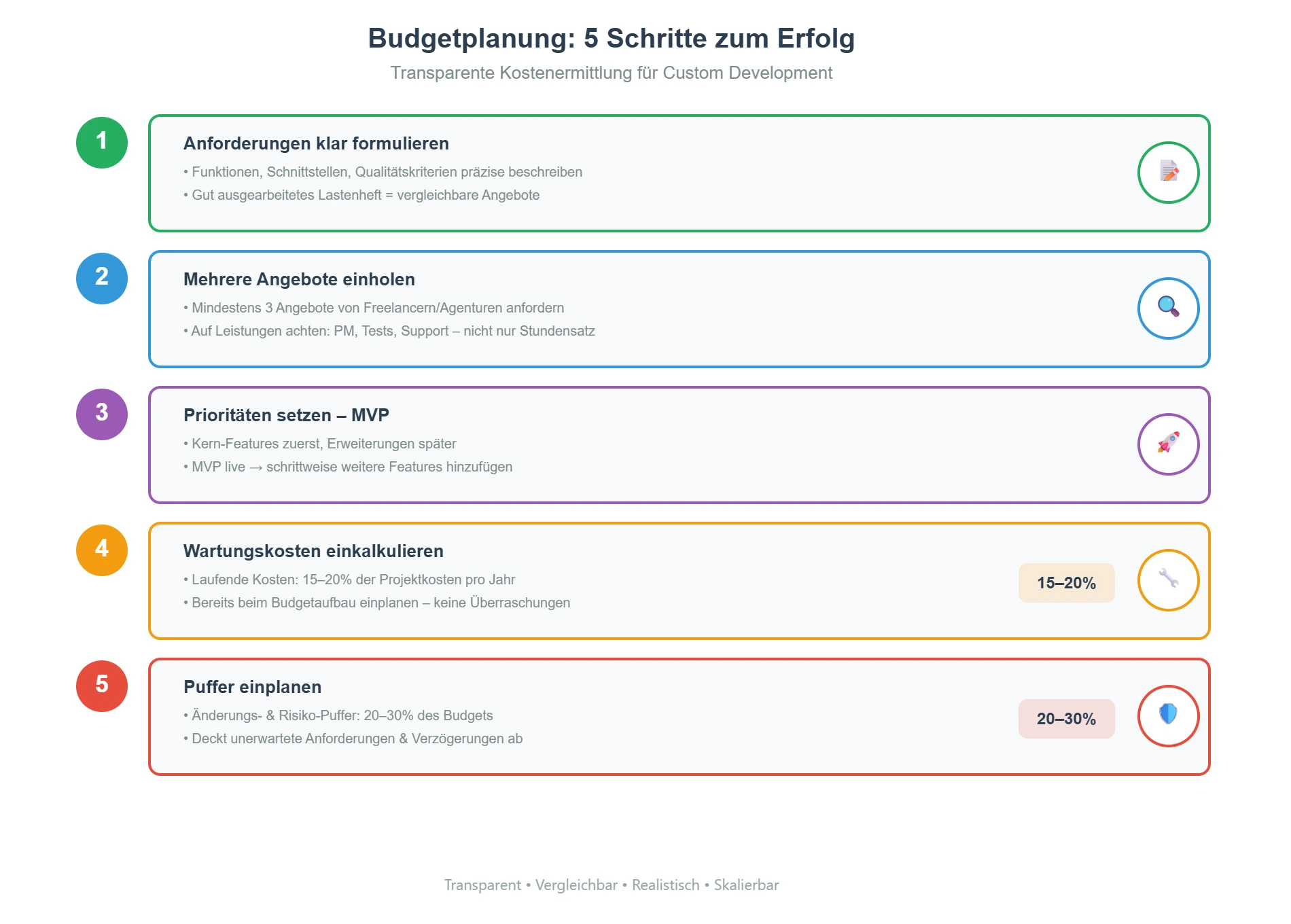
Step 1: Formulate requirements clearly
Start by describing exactly what the project should accomplish. The more precisely you describe the features, interfaces, and quality criteria, the more accurately the effort estimate for the software development expenses can be made. A well-prepared requirements specification reduces misunderstandings and enables comparable quotes.
Step 2: Obtain and compare several quotes
Request at least three quotes from freelancers, agencies, or in-house teams. Very low prices can indicate missing services or quality risks, and very high ones are not automatically justified. In addition to the hourly rates, also pay attention to which services are included – such as project management, testing, or support.
Step 3: Set priorities – the MVP approach
Determine core features and extensions, and develop an MVP first. This way you reduce development time and the initial investment. Once the MVP is live, you add additional features step by step.
Step 4: Factor in maintenance costs
Ongoing maintenance and support costs typically amount to 15–20% of the original project price per year. Plan for these items already when building your budget, in order to avoid surprises after the go-live.
Step 5: Plan a buffer
Realistic projects require a change and risk buffer of 20–30%. This buffer covers unexpected requirements, technological changes, or delays in the development process, and prevents the budget from being exceeded.
Expert tip: A thorough requirements analysis before the actual contract award is always worthwhile. It reduces misunderstandings, makes the quotes comparable, and ensures that the costs of having software programmed are based on a solid foundation.
Common cost traps and how to avoid them
When planning software projects, unexpected expenses often arise. The following pitfalls show what you should pay attention to in order to keep software optimization costs within limits:
- Unclear requirements → expensive rework: If the feature definitions are imprecise, expensive rework arises. A clear requirements analysis reduces misunderstandings and saves later corrections;
- Only looking at the hourly rate, not at the total effort and quality: Focusing on low hourly rates can neglect the total-effort-to-quality ratio. Take into account the entire project period and the quality assurance measures;
- Forgetting maintenance and operation → ongoing investments underestimated: Ongoing expenses for updates, servers, and support are often underestimated. Budget a maintenance allowance of 15–20% of the project price;
- Choosing the cheapest provider without a reference check: Cheap offers can lead to hidden defects. Check references, case studies, and customer reviews to ensure quality;
- No MVP approach – Too many features from the start increase risk, delays, and budget overruns. Start with a minimum viable product and expand step by step;
- No clear milestones and acceptance criteria agreed upon: Without defined checkpoints, uncertainty arises about project progress. Set milestones and clear acceptance criteria to manage the effort.
This way, you minimize unexpected expenses, keep investments within limits, and increase the chances of success of your project.
Conclusion: Estimating software development costs realistically
The investment for a custom development project depends on many factors – feature scope, technology, team size, and geographic location. Flat-rate prices are only rough guideline values and often unreliable. A real estimate only emerges after a thorough requirements analysis that captures the exact needs and priorities. Only in this way can effort, timeline, and budget be planned transparently and risks minimized.
Avoid hidden costs.
Plan with confidence.
We analyze your project and create a transparent effort estimate – without obligation and free of charge. This way you keep software development costs under control and get off to a successful start.
Schedule a consultation now 🔒 Your data is safe. No spam.