Choosing an App Development Agency: How to Find the Right Partner


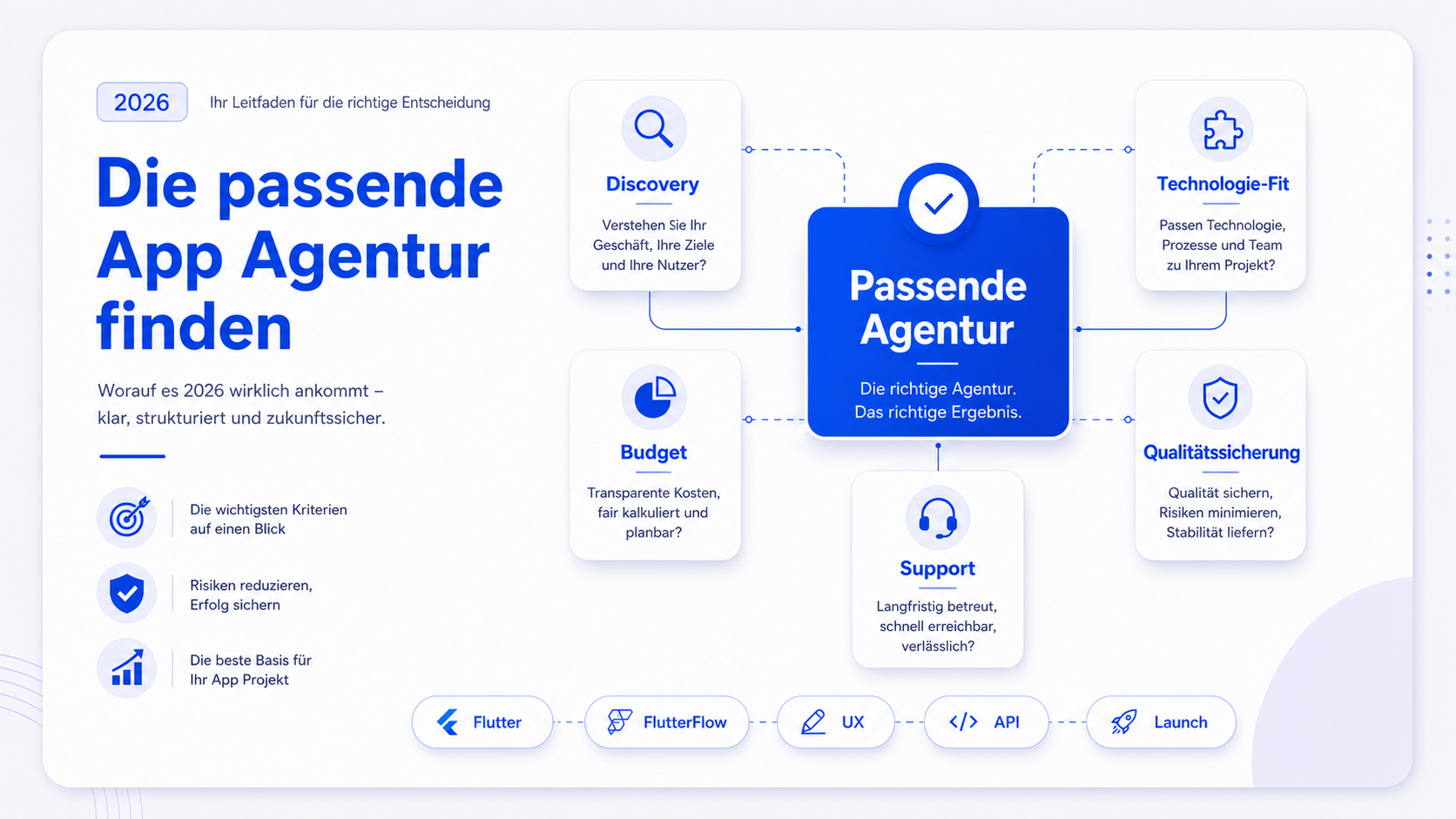

A strong product vision is essential, but only the right partner ensures digital success. Choosing an app development agency represents a critical step within the roadmap for companies in the DACH region. Wrong decisions often lead to budget overruns, technical debt, and a lack of scalability. This strategic guide for 2026 helps you compare providers precisely and eliminate risks even before signing a contract.
Why choosing the right app development agency matters
A mobile application is never just a collection of lines of code or a simple software installation. True mobile app development is an ongoing business investment in which the development team you choose directly shapes your entire digital infrastructure. Ultimately, the choice of the right partner determines whether your project succeeds in the market or fails even before launch due to fundamental structural problems.
More than just code: The strategic importance of a partner
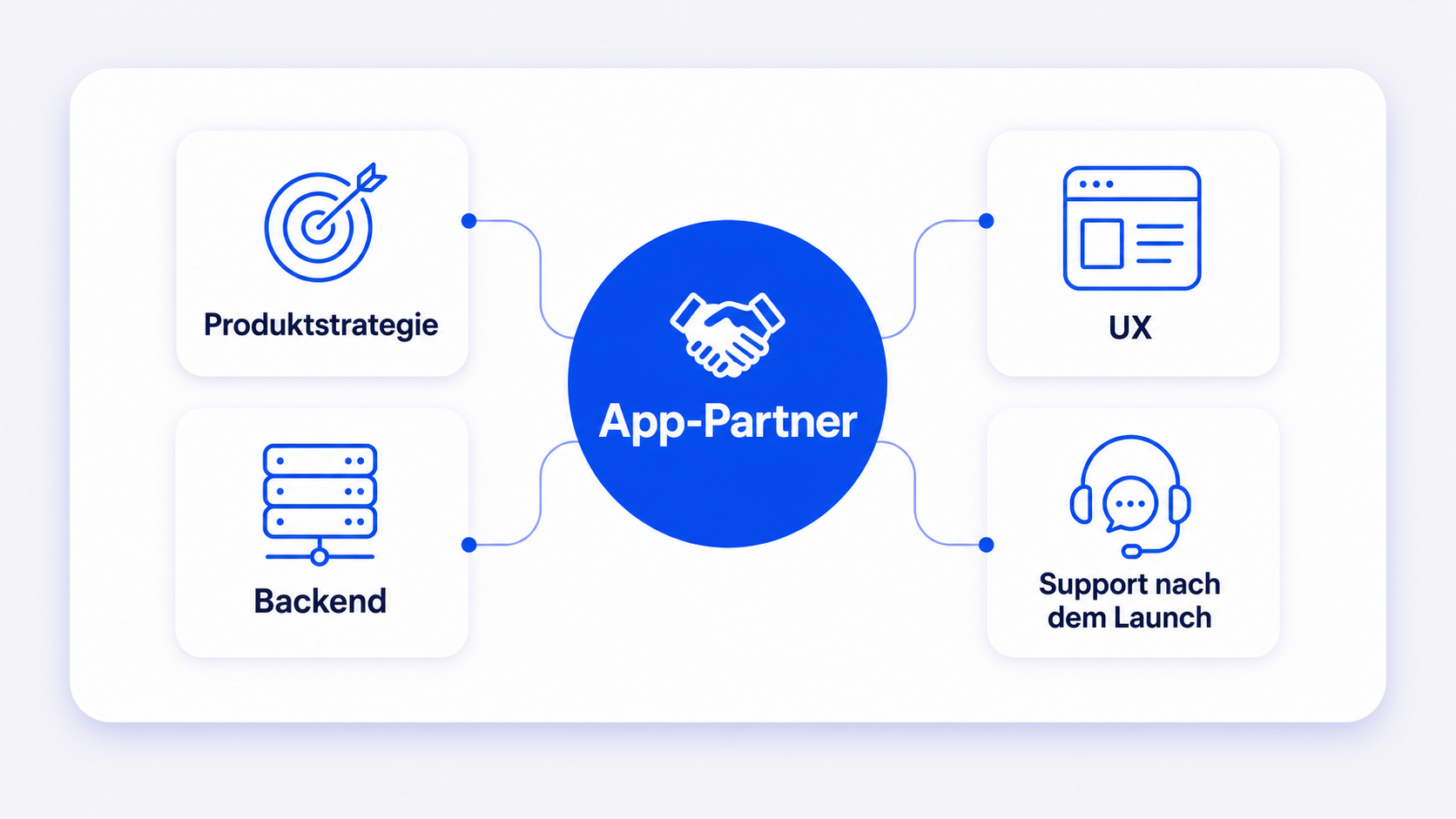
Your development provider makes a significant contribution to the continued development of your business. A professional team influences four crucial pillars of your product:
- Product strategy: Turning your original business concepts into functional digital features that users actually need.
- User Experience (UX): Designing intuitive workflows that ensure high user retention rates and seamless user experiences.
- Backend architecture: Building secure, modern database environments that can handle growing traffic.
- Post-launch support: Providing reliable system maintenance, server monitoring, and security updates.
An agency that masters all of these aspects ensures that your software is perfectly aligned with your overarching business goals.
The true cost of skipping product discovery
When an agency starts coding directly without a thorough product discovery phase, financial and technical efficiency collapse. Skipping this essential alignment step poses immediate risks for businesses:
- Crippling technical debt: Poorly structured databases and messy codebases require expensive, time-consuming reprogramming within the first year.
- Poor scalability: A weak architectural foundation prevents the application from being expanded or integrated into external software via modern APIs.
If these technical frameworks are not established early on, what should actually be a gain turns into an unpredictable financial burden.
Why startups and MVPs suffer the most
For early-stage startups and internal innovation teams in midsize companies, resource efficiency is an absolute necessity. They don't have the financial leeway to develop features based on pure guesswork.
Developing an optimized MVP with an experienced agency allows you to launch quickly, test actual market demand, and conserve your capital while maintaining maximum architectural flexibility for future updates. By taking this validated learning path, you ensure that every euro spent contributes directly to demonstrable market success.
Clarify your product goals first
Before you analyze individual portfolios or request detailed cost estimates from an app development agency, you need to be completely clear about your internal business goals. Entering software development without defined target metrics inevitably leads to misunderstandings, overrun timelines, and uncoordinated development cycles.
What kind of application do you want to develop?
The exact design of your business model determines the fundamental technical framework, security requirements, and architectural design of the application. Agencies are often specialized in specific digital frameworks, which is why classifying your product early on is essential:
- B2C app: Highly engaging, customer-facing applications that require intuitive user interfaces, fast loading times, and smooth onboarding workflows.
- B2B app: Specialized software for optimizing complex internal business processes, prioritizing strict user access controls, and managing secure databases.
- Marketplace: Two-sided ecosystems that simultaneously manage consumer transactions, vendor portals, and integrated payout architectures.
- SaaS companion application: Mobile extensions of existing desktop cloud platforms that require flawless real-time synchronization via robust backend APIs.
- Industry-specific software: Heavily regulated platforms such as in healthcare (requiring absolute GDPR compliance), FinTech (requiring bank-level encryption), fitness, or EdTech app environments.
Identifying this classification early helps you weed out generalist agencies and select a provider with a demonstrable track record in exactly your industry sector.
MVP or full product?
One of the most expensive mistakes a company can make is trying to develop a comprehensive, feature-rich software product from the very beginning. Committing to a massive, rigid project scope without initial real-world feedback is a huge financial risk that often leads to developing features the market simply doesn't want.
Instead, tactically minded companies rely on an MVP. A Minimum Viable Product is the leanest version of your application that contains only the absolutely necessary core functions to solve your users' main problem.
Opting for an MVP approach makes a lot of sense when you need to optimize your time to market, secure funding early, or work within a calculated budget framework. By quickly deploying a functional prototype, you can reliably verify actual demand, gather valuable analytics on user behavior, and adjust your features based on concrete facts rather than theoretical assumptions.
What requirements should you prepare?
To ensure a highly productive first consultation with a potential provider, you should document your initial core requirements in a structured requirements profile. Your first draft of documentation should clearly define the following tactical components:
- Target audience: Who exactly will use the application, and which specific devices do these users prefer?
- Core functions: Which functions are absolutely indispensable for the application to be functional?
- Platforms: Does your business model require native iOS and Android development, or is a versatile cross-platform web application more efficient?
- Integrations: Which third-party tools, payment gateways, CRM systems, or internal APIs does the software need to connect to?
- Budget framework: What is your maximum financial budget for the first launch phase?
- Desired timeline: When does your company realistically need to introduce the application to the public?
Defining these parameters in advance elevates you from a casual prospect to a structured, high-value client and creates a highly professional foundation for the upcoming selection process.
The most important selection criteria for a mobile app development agency
Evaluating multiple software partners requires a structured, objective framework rather than relying solely on pure intuition. To find the right mobile app development agency, your decision-makers must look beyond modern website designs and analyze the operational, technical, and architectural standards of each potential provider.
A systematic evaluation ensures that your investment produces a stable, scalable digital product delivered within your expected financial limits.
Core metrics for evaluation
To simplify this evaluation process, use the following comprehensive criteria matrix to assess each potential team:
Using these precise benchmarks enables your internal leadership to weed out superficial agencies and focus exclusively on high-performing coding teams.
Analyzing portfolios, development cycles, and legal security
A closer look at these selection criteria reveals how strongly they influence the entire lifecycle of your project. If a provider has already solved complex UX and database challenges in healthcare or FinTech, they don't need to experiment at the expense of your budget. Equally important is how the agency structures its technical implementation and day-to-day workflows:
- Technical standards and tool sets: A competent agency should distinguish itself through modern cross-platform frameworks like Flutter or speed-optimized low-code platforms like FlutterFlow, supported by clean backend development.
- Operational alignment: The team must offer structured product discovery workshops to draft detailed user stories, thereby avoiding uncoordinated feature requests later on.
- Agile collaboration: Transparent management through regular sprint demos ensures that your stakeholders are always informed about actual progress.
Finally, you should never compromise on legal and structural security aspects. A professional agency offers complete transparency regarding intellectual property and ensures that your company retains full ownership of source code, design assets, and coding accounts.
What questions should you ask a software development agency?
The first consultation with a potential provider is your most important tool for assessing their corporate transparency, communication culture, and technical standards. General pricing questions are never enough to uncover hidden structural operational risks. To gain complete clarity, your decision-makers must ask precise, technical questions that force the provider to detail their exact development workflows.
Detailed interview checklist for provider evaluation
When talking with an application coding agency, include these specific questions in your decision-making process to assess their actual competence and strategic orientation:
- What similar applications have you already developed? Verifies their industry expertise and technical familiarity with your specific business model.
- How does product discovery work at your company? Shows whether they prioritize business analysis and user stories or blindly start coding.
- Which technology do you recommend for our project – and why? Assess whether the provider selects frameworks based on your business goals or just internal resource availability.
- How do you estimate budget and timeline? Check the clarity of cost estimation structures and delivery plans.
- How do you handle changes in scope? Clarify how the provider handles scope creep, unexpected adjustments, and the pricing of change requests.
- How often do sprint demos take place? Ensure transparent, agile project progress through recurring operational review sessions.
- Who is our point of contact? Clarifies whether you communicate with a dedicated project manager or directly with a developer.
- What rights do we get to code, design, and documentation? Secures your intellectual property rights from day one.
- How do you test the software before release? Defines their quality assurance routines on various physical mobile devices.
- Do you support the launch on the App Store and Google Play? Confirms their tactical support during the strict deployment and approval procedures of Apple and Google.
- Do you offer post-launch maintenance? Ensures long-term application stability, server updates, and critical security patches.
- When do you recommend low-code or no-code? Checks their willingness to use speed-optimized frameworks like FlutterFlow for rapid validation.
- What risks do you see in our project? Measures the provider's honesty in pointing out architectural or conceptual bottlenecks early on.
- How do you avoid vendor lock-in? Ensures that your software remains portable, cleanly documented, and independent of a single agency.
- Which integrations can you implement? Tests their ability to link your application to external ERPs, CRMs, or secure payment channels.
How an agency answers these technical questions says more than any sophisticated presentation. A professional provider will openly discuss structural compromises, admit technological limitations, and firmly refuse to promise unrealistic timelines.
Comparing technologies: Native software, cross-platform, low-code, or no-code?
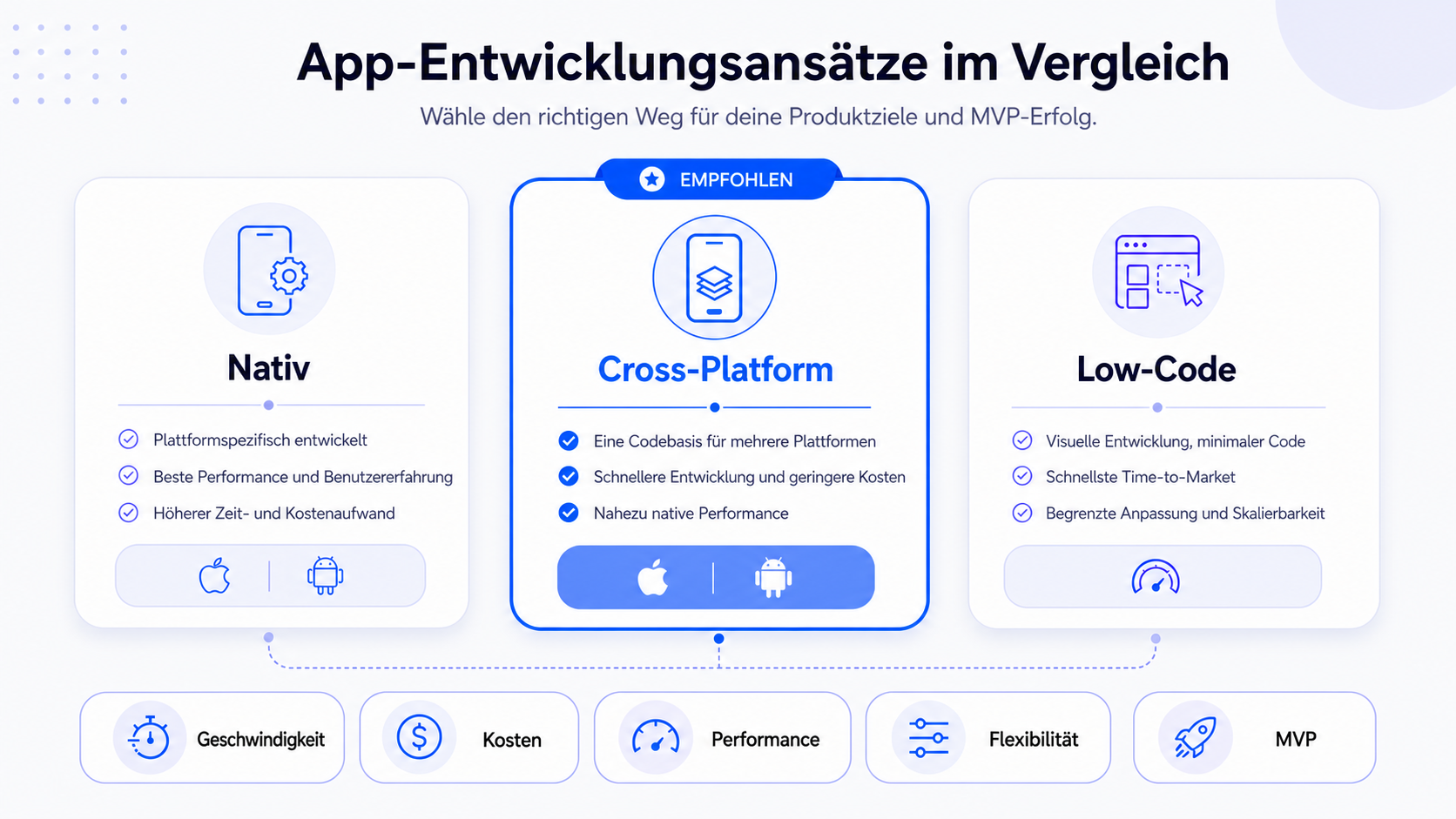
The choice of the underlying software architecture is a fundamental business decision that determines your long-term maintenance costs, development speed, and operational agility. When you consult with an app development agency, you will find that there is no single superior framework.
Instead, a professional provider evaluates your specific business goals, budget specifications, and performance requirements to select the most sensible development method.
Architecture frameworks at a glance
Use this comparison matrix to align your product requirements with the right technical approach:
Weighing these different options allows companies to avoid over-complicating simple solutions while ensuring that complex platforms receive the deep custom code they require.
Expert tip: Don't start with the technology, but with the business problem. Only when the target audience, core function, and MVP scope are clear can the appropriate development approach be sensibly chosen.
Finding the balanced path to business validation: A pragmatic approach to technology selection avoids software dogmatism. While native coding offers unmatched system access for hardware-intensive or high-frequency trading applications, it requires twice the budget and coding resources. For the vast majority of commercial applications, the efficiency of multi-platform solutions represents a far more sustainable path.
Finding the balanced path to business validation
A pragmatic approach to technology selection avoids software dogmatism. While native coding offers unmatched system access for hardware-intensive or high-frequency trading applications, it requires twice the budget and development resources. For the vast majority of commercial applications, the efficiency of a cross-platform solution represents a far more sustainable path.
Strategic framework choice: Low-code engines like FlutterFlow are not a universal replacement for custom development, but they are extraordinarily practical for many MVP scenarios where speed and capital preservation take top priority.
By using low-code frameworks, teams can deploy functional applications directly to users in a fraction of the time. The decisive factor is architectural flexibility; platforms like FlutterFlow enable teams to export clean Flutter source code at any time.
App development costs: What you should clarify early on
Understanding the financial framework before signing a contract prevents critical budget overruns. A professional app development agency works with transparent pricing models tailored to the specific complexity of the project:
- Fixed price: Best suited for structured projects with a defined specification document.
- Time & Material: Very flexible; you pay exclusively for development hours actually worked.
- Dedicated team: Specialized developers work on your product for a fixed monthly fee.
- MVP package: A fast-track concept to bring core functions to market within a calculated budget.
Beyond programming, companies must budget for ongoing costs to ensure software stability. These include backend cloud hosting (Supabase/Firebase), app store licenses, maintenance, and analytics tools. Also plan for hidden costs such as fees for third-party APIs, unexpected scope changes, and strict data protection audits (GDPR).
To categorize digital investments, initial base budgets are often based on clear feature tiers. Standard project budgets typically range from €5,000–10,000 for simple validation pilots to €10,000–50,000 for scalable multi-platform products. Enterprise systems with advanced infrastructure can range between €50,000 and €100,000 or even €100,000 to over €300,000. Ultimately, the exact app development costs are calculated individually based on your specific technical requirements.
Warning signs when choosing an app development agency
Recognizing operational warning signs during the initial review protects your capital and prevents structural project failures. When evaluating an app development agency, watch out for these critical warning signs:
- No discovery process: Skipping the business analysis phase leads directly to massive scope creep and misaligned features.
- No clear documentation: Missing technical specifications mean that external developers cannot update the application later.
- Unclear rights to code and design: If an agency refuses to transfer full ownership of the source code, you face dangerous vendor dependencies.
- Unrealistically low price: Cheap cost estimates usually hide hidden fees, a lack of experienced professionals, or poor execution.
- No QA: Releasing software without thorough testing on various devices guarantees bugs and immediate user churn.
- No maintenance: A provider that doesn't offer post-launch support makes your technical infrastructure extremely vulnerable.
- No comparable references: If a provider cannot show working applications of similar complexity, they are experimenting at the expense of your budget.
- No clear communication: Delayed responses during the initial consultations suggest a chaotic project flow.
- Technology not explained: Hidden architectural decisions conceal technical debt. True experts justify why they recommend Flutter, FlutterFlow, or native code.
- Provider promises "everything" without compromise: Development requires compromises. Agencies that promise instant timelines and unlimited features are unrealistic.
Avoiding these warning signs protects your digital product. A reliable partner always values transparency and openly discloses architectural limitations.
Decision matrix: How to compare multiple providers
To move from emotional decisions to a purely data-driven approach, your team must use a structured evaluation system. To find app developers, comparing multiple agencies requires a mathematical assessment of their operational capabilities.
Quantitative evaluation model
To illustrate how this evaluation works, here is a completed scoring matrix showing the comparison of three potential software companies:
To carry out this technical evaluation correctly, follow these exact steps:
- Rate each factor: Assign each candidate a score from 1 (poor) to 5 (excellent) based on your initial consultations.
- Calculate the weighted scores: Multiply the assigned score by the percentage weighting. For example, a score of 5 for technology fit with a weighting of 20% gives the value 1.00.
- Determine the total score: Add up the calculated values to determine the final ranking of each app development company.
Selecting a partner based solely on the lowest cost estimate is a huge risk. A provider might submit a low offer but perform critically poorly in communication or maintenance, leading to significant technical debt. This matrix ensures that you select a reliable partner based on overall value.
How Xmethod supports mobile app MVPs
As a specialized low-code/no-code digital agency from Berlin, operated by the legal entity MVKANEPE GmbH, Xmethod helps companies navigate complex technology decisions to safely validate product ideas. The agency focuses strictly on operational efficiency and offers professional MVP development, mobile app development, web development, AI automation, and flexible outstaffing solutions.
For startups and companies, speed is a crucial business metric. The public operational benchmark at Xmethod is the rapid delivery of functional software, guaranteeing a reliable MVP launch in 2 to 3 months. To achieve this safely, the team relies on a tightly integrated process. Every project starts with strategic product discovery and business analysis to select the optimal technological foundation. The team then sequentially goes through structured UX/UI design, precise development, and long-term support, ensuring that every MVP development is perfectly aligned with actual market demand.
The framework's deployment speed is based on an extremely pragmatic technology stack. By using FlutterFlow development in combination with visual platforms like Bubble, Webflow, and Weweb, Xmethod drastically reduces time-to-market. Developers complement these frontend solutions with a scalable infrastructure and use Xano, Supabase, Firebase, pure Flutter, React.js, Python, PostgreSQL, and n8n for complex workflows.
This infrastructure is successfully deployed in highly competitive industries: healthcare, FinTech, SaaS, SportTech, wellness, HRTech, EdTech, Web3, and fitness. Notable portfolio examples include the telemedicine platform Hello Doctor, health/fitness applications like Breakletics, RaedHealth, and Fitly, as well as the comprehensive Swiss LMS platform Fokus Nachhilfe.
Checklist: Choosing an app development agency
This framework ensures complete alignment between the technical implementation and your long-term business goals:
- Goals and target audience defined: Your primary commercial goals and target audience profiles are fully documented.
- MVP scope clear: You have prioritized core verification functions to avoid budget-straining scope creep.
- Relevant references checked: The team has reviewed active, working case studies in your specific industry.
- Technology recommendation understood: The choice between native, cross-platform, or a low-code solution is justified by clear architectural logic.
- Budget model clarified: Project pricing models are defined via transparent MVP packages or flexible development hours.
- Rights and documentation regulated in writing: Your company retains 100% of the intellectual property rights to code and design assets.
- Communication rhythm established: Clear reporting intervals, sprint demos, and feedback channels are in place.
- QA and testing planned: Rigorous quality assurance on physical devices is part of the roadmap.
- Post-launch maintenance clarified: Post-deployment support, hosting setup, and continuous updates are guaranteed.
- Risks openly discussed: The team transparently addresses operational limitations and technical debt.
To clear up any remaining technical ambiguities regarding pricing, timelines, or framework capabilities, read the key industry information compiled below.
Conclusion: Don't just choose developers, choose product partners
Developing a modern application goes far beyond hiring external programmers to write raw code. To ensure long-term business success, you must choose a strategic product partner capable of steering your software architecture, complying with strict data protection regulations, and ensuring product stability.
For rapid validation, a structured MVP that prioritizes speed, absolute clarity, a thorough discovery process, and dedicated post-launch support is the safest approach to scale without technical debt. If you want to efficiently turn your digital concepts into a stable, high-performing application, choose the app development agency to discuss your concrete project idea directly with Xmethod.