Web Development Best Practices in 2026: What Changed, What Didn't, and What Teams Still Get Wrong


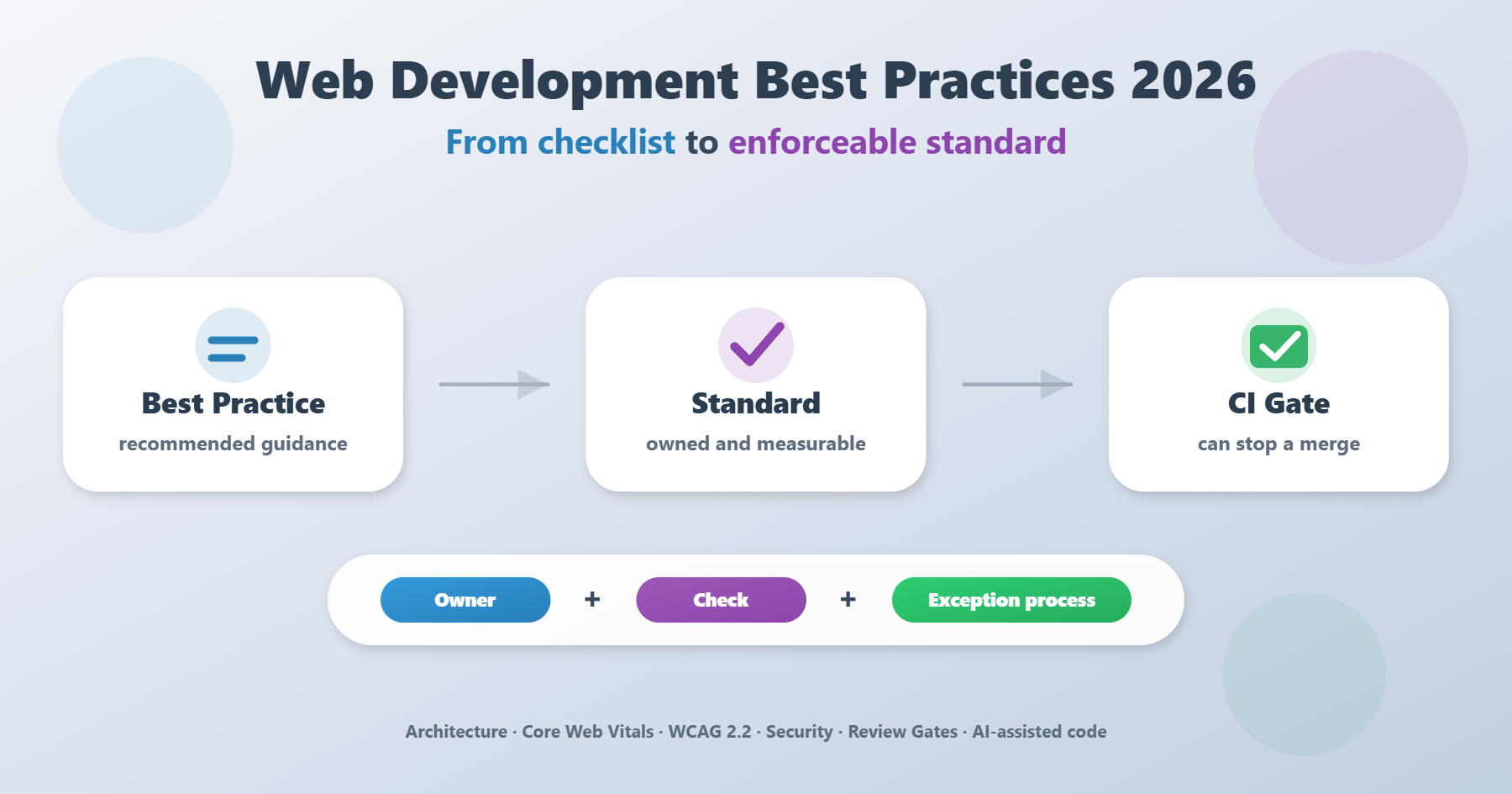

Most lists of web development best practices are a 2021 checklist with the year swapped out. The interaction metric changed, accessibility moved into procurement and delivery, and code review changed the day assistants started producing part of the diff. This guide covers what a working standard looks like now, and where teams keep losing time:
- Architecture and rendering decisions that are expensive to reverse
- Performance thresholds, and the one that replaced the metric many teams still track
- Code review gates that can actually stop a merge
- Accessibility as a delivery requirement, not a post-launch audit
- Security defaults that hold when a dependency goes bad
- Testing and delivery built around one reproducible artifact
- AI-assisted code and what it did to review
Web development standards and best practices are not the same thing
A best practice is a recommendation. A standard is a recommendation that has an owner, a check that can fail, and a documented way to make an exception. Most of what circulates under the heading of web development best practices never makes that transition. "Write maintainable code" is an intention. "The pipeline fails when changed-line coverage drops below the agreed floor" is a standard, because it has a number, a trigger, and a named person who can approve the override.
The second distinction runs through the rest of this guide: how much a decision costs to undo. Access model, data model, service boundaries, and rendering strategy are decisions you live with for years. Changing them later means migrations, contract rewrites, and a quarter nobody planned for. Lint rules, formatting, coverage thresholds, and CI warnings sit at the other end. You can change them on a Tuesday and nobody notices by Friday.
Good web development principles respect that asymmetry. Teams routinely spend a two-hour meeting arguing about a Prettier config and thirty minutes on the authorization model. We would flip that ratio. Expensive decisions deserve written reasoning; cheap decisions deserve a default and a linter.
Best practices for web development: what changed between 2021 and 2026
Five things moved enough to invalidate older guidance. Everything else on the standard list is roughly where it was.
Google promoted Interaction to Next Paint to Core Web Vital status in March 2024, replacing FID. WCAG 2.2 became a W3C Recommendation on 5 October 2023. The national measures implementing the European Accessibility Act have applied since 28 June 2025. Those three dates are old enough that "we'll look at it next year" has stopped being a defensible position.
What did not move: semantic HTML still does most of the accessibility work for free, keyboard access is still the fastest way to find broken interaction patterns, least privilege is still the cheapest security control, and a human still has to own every line that reaches main.
The sections below run from decisions that are expensive to reverse to decisions you can change in a sprint. Architecture first, then performance, accessibility, and security, then the review and delivery layer that decides whether any of it survives. The last section deals with the reason most of this fails in practice, which has nothing to do with the technology.
Architecture and rendering: the decisions you do not get to redo cheaply
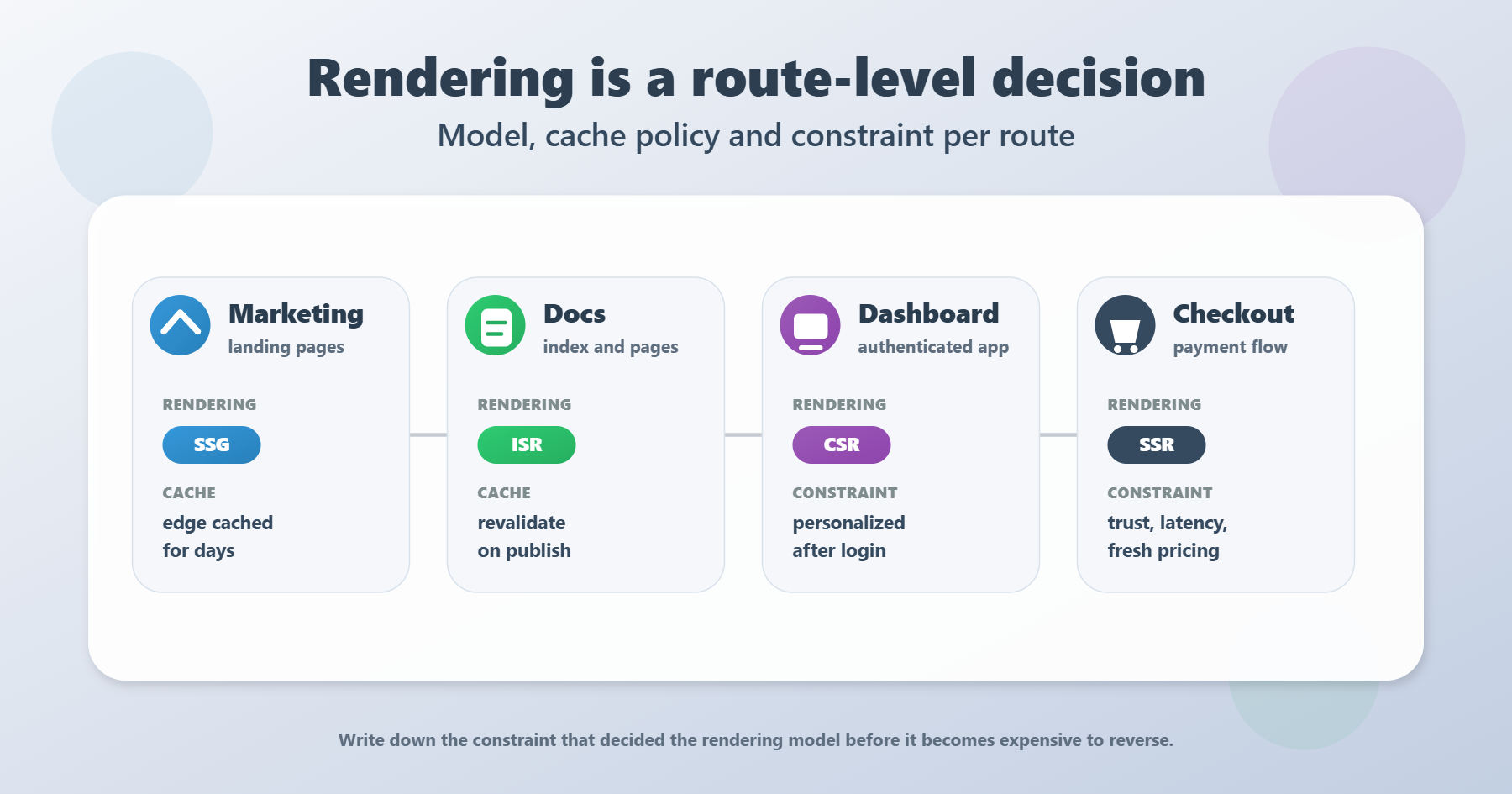
Rendering strategy is a route-level decision, not an application-level one. A marketing page, a documentation index, a logged-in dashboard, and a checkout flow have different requirements for discovery, cacheability, personalization, and interaction density. Picking one rendering model for the whole app and defending it in every architecture review is how teams end up paying for server infrastructure on pages nobody crawls, or shipping an empty shell on pages that need to be indexed.
The variables worth writing down before you choose:
- Does this route need to be discoverable by crawlers and link previews?
- Is the content personalized per user, per segment, or identical for everyone?
- Can the response be cached at the edge, and for how long?
- How much of the page is interactive before authenticated data arrives?
- What is the backend latency you cannot engineer away?
Most web application development best practices for team size follow the same shape. For a product team of five to twenty-five engineers, a modular monolith with clear internal boundaries is the sane default: one deployment, one transaction scope, one place to debug. Microservices pay off when independent ownership and independent release cadence matter more than the operational overhead they add. That is an organizational trigger, not a technical one, and teams that split services before they have the organizational reason usually end up with a distributed monolith plus a service mesh.
Here is a case where the common advice runs the wrong way. The standard recommendation is to move rendering to the server. For an authenticated dashboard, that can be the more expensive option: the route is invisible to crawlers, the payload is personalized so caching buys you nothing, and the UI only becomes meaningful after authenticated data arrives. You add server infrastructure, cache-invalidation complexity, and a hydration boundary, and the interaction path that users actually complain about does not improve. A mostly client-rendered app with aggressive code splitting can be both cheaper and easier to reason about. Discovery-critical routes are a different argument entirely.
Whatever you choose, write down why. A short decision record naming the alternatives, the constraint that decided it, and the date turns a future argument into a five-minute read. Xmethod runs product discovery and technical planning before implementation, which is the cheapest point in the project to have this argument — see product discovery.
Performance: enforce the threshold, not the score
Why INP fails differently from LCP
The three Core Web Vitals measure different failure modes, and the fixes have almost nothing in common. Per web.dev's Core Web Vitals reference (updated 31 October 2024), the "good" thresholds are LCP at or below 2.5 seconds, INP at or below 200 milliseconds, and CLS at or below 0.1 — each assessed at the 75th percentile of real users, with mobile and desktop evaluated separately.
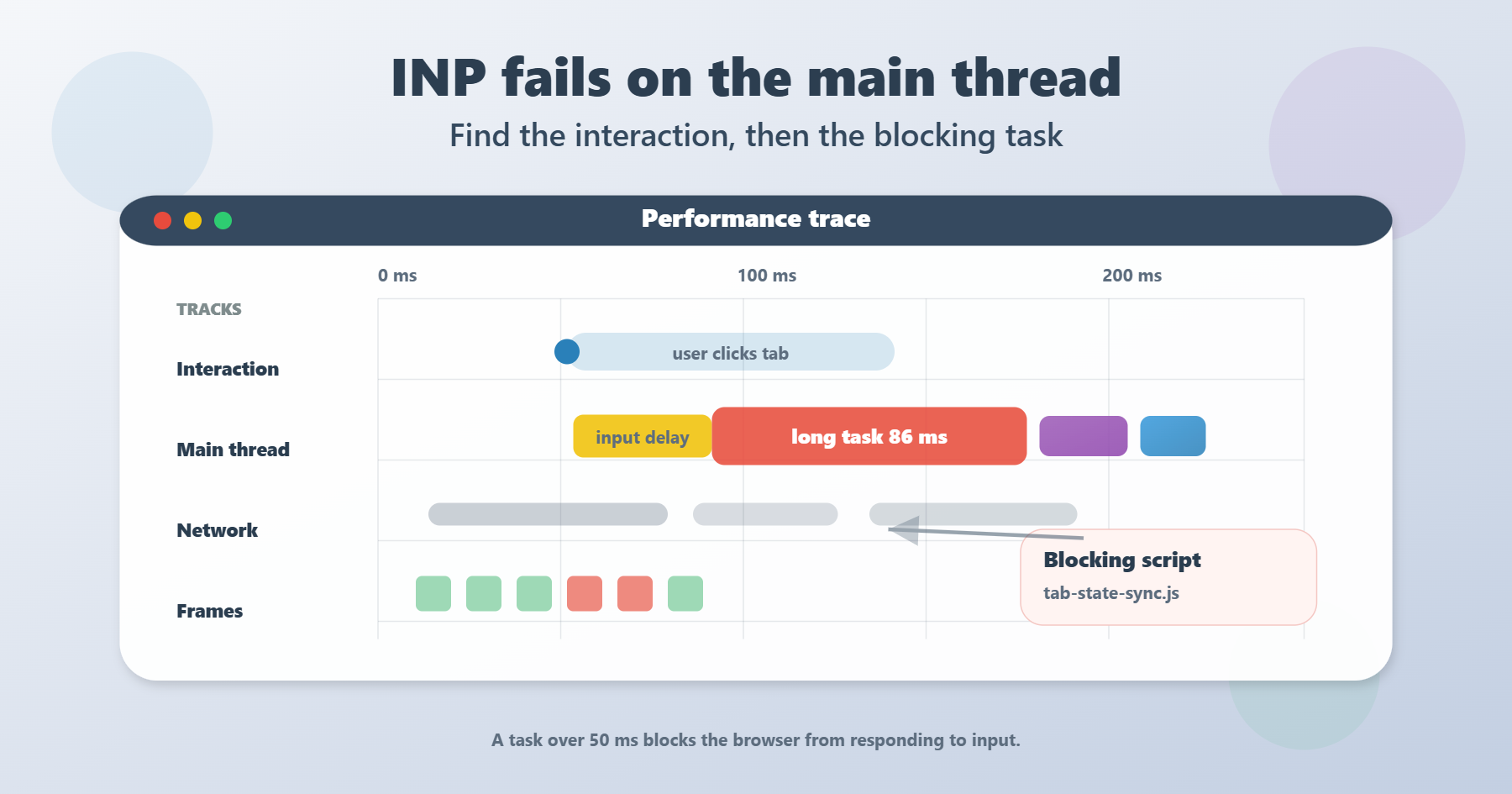
LCP is a loading problem: render-blocking resources, slow TTFB, oversized hero images, fonts that arrive late. INP is a main-thread problem. The INP documentation (updated 2 September 2025) classifies anything above 200 ms as needing improvement and anything above 500 ms as poor. An app can load in under two seconds and still feel broken because every tab switch queues 400 ms of synchronous work.
Where interaction regressions come from
A long task — anything occupying the main thread for more than 50 ms, per web.dev's guidance updated 19 December 2024 — blocks the browser from responding to input. Interaction regressions usually trace back to a small set of causes: oversized synchronous JavaScript on the critical path, event handlers doing layout-triggering work, style and layout recalculation over a large DOM, and hydration that re-runs work the server already did.
The diagnostic order matters more than the fix list:
- Find the slow interactions in field or RUM data, not in a lab run.
- Reproduce and attribute them in the Chrome DevTools performance panel.
- Break up or remove the blocking work — split tasks, yield to the main thread, move eligible computation off it.
- Add regression protection in CI and keep watching the field data after release.
Field data closes the gap Lighthouse leaves open
Lighthouse is useful. It gives you a reproducible lab measurement and a decent list of likely causes, and it will catch an obvious regression before it ships. What it cannot do is tell you whether you pass, because the standard is defined on the 75th percentile of real users on real devices and real networks. A synthetic run on a fast machine with a throttling profile is a hypothesis, not a result.
The practical form of this standard is a performance budget in CI plus a field-data dashboard someone reads. Without the budget, performance work has a half-life of about three sprints. Without the field data, you are optimizing a number that no user experiences. Xmethod lists post-launch monitoring and iterative development as part of its delivery process, which is the point where a field-data budget stops being an aspiration and becomes an operating constraint.
Best practices for web application development and for a marketing site diverge here. On a content site, LCP and cacheability dominate. In an authenticated app with long sessions, INP and memory behavior matter far more than first paint.
Accessibility is now a delivery and procurement requirement
WCAG 2.2 added nine success criteria to WCAG 2.1 and removed 4.1.1 Parsing. Four of the additions are the ones product teams hit first, and it is worth naming them precisely, because they are routinely misquoted:
- 2.4.11 Focus Not Obscured (Minimum), AA — the focused element must not be entirely hidden by sticky headers, cookie banners, or chat widgets.
- 2.5.7 Dragging Movements, AA — anything that works by dragging needs a single-pointer alternative.
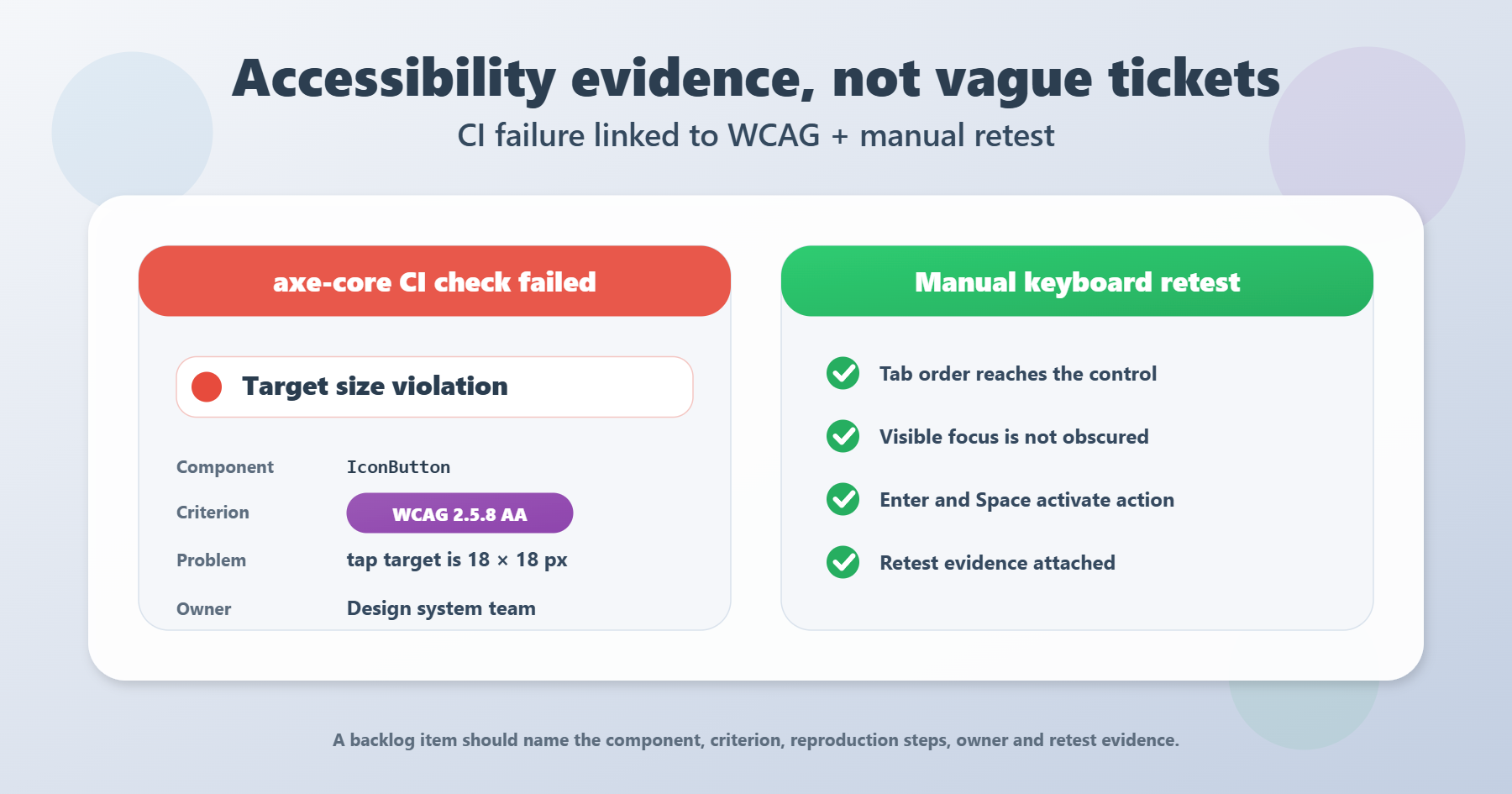
- 2.5.8 Target Size (Minimum), AA — targets of at least 24 × 24 CSS pixels, with defined exceptions.
- 3.2.6 Consistent Help, A — help mechanisms appear in the same relative order across pages.
Focus Appearance is 2.4.13 and sits at level AAA, so it does not belong in an AA conformance claim. The W3C summary of what is new in 2.2 is the reference to check before you write a requirement into a contract.
The regulatory layer is where web design and development best practices stopped being a values conversation. In the EU, national measures implementing the European Accessibility Act have applied since 28 June 2025 across e-commerce, consumer banking, e-books, passenger transport, and electronic communications, with carve-outs for microenterprises providing services and for disproportionate burden. In the US, the three instruments are separate and should not be merged: the DOJ's 2024 rule under ADA Title II sets WCAG 2.1 Level AA for state and local governments with compliance dates of 26 April 2027 and 26 April 2028 depending on population; Title III obligations for private businesses follow a different legal route; and Section 508 applies to federal agencies and incorporates WCAG 2.0. Accessibility evidence now shows up in procurement questionnaires long before it shows up in a lawsuit.
Automated tooling catches a real share of issues and should run on every pull request. It will not tell you whether a keyboard user can complete checkout. ADA.gov's own guidance says automated checkers must be paired with manual review, and that is the part teams skip.
The step that changes outcomes is unglamorous: every open accessibility issue carries the affected component, the specific success criterion, reproduction steps, the assistive technology or input mode used, severity, an owner, and retest evidence. A backlog that says "make the table accessible" is a wish. A backlog of criterion-mapped issues is a document a procurement officer or a lawyer can read.
Security defaults that survive a compromised dependency
Security is where web development standards, best practices on a wiki page, and what CI actually enforces drift furthest apart. The OWASP Top 10 belongs in threat modeling, design review, and test planning. It is not evidence of anything on its own — check the current edition directly before you cite category names, since the list has been revised.
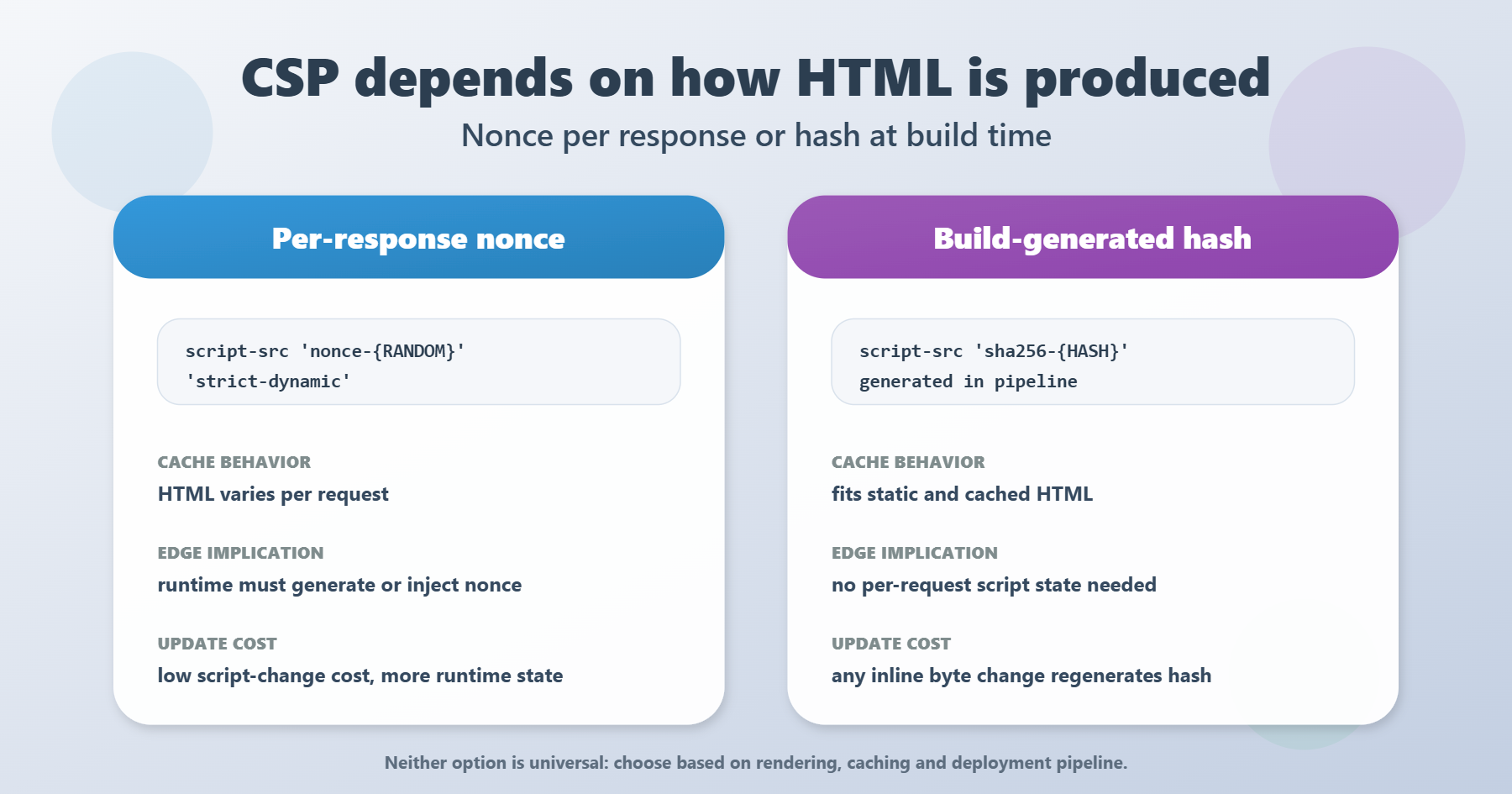
One technical choice deserves a proper walk-through, because teams get it wrong in both directions: nonce-based versus hash-based Content Security Policy. Per MDN's script-src reference, a nonce is a cryptographically secure random value that must be unique for every HTTP request, echoed in both the header and the allowed <script> tag:
Content-Security-Policy: script-src 'nonce-{RANDOM}' 'strict-dynamic'
That works well when the response is generated per request. It adds per-response state, which complicates full-page caching and static output — edge runtimes can generate or inject a nonce, but you are now maintaining that mechanism. A hash pins the exact content of an inline script instead:
Content-Security-Policy: script-src 'sha256-{HASH}'
Hashes fit statically generated output cleanly. The cost moves into the build: change a byte of that inline script, including whitespace, and the hash and policy have to be regenerated as part of the pipeline. Neither option is universally correct. Pick based on how your HTML is produced and cached, and write the reason down next to the config.
Content-Security-Policy-Report-Only is a rollout phase with an end date. A report-only policy that has been collecting violations for eighteen months is telemetry, not prevention. Same logic applies to dependency scanning, secret scanning, and SCA output: if a verified secret or a known-exploited vulnerability produces a notification instead of a failed build, you have monitoring, not a control. Keep an SBOM so that the next time a popular package is compromised, answering "are we affected" takes ten minutes instead of two days.
Review gates: the part that must be able to stop a merge
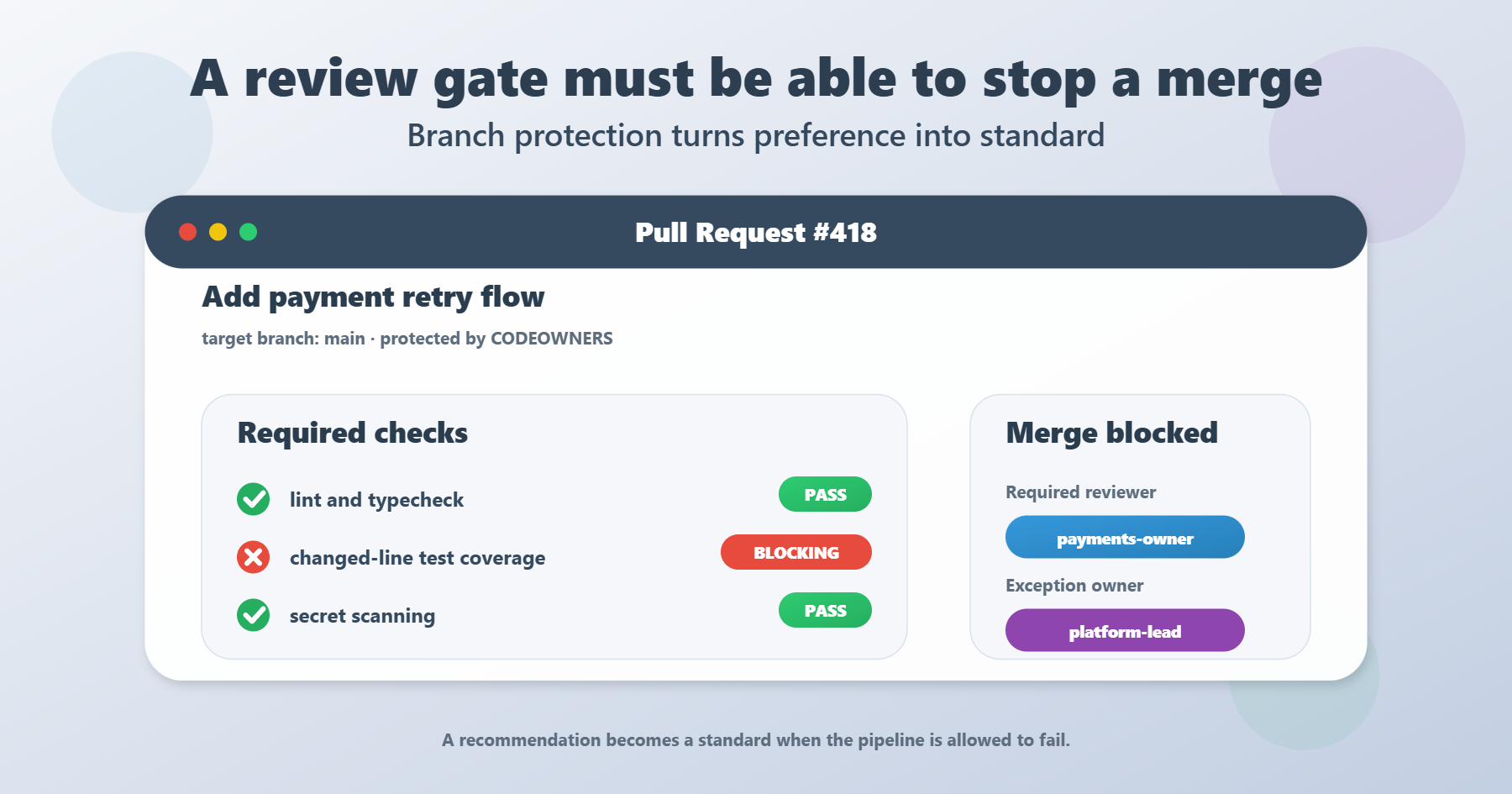
The only distinction that matters at scale is between "recommended" and "does not pass". Everything else is a preference with a wiki page. What separates professional web development best practices from a style guide is that one of them can hold a release.
Make the blocking gates mechanical, and keep taste out of them. Changed-line test coverage is a better gate than a repository-wide percentage, because it improves the codebase gradually without demanding a six-week backfill nobody will fund. The specific floor is a local decision — an 80% number copied from a blog post is not a standard, it is someone else's context. Verified secret detection blocks. A dependency with a known exploited vulnerability blocks. Changes to authentication, payments, infrastructure, or CI configuration require a second reviewer, enforced through branch protection and CODEOWNERS rather than through a sentence in CONTRIBUTING.md. Everything else can be a comment.
Then there is the advice that works against teams more often than for them. DRY is a design heuristic, and it is a terrible merge gate. Three small duplicated implementations in three bounded contexts are usually safer than one shared abstraction that couples unrelated domains and turns every future change into a cross-team negotiation. We would rather review a duplicate than untangle a premature abstraction two years later. Wait until the third instance tells you something real about the shape of the problem.
Xmethod's published process combines two-week sprints with functional, security, performance, and usability testing before launch, which gives a team a natural cadence for this decision. The operational question each sprint is narrow: which failing checks stay advisory this cycle, and which ones are now allowed to stop the release.
AI in the pipeline changed what review means
The adoption numbers are settled. The 2025 Stack Overflow Developer Survey reports that 84% of respondents use or plan to use AI tools in development and 50.6% of professional developers use them daily. Trust did not follow: 46% of respondents actively distrust the accuracy of AI output, against 33% who trust it, with 3.1% saying they highly trust it. Teams are shipping assistant-written code at scale while most of the people writing it do not believe it by default.
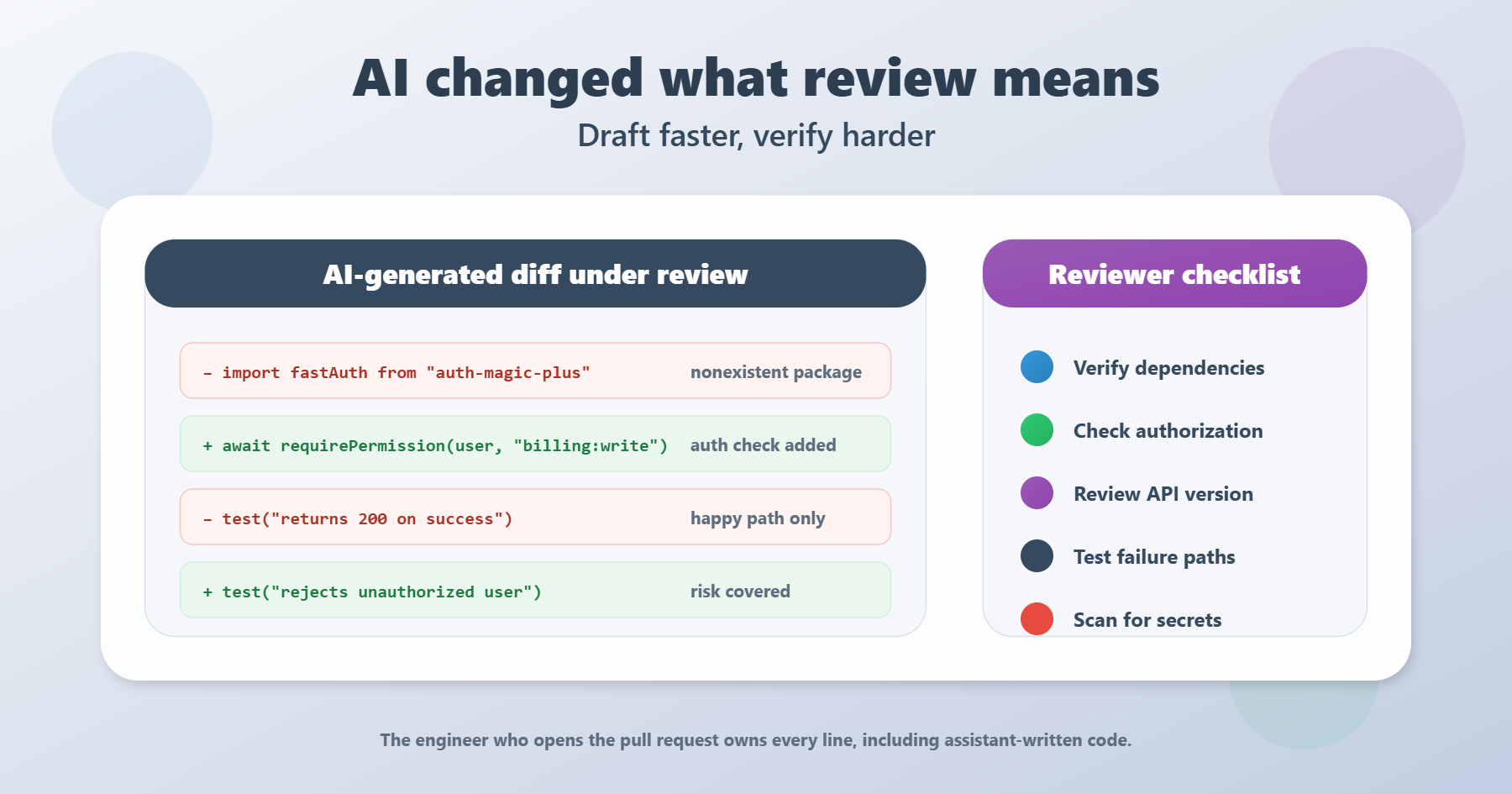
That combination is workable, and it sets the review posture. An assistant accelerates the draft, not the decision. The engineer who opens the pull request owns every line in it, exactly as if they had typed it — same tests, same review, same signature. Nothing about the tooling changes accountability.
What does change is the checklist. Handwritten code rarely invents a package that does not exist, calls an API signature from a version you are not running, or quietly produces a happy-path-only test that passes because it never touches the branch it claims to cover. Assistant output does all three regularly, and all three survive a skim. Add explicit checks for unfamiliar dependencies, unverifiable APIs, license and provenance risk on copied blocks, and secrets — autocomplete is unusually good at filling a config file with a plausible-looking key during prototyping. Generated tests are not independent evidence of correctness when the same model wrote the implementation.
We wrote more about the downstream cost of this in How Anthropic solves the problem of technical debt from AI-assisted coding.
Why good web development principles do not survive contact with a real team
Every team we work with can recite the list. Very few have it enforced. The gap is almost never technical, and after enough rollouts the failure modes start to look identical.
A standard with no owner is a suggestion. When the coverage gate breaks on a Friday and nobody is responsible for it, someone disables it, and it never comes back. A standard with no blocking mechanism is documentation; people follow it while they remember it and stop when the deadline arrives. And the most common failure of all is introducing eight standards in one sprint — linting, coverage, performance budgets, accessibility checks, dependency policy, commit conventions — watching the pipeline go red on every branch for a week, and then rolling back the entire set, including the three that were working.
There is also the false-positive problem. A check that fires noisily on issues nobody considers real teaches the team to ignore red builds, which is worse than having no check at all. Tune the rule down to what you will actually fix before you make it blocking.
What we would do instead: one gate per release cycle. Turn it on in warning mode. Clear the existing backlog it exposes. Name an owner. Flip it to blocking once the baseline is under control. Document how to request an exception, and give every exception an expiry date and an approver. Two weeks of warning mode is a reasonable starting point for most teams, not a law.
The 2025 DORA research makes a related point about AI: it amplifies an organization's existing strengths and weaknesses. Automation behaves the same way with standards. It magnifies a sound ownership model, and it magnifies unclear accountability just as efficiently. Worth noting while you are there: DORA's current delivery metrics guide lists five measures, not the four everyone still quotes — deployment rework rate is now tracked separately.
Standards hold when they are attached to delivery decisions, sprint reviews, and what happens after launch. Xmethod is a Berlin-based development agency building custom web applications, SaaS products, mobile apps, and low-code solutions, working through product discovery, technical planning, two-week sprints with demos and status reports, testing before launch, and continued iteration afterwards. That cadence gives a team the natural checkpoints this article keeps coming back to: a place to set a threshold, a person to own it, and a moment to decide whether a failed check should stop a release or just leave a comment. If you want to see how that process is structured end to end, read about custom software development at Xmethod.
Final thoughts
Put two teams in a room and they will produce nearly the same list of best practices in web development. The list is not the differentiator and has not been for years. What separates a team that ships predictably from one that ships in bursts is how many items on that list are measurable, owned by a named person, wired into CI, and allowed to fail a build — and how the exceptions are handled when they are not.
Review the expensive decisions on a slow cadence and the cheap ones continuously. Revisit the whole set when a metric definition changes, when a regulation starts applying, or when your delivery model shifts. All three happened between 2023 and 2025, which is why the web development best practices that held up in 2021 need a second look before you plan the next quarter.
Frequently Asked Questions
What are the most important web development best practices in 2026?
In rough order of how expensive they are to get wrong: decide rendering and data-access strategy per route rather than per application; hold Core Web Vitals at the 75th percentile of field data; build accessible semantics in from the start and test against WCAG 2.2; enforce security controls such as CSP, dependency scanning, and secret detection as blocking checks; make quality gates capable of stopping a merge; ship one reproducible artifact through every environment; and keep a named human accountable for AI-assisted code.
What is the difference between web development standards and best practices?
A best practice is a recommended approach that depends on context — team size, product stage, traffic profile. A standard is a requirement with three properties: it is measurable, it has an owner, and there is a defined process for approving exceptions. External standards like WCAG 2.2 or Section 508 come with published criteria and, in some cases, legal weight. Internal engineering standards are the ones your team writes, and they only count once something in the pipeline can fail because of them.
Which Core Web Vitals thresholds should a team target?
Largest Contentful Paint at or below 2.5 seconds, Interaction to Next Paint at or below 200 milliseconds, and Cumulative Layout Shift at or below 0.1. Assess all three at the 75th percentile of real-user data, and evaluate mobile and desktop separately — mobile almost always fails first. Lighthouse is a diagnostic tool for finding likely causes, not the pass condition. The pass condition is field data. Thresholds are published and maintained on web.dev.
Do web development best practices differ for a web app and a marketing site?
Yes, in emphasis. A marketing site lives on discovery, LCP, and cacheability, which favors static or server rendering and aggressive edge caching. An authenticated application lives on INP, long-session memory behavior, authorization correctness, and state management, where client-side rendering is often the cheaper choice. Web app development best practices for 2026 and content-site practices converge on everything else: semantic HTML, keyboard access, security defaults, observability, and a human owner for every merged change.
When does a WCAG 2.2 audit need to be repeated, and what triggers an off-cycle one?
There is no universal interval. Tie cadence to release frequency and risk: run automated checks on every pull request, run manual keyboard and screen reader passes on any critical journey you changed, and run a broader audit before major releases or procurement submissions. Off-cycle triggers are specific — a design system change, a framework migration, a redesign of authentication or payments, a new third-party widget, a user complaint, or a customer's accessibility questionnaire. Each of those invalidates part of your previous evidence.