ProRunning
About the Client
Steve Münch is a technical consultant in the metallurgical industry based in Switzerland. He works with industrial plants where continuous metal casting demands high precision and stable operations.
His clients are engineers and operators who work with production equipment every day, monitor deviations, and resolve malfunctions. Any error can lead to production downtime and direct financial losses.
Goals and Objectives
The aim was to transform expert technical support from a manual service into a scalable digital product that would:
- reduce reliance on phone calls and the consultant’s direct involvement;
- speed up incident diagnosis and resolution;
- systematize Steve’s accumulated expertise and consolidate it in one place.
Solution
Caster Wizard is a mobile application designed to support engineers by combining incident diagnostics, expert communication, analytics, and a knowledge base within a single interface.
Discovery and Pre-Project Analysis
We studied real reports, incidents, and technical documentation to understand the most common failures and how engineers handle them in the field.
Based on this research, we:
- mapped the key user flows and real working scenarios of engineers;
- identified incident categories and their priorities;
- defined the minimum dataset required for fast reporting;
- designed the information architecture and created the first wireframes.
It was during the discovery phase that the idea of the interface as a “control panel” emerged — with visual indicators, color-coded logic, and one-click quick actions.
System Status Dashboard
The main screen of the application is not just raw telemetry, but an interpreted view of system health.
Here, users can immediately see:
- how many issues have occurred and how many have already been resolved;
- which incidents recur most often;
- which risks and deviations are currently relevant to their equipment.
Reporting
We replaced long support request forms with a reporting flow designed to feel like a fast diagnostic process.
In this section, the engineer:
- selects the type of issue (Precision / Failure / Proven Issues);
- answers a set of targeted questions;
- adds parameters and photos.
The report is then sent to an expert, and work on resolving the incident begins.
Support Chat
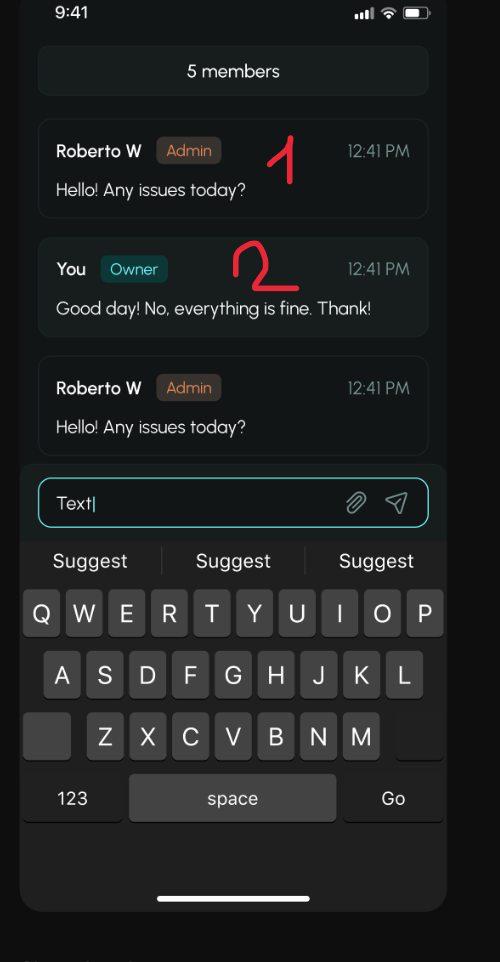
Every message in the chat is linked to a real production situation. Engineers can attach a report, add photos, or clarify details related to a specific incident.
Core features include:
- a shared communication feed for the whole team;
- flexible role configuration (engineers, managers, operators, supervisors);
- support for both one-on-one and group discussions.
Each participant logs in under their own account, which preserves personal context and makes it clear who is responsible for what and who made each decision.
Analytics and Knowledge Base
Once a report has been processed, it receives a status and is enriched with specific recommendations: what to inspect, which parameters to adjust, and how to prevent the issue from happening again.
Over time, all reports become part of a unified knowledge base.
Engineers can:
- browse incident history;
- filter incidents by issue type and status;
- analyze recurring failures;
- return to solutions that have already proven effective.
CRM for Industrial Technical Support
The admin panel in Caster Wizard serves as an operational center where all customer and production issue data is brought together.
It allows teams to:
- review all requests and reports;
- identify which failures occur most frequently;
- track how quickly issues are resolved;
- filter data by date, steel grade, or problem type.
For example, in just a couple of minutes, a user can understand what happened on a production line over the past week and how those issues were resolved.
Role Model
System users (company members) are configured manually. Each company can assign roles such as operators, supervisors, and managers, depending on its team structure.
Scalability
As multiple plants connect to the system, a network effect begins to emerge:
- problem patterns can be transferred across facilities;
- solutions can be found faster;
- expertise becomes scalable.
In effect, the product creates a distributed industry knowledge base.
Product Roadmap
The next stage of product development includes:
- AI + RAG for automated report processing;
- incident prediction;
- report editing;
- report search;
- push notifications;
- multilingual support, starting with German.
Result
Today, engineers can navigate situations faster and make decisions based on data rather than assumptions. The expert no longer wastes time sorting through chaotic requests — instead, they work with structured information.
The most important change is the emergence of accumulated operational knowledge: every incident stays in the system and strengthens future decision-making.