AI Business Strategy for Enterprise in 2026: A Practical Framework That Connects AI to Business Outcomes
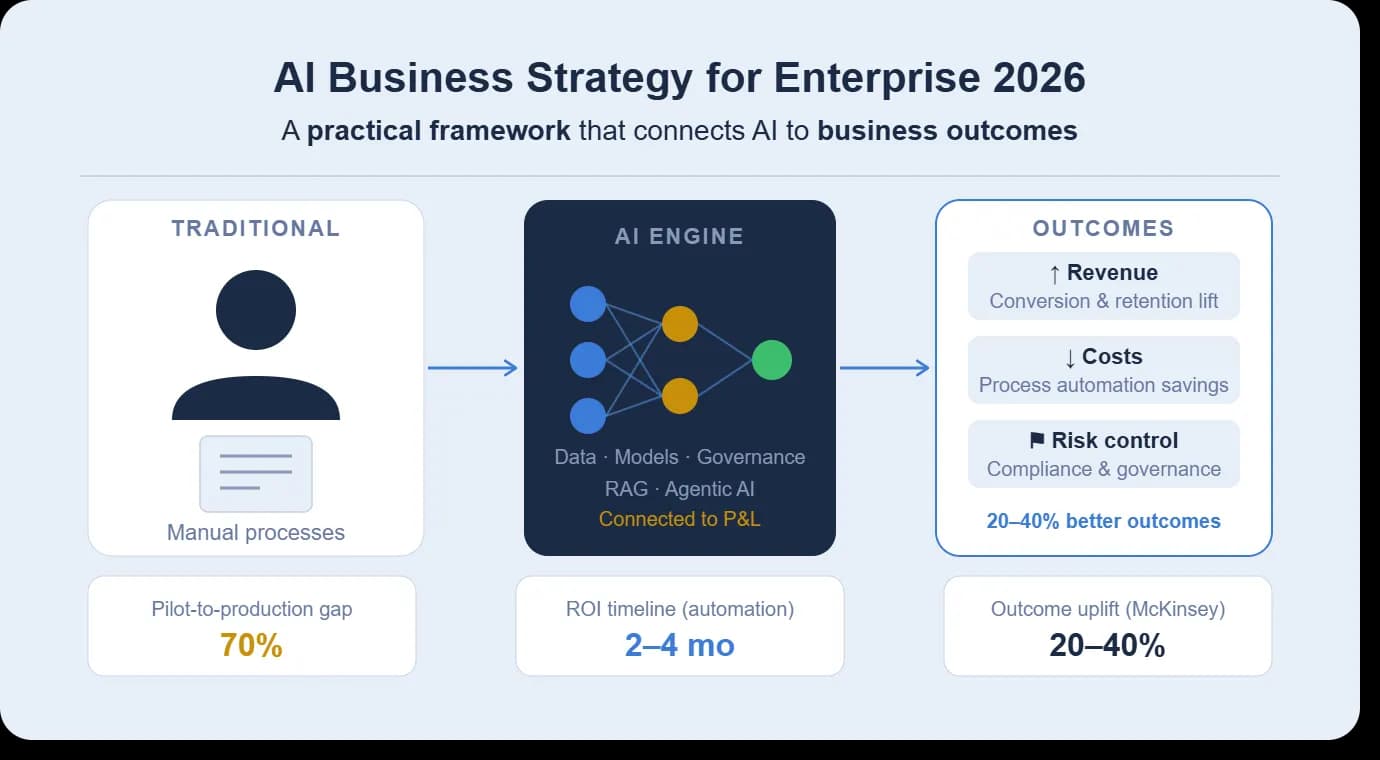

In 2026, the organizations that will be the victors in the market will not be the ones that implemented the most pilot programs, but the organizations that have an AI business strategy tightly linked with the key indicators — including revenues, expenses, and risks. According to McKinsey, companies that build an adequate operational structure demonstrate a 20–40% increase in business outcomes; others that ignore the need for transformation are still stuck at the testing stage.
What Is an AI Strategy for Companies (And What It’s Not)
An appropriately constructed AI roadmap is a detailed document that harmonizes the company’s technological investments with its global goals. Specifically, it should encompass the following:
- Harmonizing technological investments with the company’s global performance indicators;
- Determining strategic priorities and implementing a radical transformation of business processes;
- Ensuring the security of information assets and comprehensive management of the company’s data.
It is not merely purchasing new software or introducing a program like “Let’s use ChatGPT!” The most basic difference between traditional AI adoption and a real AI strategy for companies is measurable outcomes.
The present market environment experiences substantial change — generative AI and agentic AI are creating a new work rhythm. Organizations that do not have a strategic vision will be disadvantaged by taking expensive yet reactionary steps. Teams evaluating where to begin often benefit from reviewing the best AI agents in 2026 — understanding which tools actually deliver results helps ground strategic decisions in reality rather than hype.
Expert tip: Before choosing any tool or model, define the outcome first. Revenue lift? Cost reduction? Risk mitigation? The answer shapes everything else.
Why Enterprise AI Strategy Is Different in 2026
The scale of problems that corporations face demands coordination across departments, integration with current systems, and observance of international regulations. Agentic AI transforms the landscape, with autonomous agents managing processes — which requires an implementation strategy with the involvement of multiple layers.
Regulatory pressure is increasing at a worrying pace. The EU AI Act for high-risk systems is imminent, and ignoring compliance is no longer an option. According to Gartner, the majority of pilot programs get stuck in “pilot purgatory” due to a lack of direct connection between the pilot and operational business processes.
Industry leaders are attentive to building a systemic approach and a hybrid infrastructure — not just running experiments. Companies looking for external support in this process should consult a shortlist of best digital transformation consulting companies to identify partners with proven enterprise transformation track records.
| Approach | Old Approach (2022–2024) | Strategic Approach (2026) |
|---|---|---|
| Tooling | Individual tools, siloed | Cross-functional, integrated |
| Pilots | Experimenting in isolation | Connected to P&L outcomes |
| Ownership | IT-led projects | C-suite ownership |
| Governance | No governance | AI governance & compliance built-in |
| Mindset | Reactive to trends | Proactive, roadmap-driven |
Industry leaders are attentive to building a systemic approach and a hybrid infrastructure — not just running experiments.
The 4 Pillars of a Successful AI Business Strategy
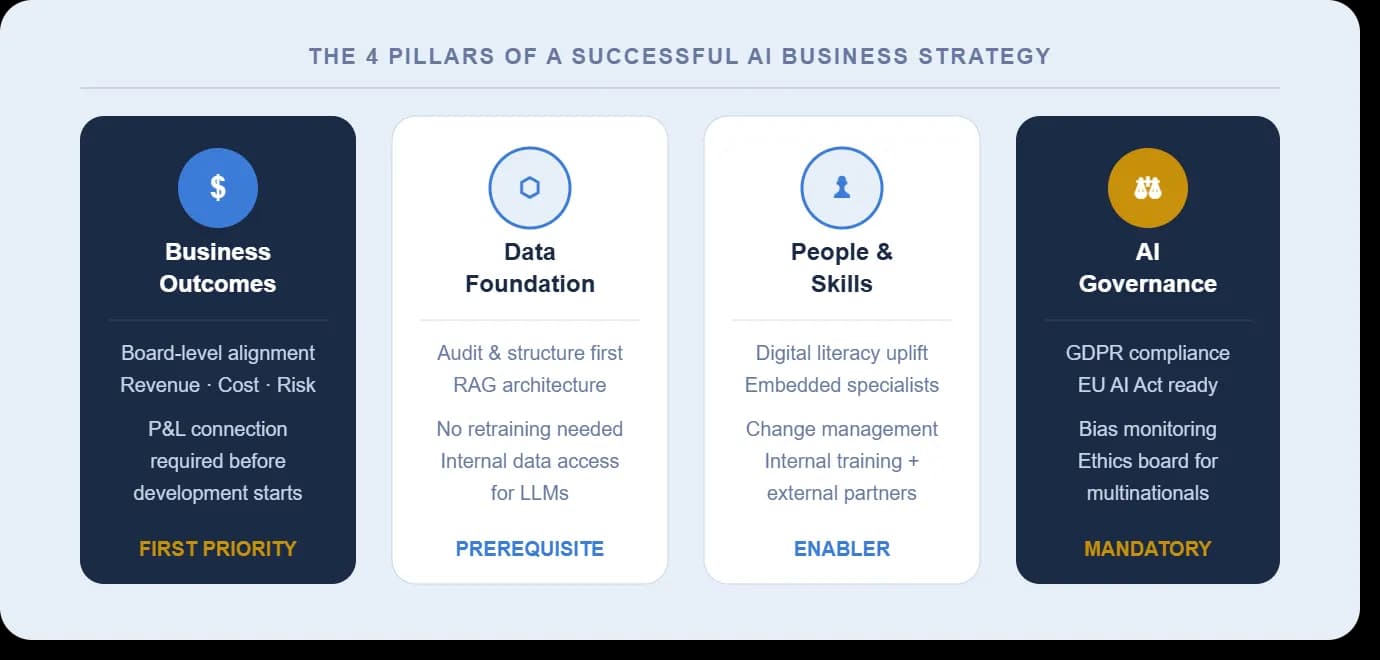
Effective execution relies on four interrelated components that work together as one scalable solution.
Pillar 1 — Business Outcomes First
Start at the board level, where revenue generation, cost reduction, and risk mitigation rank as top concerns. The tech roadmap must adopt unyielding business language. All projects should have a quantifiable business impact even before development commences — a direct connection between implemented solutions and P&L lines.
Pillar 2 — Data Foundation
Any model can be no better than the data used by it. The information of many enterprises is scattered, unstructured, and poorly governed. A full audit and structuring of the data infrastructure must come before any complex algorithm deployment.
RAG (Retrieval-Augmented Generation) architecture gives large language models the ability to use internal information without full retraining — making AI introduction significantly cheaper for businesses.
Pillar 3 — People, Skills & Change Management
Big transformations often fail due to the human factor, not server deployment issues. Every enterprise needs to invest in improving digital literacy, hiring specialists, and building the skills needed across teams.
Change management should start with handling employee concerns and ensuring clear interdepartmental communication. Most enterprises today combine internal training with collaboration from external specialized partners. When evaluating which external partners to engage, a curated list of best AI automation companies provides a useful benchmark for assessing capability and fit.
Pillar 4 — AI Governance & Responsible AI
Process regulation is no longer a choice — it is a legal obligation and a competitive edge. The security framework includes GDPR compliance for data privacy, constant model bias monitoring, and compliance with the EU AI Act. For multinationals, forming an ethics board becomes a necessity. Responsible AI adoption builds trust with clients and stakeholders.
Developing an AI Strategy: A 6-Step Framework for Enterprise Leaders
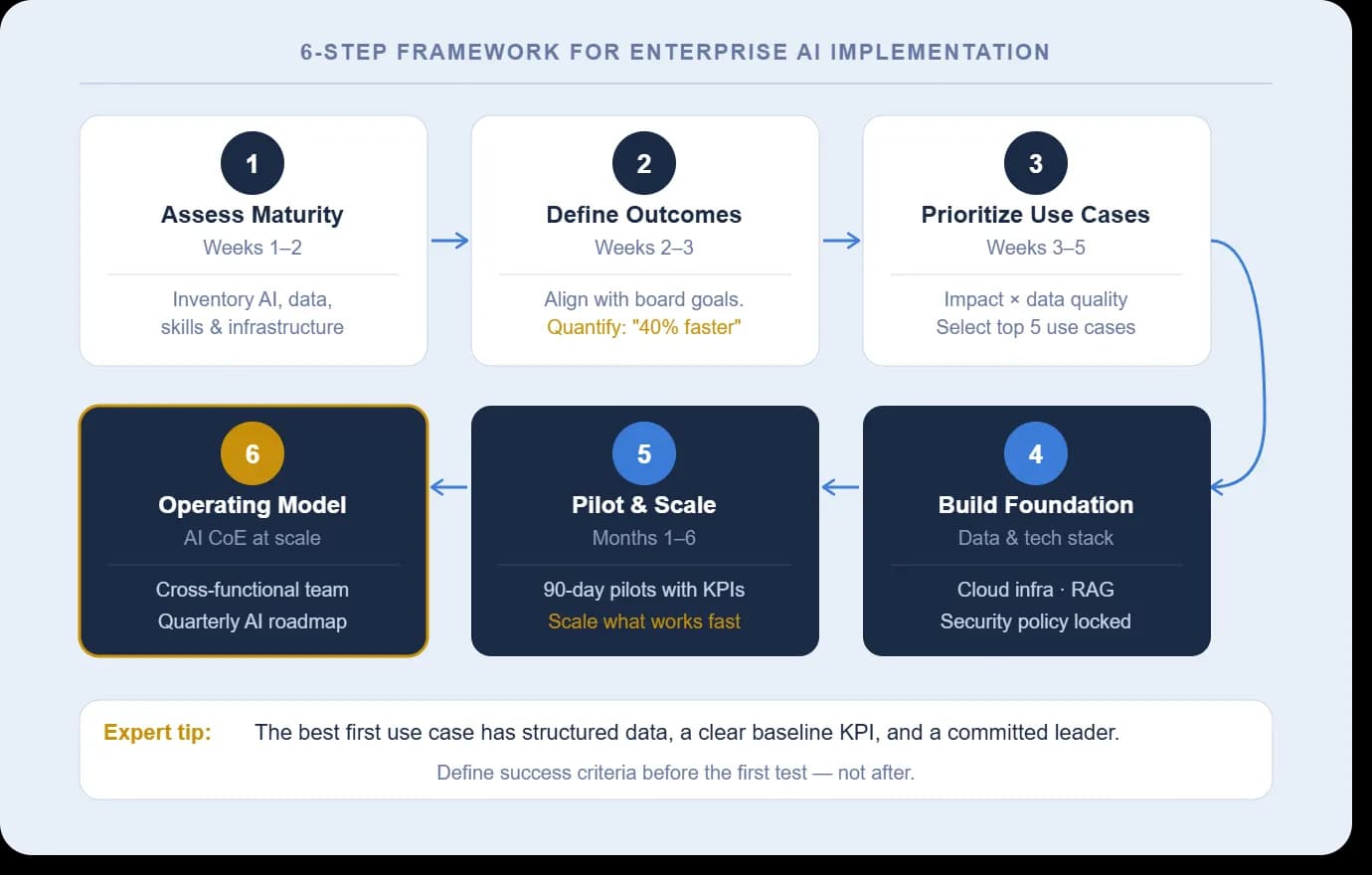
Putting theory into practice demands discipline and systematization. Here is the algorithm that will help you organize large-scale business transformation safely and efficiently.
- 1Assess your current AI maturity (Weeks 1–2): Start with an AI maturity assessment across all departments. Inventory your algorithms, pilots, and data. Pinpoint shortages in data, skills, and computing infrastructure to form an objective picture of the current situation;
- 2Define strategic outcomes (Weeks 2–3): Align the direction of development with key objectives from the board. Avoid vague statements like “improve efficiency” — be specific: “40% reduction in invoice processing time” is a metric that can be measured;
- 3Identify and prioritize use cases (Weeks 3–5): Run workshops with departmental heads to generate ideas. Build an evaluation matrix based on business impact, data availability, and payback period. Choose up to five integration areas as your first wave;
- 4Build the data and technology foundation: Audit all potential data sources for prioritized tasks. Decide on the architecture — build in-house, buy existing, or both. Choose your cloud infrastructure (Azure, AWS, or GCP) and finalize security policy before model release. The choice of underlying technology stack matters as much as the strategy itself; reviewing the best app development frameworks can help technical leads align tooling decisions with enterprise-grade requirements;
- 5Pilot, measure, and scale (Months 1–6): Launch a 90-day pilot with a fixed timeline and explicit success criteria. Compare results against baseline measurements. Successful pilots get immediate scaling budgets; failed ones get documented for organizational learning;
- 6Build the operating model for scale: Create an AI Center of Excellence (CoE) or a cross-functional team. Distribute responsibilities across product owners, data scientists, and risk managers. Develop a quarterly-reviewed AI roadmap with governance policies embedded from the start.
Expert tip: The best initial project always has large volumes of structured data, a clear baseline KPI, and a committed leader who is ready to drive the process.
Generative AI Business Strategy: What’s Different in 2026
The corporate world has fully adopted generative tools into practical use. Sophisticated language models are now active within marketing, business operations, legal affairs, and customer support teams.
Introducing state-of-the-art machine learning into major businesses requires careful consideration of risks — including hallucination (incorrect data generation), intellectual property concerns, and thorough model control. Today’s best practice is RAG technology, which integrates LLMs with internal databases while avoiding expensive retraining.
The next groundbreaking shift is agentic AI — self-sustaining agents capable of running complex multi-step procedures and communicating with enterprise ERP/CRM software. This level of integration requires entirely new governance, including mandatory human-in-the-loop review for high-stakes decisions.
Expert tip: Treat generative AI outputs like a first draft from a smart junior employee — always review before they reach a customer or a decision.
Common Mistakes in Enterprise AI Strategy (And How to Avoid Them)
Large-scale technology initiatives are notorious for collapsing due to predictable planning and communication failures. Avoid these errors when executing an enterprise AI strategy:
- Treating it as an IT project only: Implementation requires C-suite involvement — not just the CTO — to ensure economic results;
- Deploying before fixing data architecture: Decision-making based on flawed datasets will inevitably lead to model failure;
- Piloting without scaling criteria: Success criteria must be defined before the very first test;
- Neglecting change management: Even perfect algorithms can be ruined by employee resistance to transformation;
- Ignoring compliance from day one: The program must be compatible with existing regulations and standards before launch;
- Chasing every new model: Advanced models are irrelevant if they cannot be applied to your specific objectives;
- Not establishing governance: One major incident can delay the entire program by years.
A well-thought-out strategy combined with quality control and high-level executive involvement increases the chances of successful implementation considerably.
Measuring Success: KPIs and ROI
AI ROI can be calculated accurately — but that requires setting up baseline parameters before implementing the technology. Metrics fall into three main categories: efficiency KPIs (faster processing times, workforce reassignment), revenue impact (increased conversion rates, improved client retention), and risk metrics (reduced downtime, fraud detection).
| Use Case | Measurable KPI | Typical ROI Timeline |
|---|---|---|
| Invoice processing automation | Processing time, error rate | 2–4 months |
| Customer service chatbot | Ticket deflection rate, CSAT | 3–6 months |
| Predictive maintenance | Downtime reduction, repair cost | 6–12 months |
| Sales lead scoring | Conversion rate, deal velocity | 3–6 months |
Do not be tricked by vanity metrics — the number of models implemented does not correlate with actual business outcomes. Return periods vary considerably: straightforward automation produces results within weeks, generative models require 3–6 months, and radical transformation can take up to two years.
Xmethod: Turning AI Strategy into Business Reality
A finished strategy document is merely the starting point. Many companies cannot bridge the gap from a well-prepared presentation to practical results without professional assistance. Xmethod acts as a strategic partner, assuming responsibility for enterprise implementation and turning theoretical ideas into productive software.
Our key focus areas:
- Strategic alignment: Bringing use cases in line with your P&L goals;
- RAG architecture: Building secure enterprise solutions based on corporate data while preserving confidentiality;
- Data foundation setup: Integration of different databases and compatibility with legacy ERP and CRM systems;
- Full-cycle governance: Developing systems fully compliant with European privacy regulations from day one.
Our primary mission is to pull your business out of the endless testing loop. Xmethod guarantees a scalable infrastructure with a measurable return on investment.
Conclusion: From AI Experiments to AI-Driven Enterprise
By 2026, the gap between companies with a systematic AI business strategy and those experimenting chaotically will continue growing at a startling pace. Success belongs not to those who spend limitless amounts on IT infrastructure, but to visionary leaders whose digital strategy aligns with revenue, scales smoothly, and stays under control.
Xmethod helps enterprises devise and implement AI frameworks connected to business goals — from prioritizing use cases to governance and scalable adoption.
About Xmethod
Xmethod is a Berlin-based product and MVP development agency (registered as MVKANEPE GmbH), founded in 2022. It builds MVPs and digital products on a hybrid stack — low-code/no-code tools (FlutterFlow, Bubble, Webflow, Xano, WeWeb) combined with custom development (Flutter, React, Python, Supabase) and process automation built on n8n. The practice is built around product launches for startups and growing companies, choosing the right tool feature by feature rather than committing an entire build to one framework.
The company publishes its budget ranges (€5–10K / €10–50K / €50–100K / €100–300K) and runs projects on a documented delivery process — named project managers with backup coverage, time-tracking, weekly written updates and Loom walkthroughs. It holds a 4.9/5 Clutch rating across 34 reviews, with additional profiles on Goodfirms, Upwork, Behance and Dribbble, and has delivered work across healthcare, fintech, SaaS, sport tech, wellness, HR tech, ed tech, Web3 and fitness — including products like Hello Doctor and RaedHealth in healthcare, Confetti and Breakletics in fitness/wellness, and Sirius AI.
Frequently Asked Questions
More from the blog
AI Automation: How Businesses Can Benefit from AI for Companies
Discover how AI automation can transform your business. Learn more about the benefits, challenges, and concrete use cases of AI across various industries.
 AI
AIHow Anthropic Solves the Problem of Technical Debt from AI-Assisted Coding
Anthropic's Erik Schluntz explains how his team ships 22,000 lines of AI-generated code safely: leaf nodes, product-manager scoping, and stress tests.
 AI
AIBest Website Design Companies in 2026: Top 10 Agencies Compared
Looking for the best website design companies? Explore 10 agencies ranked by service range, tech flexibility, speed, PM quality, and pricing.
Let’s discuss your project
Free and non-binding — book a slot straight away or drop us a message.
Dennis Polevik
CEO
Free intro call with Xmethod
- Free, no obligationNo obligation and no cost
- Straight with the teamStraight with the team, no sales reps in between
- A concrete next stepYou leave with a concrete next step
Dennis Polevik
CEO
Let's discuss your project
What happens next?
- Reply within 1 business dayWe review your project and get back to you within 1 business day
- Short call on your goalsWe hop on a short call to align on scope and goals
- Clear proposal, no obligationYou get a clear proposal — no obligation, no pressure