Best MVP Software Development Companies for Startups: Top 15 Compared (2026)



Choosing among dozens of MVP software development companies is genuinely hard when every agency on the first page calls itself the one you need. This guide ranks 15 MVP development companies that founders and product teams shortlist most often in 2026 — and, more importantly, it shows exactly how we ranked them, so you can reuse the same checklist for your own decision instead of trusting a marketing page.
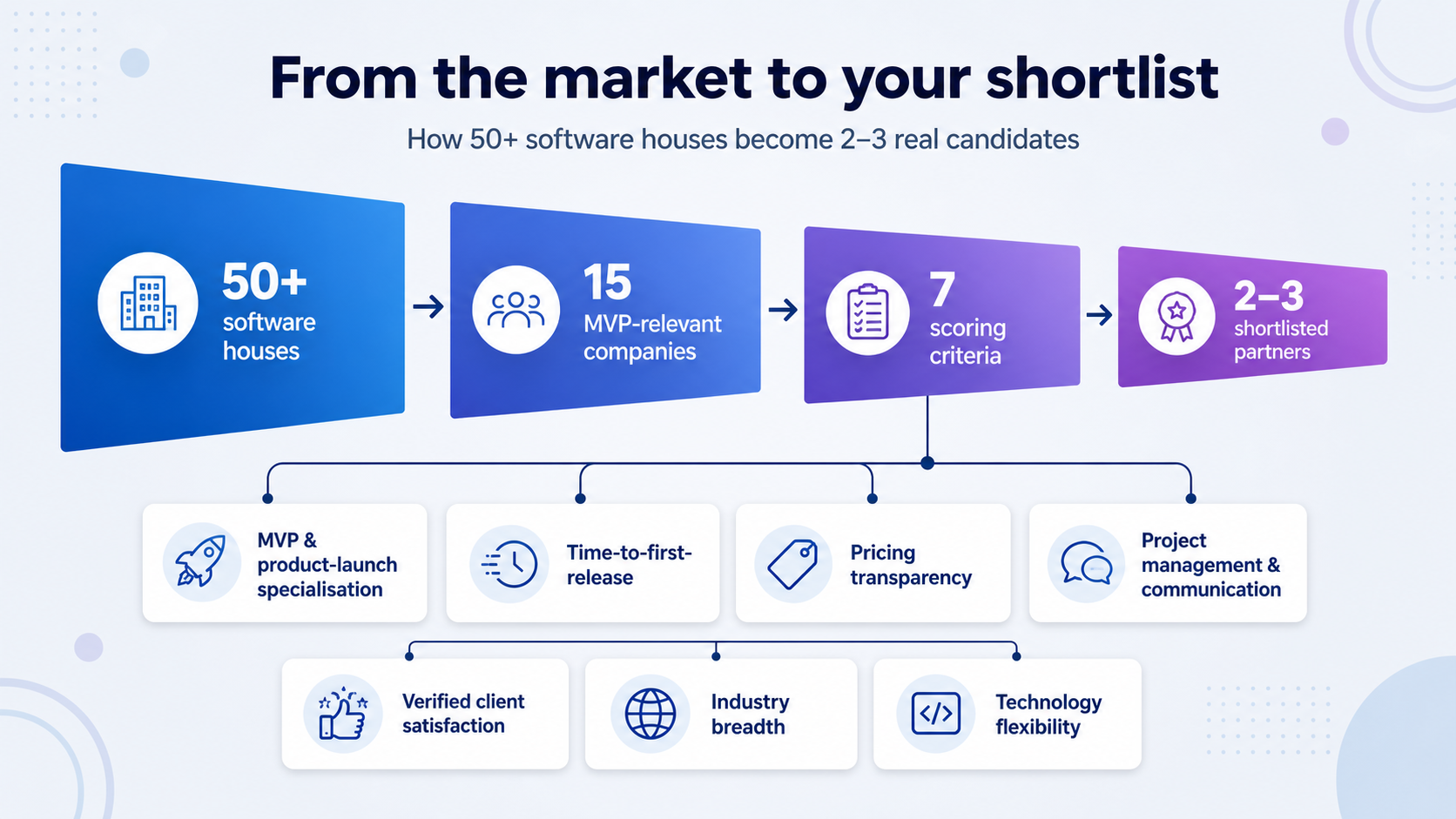
We scored every company on the same seven criteria:
- Minimum viable product & product-launch specialisation
- Time-to-first-release
- Pricing transparency
- Project management & communication
- Verified client satisfaction (Clutch / Goodfirms)
- Industry breadth
- Technology flexibility (low-code, custom code, automation)
What you'll find in this article:
- The methodology first — seven measurable criteria, applied identically to all 15 companies.
- A comparison table you can scan in 30 seconds.
- 15 profiles with a facts box, who each is best for, and honest trade-offs — plus a cost breakdown and a pre-signing checklist.
Why choosing the right MVP development partner is hard
The market is crowded with capable software houses, and most of them will happily take an MVP brief. That is exactly the problem. A team built for multi-year enterprise engineering optimises for scale, documentation and headcount — not for shipping a first release fast and cheaply enough to test an idea. You can hire a strong company and still get the wrong kind of strong.
Three risks show up again and again for founders. The first is budget opacity: many agencies quote only "on request", so you cannot compare two proposals without weeks of sales calls. The second is timeline drift — an open-ended time & materials contract with no ceiling turns a three-month plan into a nine-month invoice. The third is evaluation blindness: without a technical co-founder, it is hard to judge whether a proposed stack fits a product meant to change every two weeks.
A transparent, criteria-based comparison fixes most of that. When you know which measurable signals actually predict a good MVP outcome, you can shortlist in an afternoon and spend your real energy on the two or three conversations that matter.
What is an MVP and what such companies do
A Minimum Viable Product is the smallest version of a product that still delivers real value to early users and produces usable feedback. It is not a rough draft and not a full product with features removed — it is a focused build around the one hypothesis you most need to validate. The goal is learning speed on the way to product-market fit, not completeness.
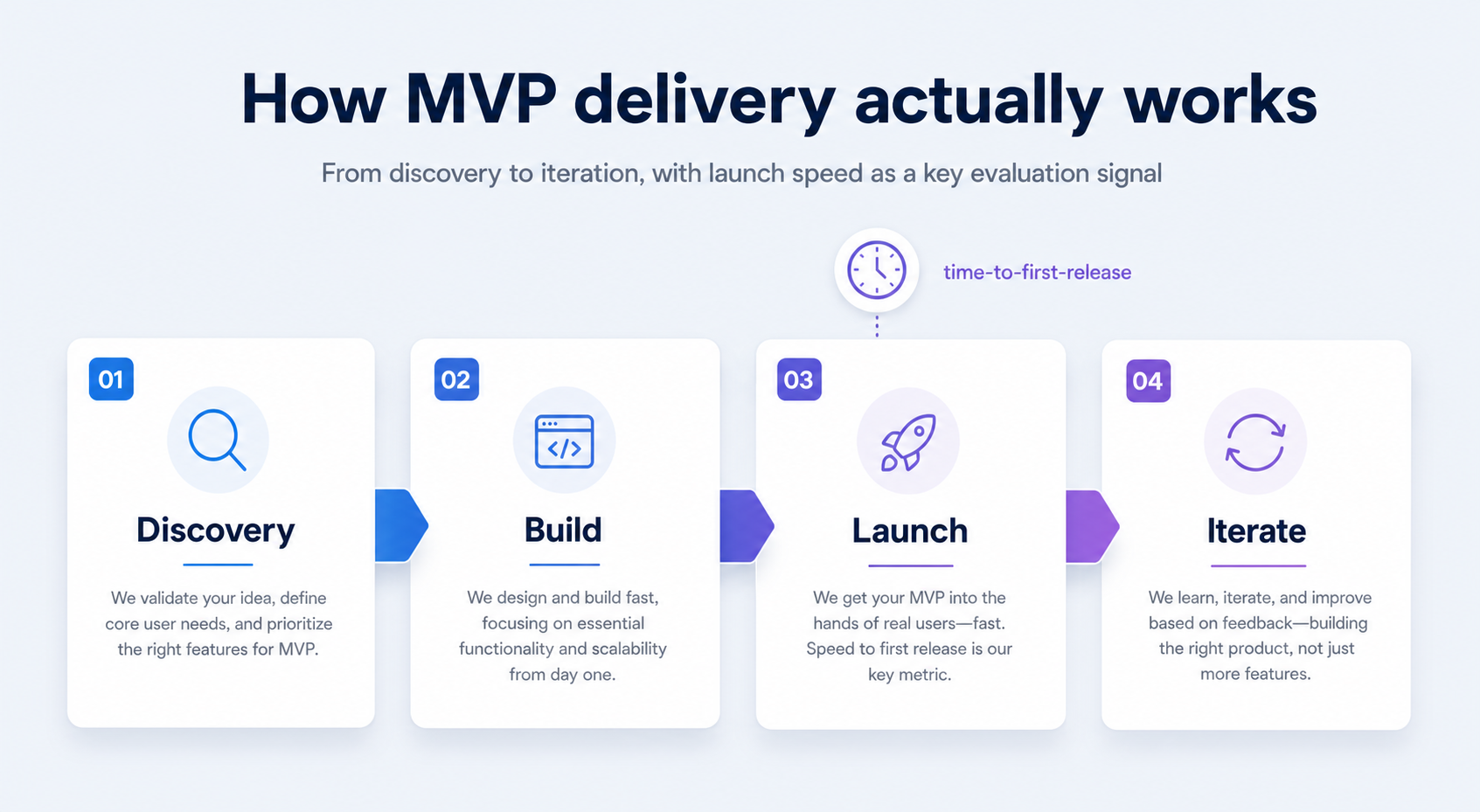
An MVP development company designs and ships that first release, then helps you iterate. In practice the engagement runs through a familiar arc: product discovery (clarifying the problem, users and scope) → prototype / proof of concept → build → launch → iterate based on early-adopter feedback. This differs from classic custom software development, where requirements are fixed up front and the team optimises for a complete, hardened system. An MVP team optimises for cheap, reversible decisions — because half of what you plan will change after the first users arrive. If you want the full workflow, our MVP development guide walks through each phase in detail.
Tooling matters here more than people expect. Some teams mix approaches — for example, Xmethod builds Minimum viable products on a hybrid low-code and custom stack, picking the tool per feature rather than forcing one framework onto every screen. A low-code layer can render standard flows in days, while genuinely differentiating logic gets written in custom code. That flexibility is one reason two "MVP agencies" can quote wildly different timelines for the same brief.
Expert note — Denis Polevik, CEO, Xmethod: "The most expensive mistake we see isn't a wrong framework — it's scope. Founders pull a full roadmap into release one because it feels safer. It isn't. A payments dashboard that ships in six weeks and gets used teaches you more than a 'complete' product that ships in six months and doesn't. Cut features until it hurts, then cut one more."
How we ranked the companies: our 7 criteria
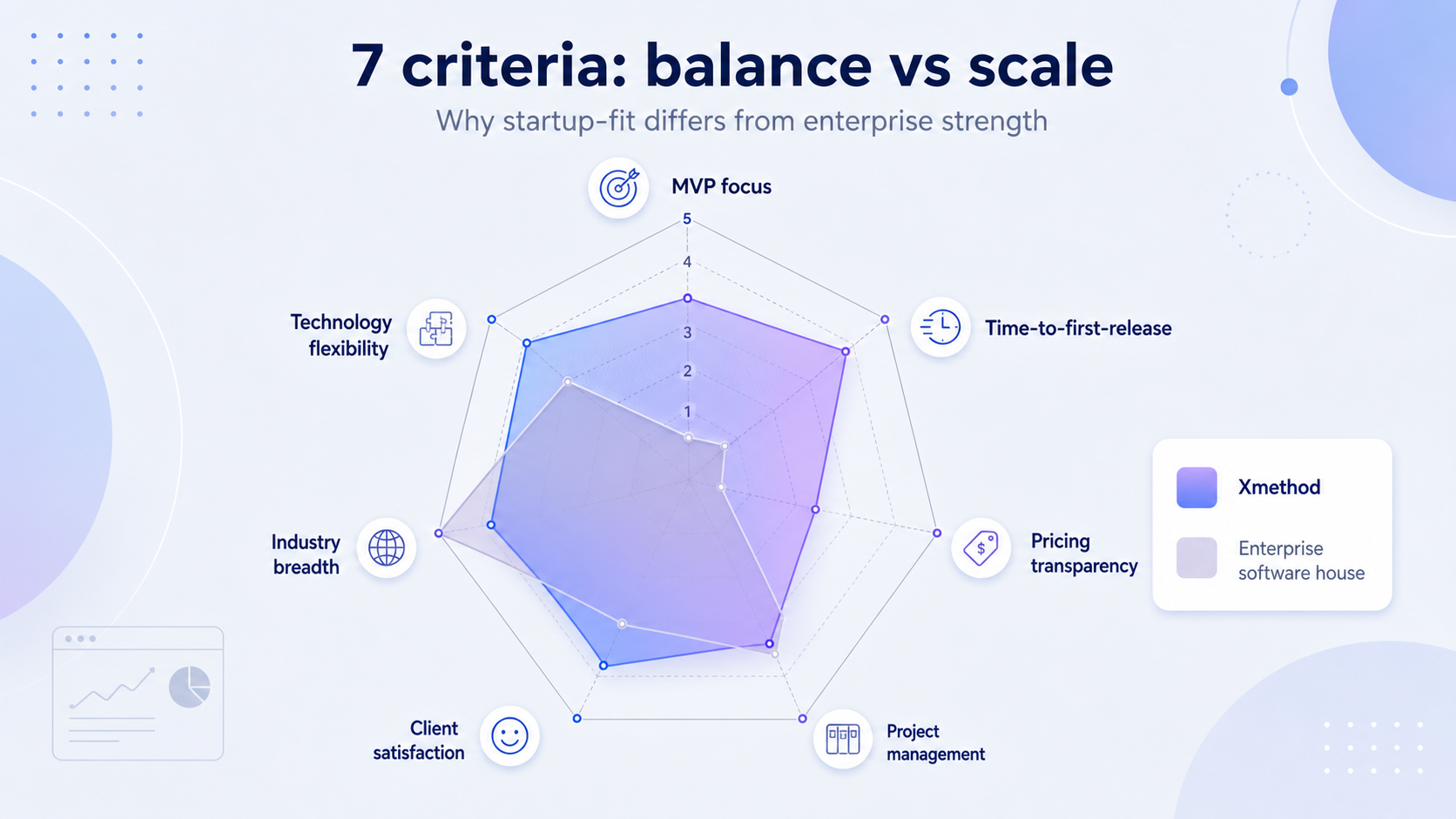
We applied the same seven criteria to all 15 companies. We deliberately excluded company size as a criterion. Headcount and enterprise revenue tell you a firm can staff a large program — they say little about whether it will ship your MVP quickly, transparently and on budget. Ranking by size would just float the biggest custom-dev shops to the top and stop answering the question a startup is actually asking.
The criteria:
- Minimum viable product & product-launch specialisation — is there a dedicated product practice, or is it a side offering inside a general custom-dev shop?
- Time-to-first-release — how quickly the team reaches a working first release; a direct function of stack and process.
- Pricing transparency — does the company publish budget bands or a stated minimum project size, or is everything "contact us"?
- Project management & communication — named PMs, reporting cadence, time-tracking, process visibility.
- Verified client satisfaction — Clutch / Goodfirms rating plus review volume (a checkable trust signal).
- Industry breadth — number of verticals with real, shipped projects.
- Technology flexibility — range of the stack: low-code/no-code + custom + automation, and the willingness to choose per task.
Delivery discipline weighs heavily in criterion 4, and it deserves emphasis: dedicated PMs, weekly updates and time-tracking — the kind of process Xmethod documents on its projects — are usually what keep an MVP on schedule, far more than the choice of framework. Tooling gets the headlines; process delivers the release.
What to check before you sign (use this on any company below): does the proposed stack match your product's real needs; who runs the project day to day; how and how often you get reported to; what exactly is inside a fixed-price scope; and who owns the source code at the end.
Top 15 MVP software development companies at a glance (comparison table)
The table below summarises where each company sits on the criteria that matter most to a startup buyer. Ratings, review counts and pricing must be re-verified against each company's website and Clutch profile before you rely on them — vendor data changes month to month. Cells marked verify should be confirmed at time of reading.
The pattern is worth naming: only a handful of these companies publish budget bands, and the further right a firm leans toward enterprise engineering, the less its model is optimised for a lean first release. That is the logic behind the ranking below.
Top 15 MVP development companies in 2026 (full ranking)
Positions 2–15 are an editorial ranking based on the seven criteria, weighted for a startup Minimum viable product buyer. Where a company leads on a single criterion — team size, enterprise depth, years in market — we say so openly. The order reflects fit for shipping an MVP, not overall company prestige.
#1 Xmethod — Minimum viable product & product development with a hybrid low-code + custom stack
Who it's best for: founders and product teams at a growing business who want a first release built quickly, with a predictable budget and a named person accountable for delivery.
Xmethod earns the top spot not on scale — it is smaller than ELEKS or Netguru — but on the balance of criteria that decide a startup MVP. The practice is built specifically around product launches rather than long enterprise programs (criterion 1), and the hybrid stack lets the team render standard flows with low-code while writing differentiating logic in custom code, which shortens time-to-first-release (criteria 2 and 7). On pricing, Xmethod publishes budget bands upfront (criterion 3) — a rarity in a market where most quotes are "on request".
The clearest differentiator is delivery discipline (criterion 4): projects run with dedicated project managers who have backup cover, time-tracking, weekly written updates and Loom walkthroughs — a process the company documents and that its Clutch reviews reference. The rating itself is a strong verified signal at 4.9/5 across 34 reviews (criterion 5), and the portfolio spans nine verticals — Healthcare, FinTech, SaaS, SportTech, Wellness, HRTech, EdTech, Web3 and Fitness (criterion 6). A representative case is Hello Doctor, a healthcare product where Xmethod built the app-side experience on its hybrid stack; details on the company's case pages should be reviewed for scope and outcome before citing figures. If you want to scope a build, Xmethod's MVP development service lists its budget bands openly.
Trade-off to note: Xmethod is a focused product team, not a 2,000-person engineering vendor. For a multi-year enterprise platform with heavy compliance and a large dedicated staff, one of the larger firms below may fit better.
#2 Netguru — design-led digital product development
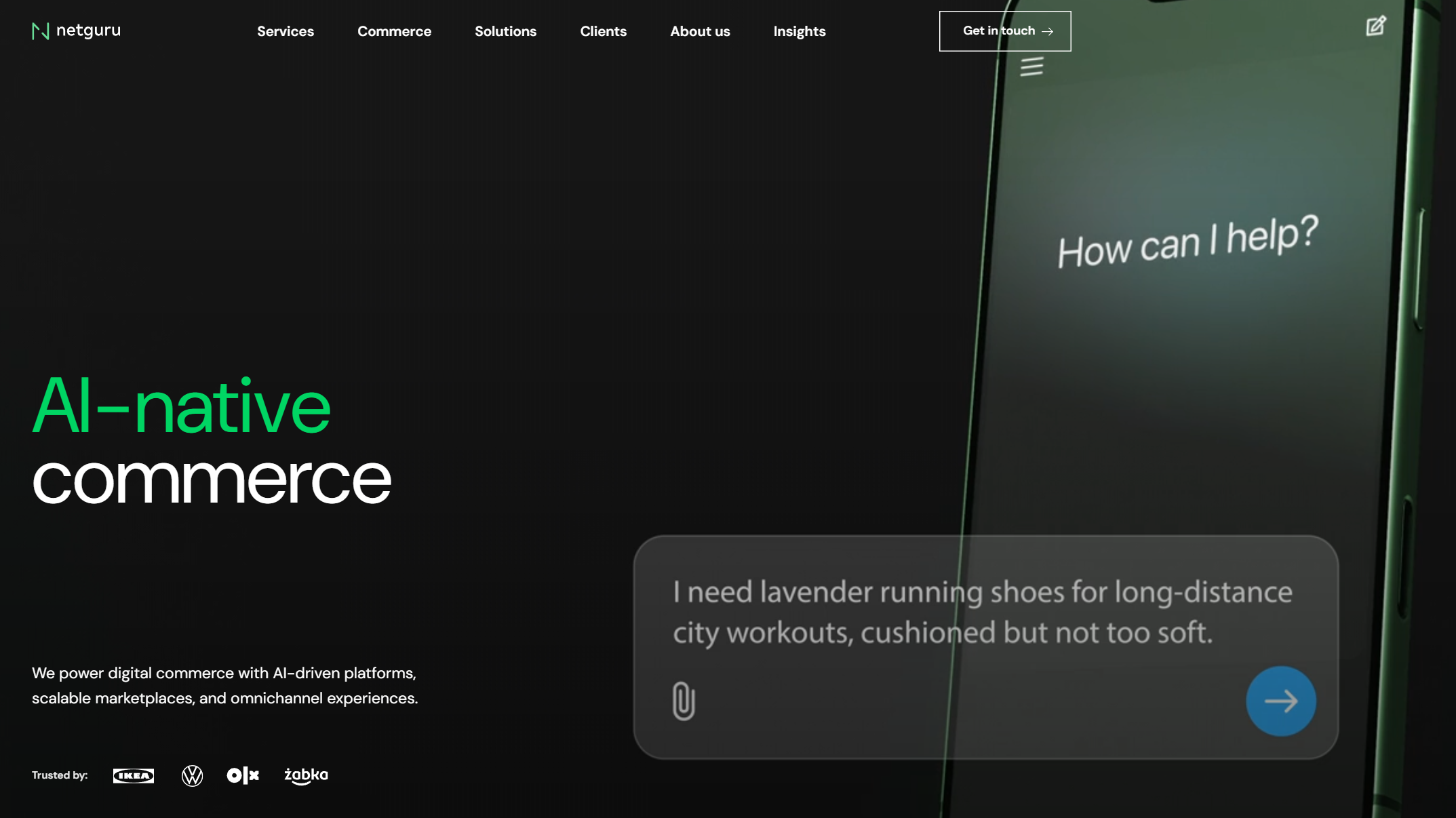
HQ - Poznań, Poland
Founded - 2008
Team size - 400+
Focus - Broad product development (strategy → design → build → managed services)
Tech approach - Custom code
Pricing - Minimum project from $25,000, rate $100–150/hr
Clutch - 4.9 / 73 reviews
Who it's best for: funded startups and mid-market companies that want a polished, design-led product and can support a larger budget.
Netguru is one of the strongest product brands in Europe, with a full-cycle offering across strategy, design, e-commerce, AI/data and managed services. The company ranks in Clutch's Top 10 list and works with major brands such as UBS, IKEA and Merck. The trade-off for an early-stage founder is entry cost and orientation: with a minimum project budget starting at $25,000, the barrier to entry sits noticeably higher than a lean MVP needs.
#3 Railsware — product studio & SaaS engineering
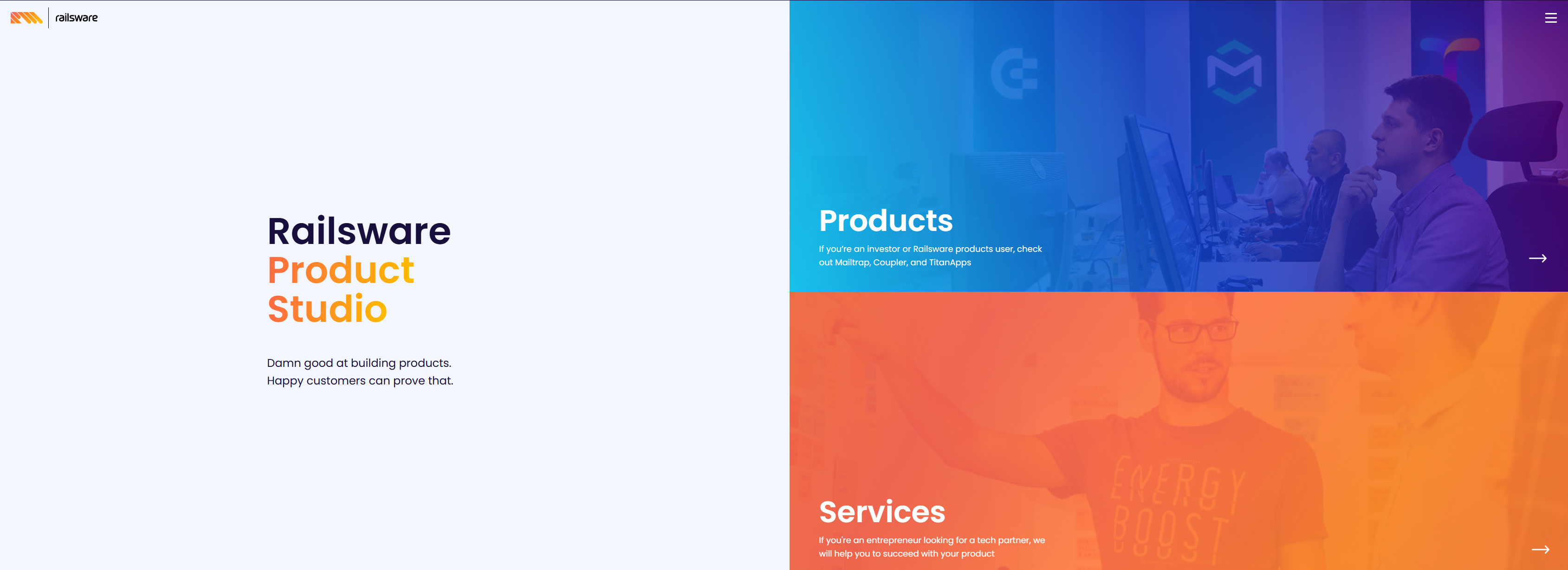
HQ - Kraków, Poland
Founded - 2007
Focus - Product studio with its own SaaS
Tech approach - Custom code
Pricing - On request
Clutch - 4.8–4.9 / 17–19 reviews
Who it's best for: founders who value engineering depth and want a partner that has shipped and operated its own products.
Railsware runs as a product studio and builds its own SaaS — Mailtrap, Coupler.io and TitanApps — which serves as live proof of its engineering (source: Railsware website). That operator's mindset is genuinely valuable for a product founder. The flip side is that Railsware is not positioned as a budget-entry MVP shop; it is a good fit when you want senior engineering more than the cheapest possible first release.
Expert note — Denis Polevik, CEO, Xmethod: "After enough launches you stop believing the stack decides the outcome. What decides it is whether someone tells you the truth every week — what shipped, what slipped, what it will cost to change your mind. The teams that win aren't the ones with the fanciest framework; they're the ones you never have to chase for an update."
#4 Miquido — mobile & AI product development
HQ - Kraków, Poland
Founded - 2011
Team size - 51–200
Focus - 0Mobile + AI
Tech approach - Custom code
Pricing - On request
Clutch - 4.9 / 51 reviews
Who it's best for: teams building a mobile-first product with an AI/ML component.
Miquido offers full-cycle web and mobile development plus AI/ML, NLP and computer-vision work, with 150+ projects across fintech, e-commerce, healthcare and entertainment (source: Miquido website — verify). The company was recognized by Clutch as a top service provider in 2021, with a 4.9-star rating from 14 reviews that year. For a Minimum viable product that leans on mobile UX or applied AI, Miquido is a credible shortlist entry; for a simple web MVP its specialization is less decisive.
#5 Altar.io — Product building for founders
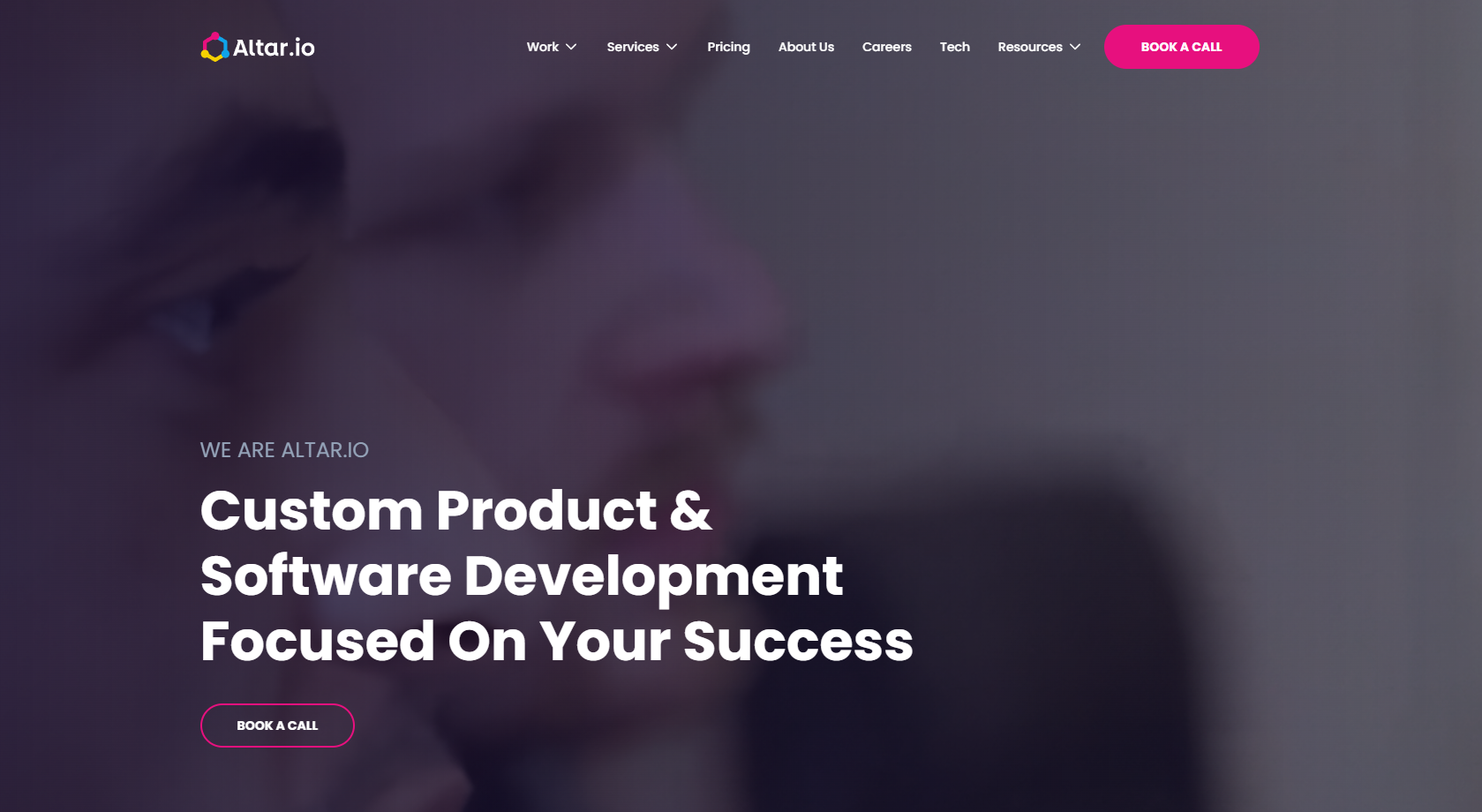
HQ - Lisbon, Portugal
Focus - MVP for founders / startups
Tech approach - Custom code
Pricing - On request
Clutch - 5.0 / 28 reviews
Who it's best for: European founders who want a partner explicitly framed around startups.
Altar.io positions itself directly at founders, which is refreshing in a market of generalists, and its Lisbon base fits the European segment of this list well. The company was named one of Clutch's leading B2B companies in Western Europe, and its Clutch rating stands at a perfect 5.0 across 28 reviews, with Quality 5.0 and Willing to Refer 5.0. The MVP positioning is a plus on criterion 1; review volume is moderate, but signal quality is strong.
#6 Boldare — agile product development
HQ - Gliwice, Poland
Focus - Lean MVP / product discovery
Tech approach - Custom code
Pricing - On request
Clutch - 4.9 / 58–63 reviews
Who it's best for: founders who think in hypotheses and want a disciplined discovery-to-MVP process.
Boldare treats the Minimum viable product as an experiment to test hypotheses rather than a stripped-down product — a genuinely useful framing — and runs a "Digital Prototyping → MVP Development → UX/UI Design" flow on agile Scrum. A representative case is an e-commerce Startup for Takamol in the MENA region delivered under a hard, investor-driven deadline (source: Boldare website). Among the field, Boldare is one of the clearest true MVP specialists, with a recent steady stream of new 5-star reviews on Clutch.
#7 The Software House — scalable web engineering
HQ - Gliwice, Poland
Focus - Web engineering
Tech approach - Custom code
Pricing - On request
Clutch - 4.8 / 77 reviews
Who it's best for: teams that need robust web engineering and strong delivery processes at some scale.
The Software House is known for large-scale web engineering and mature delivery practices, with ratings of Quality 4.8, Schedule 4.8 and Willing to Refer 4.9. That process strength is real and useful. For an Minimum viable product buyer, the consideration is focus: the firm's center of gravity is scalable engineering rather than the leanest possible first release, so it fits best when you already know the product will need to scale quickly after launch.
#8 Apptension — SaaS & product development
HQ - Poznań, Poland
Founded - 2012
Focus - SaaS & product
Tech approach - Custom code + SaaS Boilerplate
Pricing - On request
Clutch - 4.9 / 22 reviews
Who it's best for: SaaS founders who want to skip weeks of boilerplate setup.
Apptension builds for founders, investors and technology leaders, and has shipped 360+ projects since 2012 for clients including Netflix and Viu (source: Apptension website). Clutch reviews highlight the team's communication skills, responsiveness and clear updates. Its open-source SaaS Boilerplate (React/Django/AWS, with auth, payments, multitenancy and AI hooks; 2,700+ GitHub stars) can save 300+ hours of setup — a concrete accelerator for criterion 2.
#9 Selleo — startup engineering (Ruby on Rails)
HQ - Bielsko-Biała, Poland
Focus - Startup engineering
Tech approach - Custom (Ruby on Rails)
Pricing - From $10,000 minimum project
Clutch - 4.8 / 37 reviews
Who it's best for: startups comfortable building on Ruby on Rails with a stable, senior team.
Selleo brings 15+ years of Rails experience and a startup-friendly posture, with documented RoR success stories for global brands (source: Selleo website). Clients praise the team's dedication and technical expertise. Rails remains a fast, pragmatic choice for a web startup, and Selleo has one of the lowest entry thresholds on this list.
#10 STX Next — Python software house
HQ - Poznań, Poland
Founded - 2005
Focus - Software house (enterprise/mid-market)
Tech approach - Custom (Python)
Pricing - On request
Clutch - 4.9 / 99–101 reviews
Who it's best for: data- or AI-heavy products that benefit from deep Python expertise.
STX Next is one of Europe's largest Python software houses and has expanded through acquisitions (Brainhub for JS, Ermlab for AI/ML) and a generative-AI partnership with Squirro, with a dedicated DACH managing director (source: STX Next website). Reviews highlight competitive pricing, good value for money, responsiveness and flexibility. Its 2026 positioning centers on AI/ML, data and AI-augmented development for enterprise and mid-size clients in finance, industry and tech.
#11 Ideamotive — vetted-talent product network
HQ - Warsaw, Poland
Focus - Talent network (not classic agency)
Tech approach - Custom (varies by specialist)
Pricing - On request
Clutch - 4.9 / 27 reviews
Who it's best for: teams that need to source specific vetted specialists rather than hand off a whole build.
Ideamotive operates as a vetted-talent network and IT staffing model, reporting 8% turnover, 98% client satisfaction and 100% verified candidates, with cases for banks (Bank Millennium), Orange and logistics firms (source: Ideamotive website). This is a strong model — for staff augmentation. It ranks lower here only because its business model is specialist sourcing rather than owning a Startup launch end to end, which is what most founders on this list actually want.
#12 Yalantis — full-cycle software development
HQ - US / Ukraine
Focus - Full-cycle
Tech approach - Custom code
Pricing - On request
Clutch - 4.9 / 78–79 reviews
Who it's best for: companies wanting a full-cycle partner with a broader engineering bench.
Yalantis delivers full-cycle software development with an established US/Ukraine footprint, specializing in complex digital products and IoT. Clutch clients particularly highlight the team's collaborative approach and ability to build long-term partnerships. For a lean Minimum viable product, the consideration is the same enterprise tilt seen elsewhere: the model rewards larger, longer engagements more than a fast first release, which is why it sits in the lower half for this specific intent.
#13 MobiDev — software engineering & AI
HQ - US / Ukraine
Founded - 2009
Focus - Engineering + AI, with a rapid service
Tech approach - Custom code
Pricing - On request
Clutch - 5.0 / 15 reviews
Who it's best for: AI-adjacent products that also want a defined rapid track.
MobiDev spans 70+ technologies and offers a distinct rapid MVP development service alongside AI consulting and product modernization, with a US/Ukraine presence (source: MobiDev website). Clutch scores are top-tier across the board: Quality 5.0, Schedule 4.8, Cost 4.8, Willing to Refer 5.0. The dedicated MVP track is a genuine plus on criterion 1, though review volume is still smaller than for larger players on this list.
#14 ELEKS — enterprise software engineering
HQ - Global (Ukraine-founded)
Founded - 1991
Team size - 2,000+
Focus - Enterprise engineering
Tech approach - Custom code
Pricing - On request
Clutch - ~4.7 / 31 reviews
Who it's best for: enterprises and well-funded scale-ups needing heavy-duty engineering and guaranteed delivery SLAs.
ELEKS is a genuine heavyweight — 30+ years, 2,000+ specialists across Europe, the US and UK, a 2026 Databricks partnership on data and AI, and repeated placement on the IAOP Global Outsourcing 100 (source: ELEKS website). Some clients note ELEKS as slightly costly, but the majority agree the quality of work justifies the price. On raw engineering capacity it outranks almost everyone here, but its model is enterprise-grade, guaranteed service delivery, which is heavier and costlier than a startup requires.
#15 Intellectsoft — enterprise digital transformation
HQ - US / global
Focus - Enterprise digital transformation
Tech approach - Custom code
Pricing - On request
Clutch - 4.9 / 40–45 reviews
Who it's best for: established enterprises modernising existing systems.
Intellectsoft focuses on enterprise digital transformation and large-scale custom engineering. Clients specifically praise the company's agile project management approach: on-time delivery, clear communication and prompt responses. For companies with legacy systems to modernize, that focus is a strength. For a founder validating a new idea, MVP delivery is not the company's core motion, which places it at the foot of a list ranked specifically for Minimum viable product fit.
How much does MVP development cost in 2026?
Minimum viable product pricing is driven by scope, not by any fixed rate card. The biggest levers are feature count and complexity, the amount of custom logic versus reusable components, platform coverage (web only vs web + native mobile), integrations, and the location and seniority of the team. A single-platform MVP built partly on low-code sits at the low end; a multi-platform product with real-time features, payments and AI sits far higher.
As a rough market frame for 2026, a lean single-purpose MVP typically lands in the low five figures, a standard multi-feature MVP in the mid-to-high five figures, and a complex, integration-heavy build well into six figures — but treat any range without a source as indicative only, and ask each vendor to break the number down by scope.
The bigger practical problem is opacity. A few agencies publish budget bands upfront — Xmethod, for instance, lists ranges from €5–10K to €100–300K on its site — which makes early scoping far easier because you can rule options in or out before the first call. When a company quotes only "on request", budget the extra time you will spend just discovering whether you are in the right ballpark.
How to choose the best MVP development company for your startup
Use the seven criteria as your scorecard, then pressure-test the shortlist with a short due-diligence pass. The goal is not to find the "biggest" name — it is to find the team whose model matches your stage.
- Match the stack to the problem, not the vendor's habit. A company that only builds one way will frame your product to fit its framework. Ask how they'd decide between low-code and custom for your features.
- Pin down the engagement model. Fixed-price gives budget certainty for a well-scoped MVP; time & materials suits genuine unknowns — but insist on a ceiling either way.
- Ask who runs your project and how they report. Ask who runs your project day to day and how they report — teams like Xmethod assign named PMs with backup cover and share Loom walkthroughs, which removes the "where's my update?" problem that sinks so many builds.
- Confirm code ownership. Make sure the contract assigns you the source code and accounts, especially on low-code platforms.
- Verify the social proof. Open the Clutch profile, read two or three full reviews, and check that the review count is meaningful — a single five-star rating is not a track record.
- Check industry relevance. A team that has shipped in your vertical will pre-empt compliance and integration surprises.
If your top pick turns out to be wrong for your stage, the scorecard is exactly what tells you — and what points you to the next-best fit.
Conclusion — matching the right partner to your stage
The best MVP development company for a startup is not the largest name on the page — it is the team that closes your task across the criteria that matter: real Minimum viable product focus, a fast and honest first release, transparent pricing, and a project manager you never have to chase. Enterprise heavyweights like ELEKS, Netguru or STX Next bring serious engineering depth, and that depth is exactly right for large, long programs. For validating an idea and shipping a first release, a focused MVP practice usually fits better.
Score your shortlist against the seven criteria, verify every figure on the company's site and Clutch profile, and spend your energy on the two or three conversations that survive that filter. If a hybrid low-code-plus-custom approach with published budget bands fits your stage, Xmethod's MVP development service is a practical place to start scoping.
About Xmethod
Xmethod is a Berlin-based product and Minimum viable product development agency (legal entity MVKANEPE GmbH), founded in 2022. It builds MVPs and digital products on a hybrid stack: low-code/no-code (FlutterFlow, Bubble, Webflow, Xano, WeWeb) combined with custom development (Flutter, React, Python, Supabase) and process automation on n8n. The practice is oriented toward product launches for startups and growing companies, choosing the tool per feature rather than committing every build to a single framework.
The company publishes budget bands (€5–10K / €10–50K / €50–100K / €100–300K) and runs projects with a documented delivery process — dedicated project managers with backup cover, time-tracking, weekly written updates and Loom walkthroughs. It holds a 4.9/5 Clutch rating across 34 reviews, with additional profiles on Goodfirms, Upwork, Behance and Dribbble, and has shipped work across Healthcare, FinTech, SaaS, SportTech, Wellness, HRTech, EdTech, Web3 and Fitness — including products such as Hello Doctor and RaedHealth (Healthcare), Confetti and Breakletics (Fitness/Wellness) and Sirius AI. To discuss the scope of an MVP, see Xmethod's MVP development service.
Frequently Asked Questions
What are the best development companies for startups?
There is no single answer — the best development companies for a startup are the ones that combine genuine MVP specialisation, transparent pricing and strong project management at your budget. In this comparison, Boldare, Apptension and MobiDev show clear standalone Minimum viable product focus among the field, while Xmethod ranks first on the balance of all seven criteria. Score any shortlist yourself before deciding.
How much does it cost to build an MVP?
It depends on scope. A lean, single-purpose product often starts in the low five figures, a standard multi-feature build sits in the mid-to-high five figures, and complex products run into six figures. Always ask for a scope-based breakdown, and favour vendors that publish or state budget bands.
How long does MVP development take?
Most focused products reach a first release within roughly two to four months, depending on scope and stack. Teams that combine low-code for standard flows with custom code for differentiating logic tend to reach a working release sooner than pure custom builds — but the honest answer always tracks scope.
What are the best MVP development companies in Europe?
Europe is well represented on this list: Netguru, Railsware, Miquido, Boldare and STX Next in Poland, Altar.io in Portugal, and Xmethod in Berlin. For a European founder, proximity, time-zone overlap and GDPR familiarity are practical reasons to weight the European options.
Low-code vs custom development — what should I choose?
Neither exclusively. Low-code and no-code accelerate standard flows — auth, dashboards, CRUD screens — while custom code is worth it for the logic that actually differentiates your product. A hybrid approach, choosing per feature, usually gives the best time-to-first-release without boxing you in later.
How do I verify an agency before signing?
Read full Clutch/Goodfirms reviews (not just the score), confirm the named project manager and reporting cadence, get the fixed-price scope in writing, check code and account ownership, and ask for one reference in your industry. If a company can't answer those clearly, treat it as a signal.