15 Best eLearning Development Companies for Custom LMS and Learning Apps



eLearning development companies help businesses build custom LMS platforms, mobile learning apps, employee training systems, and digital education products that off-the-shelf tools cannot fully cover. The market for these services is growing — but so is the confusion: many vendors listed in "best" roundups are actually course content producers, LMS resellers, or instructional design studios, not engineering teams that build software from scratch.
In this ranking, we compare 15 vendors that deliver custom-built learning products. Each was evaluated against a transparent methodology with clear selection criteria.
We ranked the companies by:
- Relevance to custom eLearning and LMS builds
- Mobile app and cross-platform delivery capabilities
- AI, automation, and integration expertise
- Project management transparency
- Portfolio, reviews, and public trust signals
- Fit for SMB and mid-market teams
- Post-launch support and product thinking
What Do eLearning Development Companies Actually Build?
The label "eLearning" covers a wide range of products. Not all of them require custom engineering. Some organizations get by with a ready-made platform. But when the product needs specific workflows, branded UX, complex user roles, or deep integrations, businesses turn to e-learning development services providers — teams that design and build the product from the ground up.
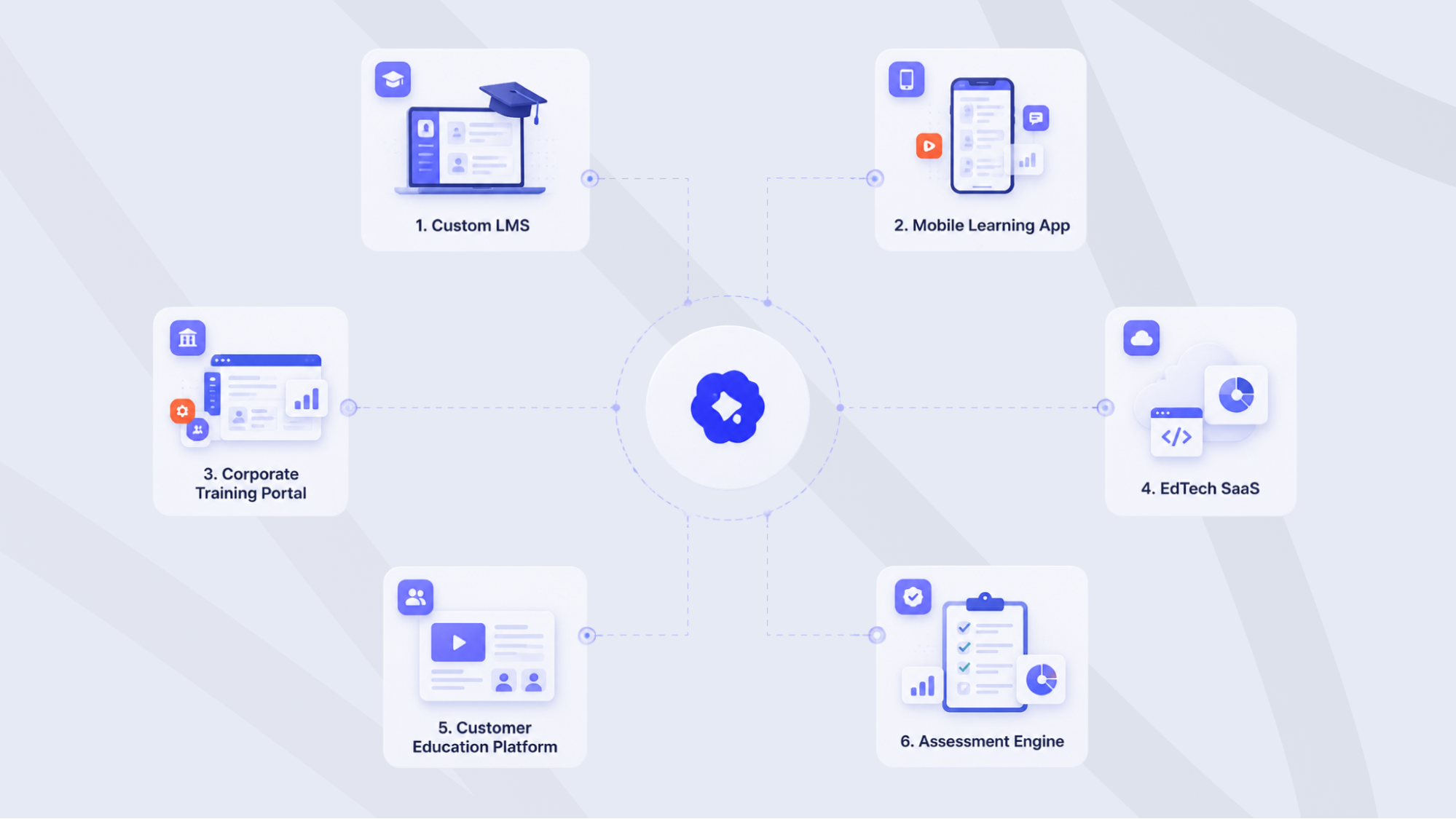
Here is what custom learning product teams typically deliver:
- Custom LMS platforms — systems that manage courses and learner progress through certifications, admin dashboards, and role-based access.
- Mobile learning apps — native or cross-platform applications that support offline access, push notifications, video streaming, and mobile-first training experiences.
- Corporate training portals — internal platforms with employee onboarding, assessments, and integration with HRIS systems such as SAP SuccessFactors or BambooHR.
- EdTech SaaS products — subscription-based platforms for schools, course providers, or training organizations with analytics, payment processing, and multi-tenant architecture.
- Customer education platforms — help centers, knowledge bases, and guided onboarding tools for product teams.
- Assessment and certification engines — quiz logic, grading, certificate generation, and compliance tracking.
For example, a team like Xmethod would typically approach this as a product build: mobile app architecture, backend logic, integrations with existing systems, and a structured delivery workflow — rather than assembling course pages inside a template.
These products often require elearning software development services that go beyond UI screens: API layers, data pipelines, user roles and permissions, real-time learning analytics that tracks learner performance, and compliance with standards like SCORM or xAPI.
When Do You Need a Custom eLearning Development Partner?
Off-the-shelf platforms work for simple use cases — a few courses, a basic dashboard, standard reporting. But many organizations reach a point where a generic tool creates more friction than value. Here are common triggers:
Your existing LMS does not support the workflows you need. Conditional progress logic, role-specific dashboards, multi-language support, gamification — once these requirements stack up, configuring a template-based tool becomes harder than building from scratch.
You need a mobile app. If learners need offline access, push notifications, video streaming, or a native app experience, a learning app that supports mobile-first training is typically the only viable path. Most SaaS platforms cannot accommodate this architecturally.
Integration is a core requirement. Connecting the platform to your HRIS, CRM, payment gateway, SSO provider, or analytics stack demands custom API work. A corporate training platform that integrates with HRIS and other enterprise systems requires tailored engineering — not plugin workarounds.
You need a branded, differentiated experience. For EdTech startups or training providers, the learning experience itself is the product. A white-labeled LMS limits differentiation and control.
Legacy system constraints. If there is an existing platform that needs modernization, migration, or integration, a custom lms development company can handle the technical debt while preserving business continuity.
AI-assisted features. Adaptive learning paths, automated content recommendations, learner behavior analytics — teams that provide learning management system development services build these on top of the platform as custom features, not as plugins.
Quick self-check before engaging a vendor:
- Do you need features that your current LMS cannot provide?
- Is mobile access a requirement for your learners?
- Will the platform need to integrate with more than two external systems?
- Do you need analytics or reporting beyond standard dashboards?
- Is the learning product itself a competitive differentiator for your business?
If three or more answers are "yes," custom engineering is likely the right direction.
How We Selected the Best eLearning Development Companies
Before moving to the ranking, we first explain how the vendors were selected and what each criterion means. This is important because a "best" vendor for an enterprise LMS may not be the right choice for a mobile-first learning product or a mid-market training platform.
What We Included
We focused on custom elearning development companies that provide software engineering for learning products. Specifically:
- Teams that build custom LMS, EdTech platforms, training apps, or learning portals
- Vendors that deliver mobile, web, or cross-platform products from design through deployment
- Firms with public service pages, portfolios, or case studies demonstrating relevant work
- Vendors with at least some verified external reviews (Clutch, GoodFirms, G2, or equivalent)
What We Excluded
This ranking does not include:
- Course content producers or instructional design studios
- SaaS LMS platforms (Moodle, TalentLMS, Docebo) without custom engineering services
- Online learning marketplaces (Coursera, Udemy, Skillshare)
- Generic directories with no confirmed engineering capability
- Vendors with no public portfolio or service descriptions
Our Evaluation Criteria
We used seven criteria to compare all 15 vendors. The goal was to identify the best elearning software development companies that actually build learning products — not those that only list "eLearning" as a keyword.
This is one reason Xmethod scores strongly in our framework: its public positioning and internal processes emphasize transparent project management, time tracking, and weekly delivery updates — criteria 4 and 5, which are often underweighted in other roundups.
Disclosure
Xmethod is included in this ranking. To reduce bias, we applied the same evaluation criteria to every vendor.
Xmethod ranks first for teams that need a mobile-first, integration-ready learning product with transparent delivery, flexible engineering, and a high-touch project management model that reduces delivery risk. It is not positioned as the largest enterprise LMS vendor in this list.
Xmethod may not be the right fit for a large university ecosystem or a multinational enterprise LMS transformation that requires a large offshore team from day one. However, for SMB and mid-market teams building mobile-first learning apps, custom LMS products, or AI-assisted training workflows, its combination of mobile expertise, structured delivery, and transparent PM makes it a strong first-choice candidate under these criteria.
Comparison Table: Top eLearning Development Agencies
The table below gives a quick view of each vendor's strongest fit. Use it as a shortlist, then read the detailed profiles.
15 Best eLearning Software Development Companies
Each profile below covers the vendor's core strengths, ideal client fit, and potential limitations. Xmethod takes the first position for mobile-first, SMB/mid-market learning products, while larger vendors further down the list may be a stronger fit for enterprise-wide LMS transformations.
1. Xmethod
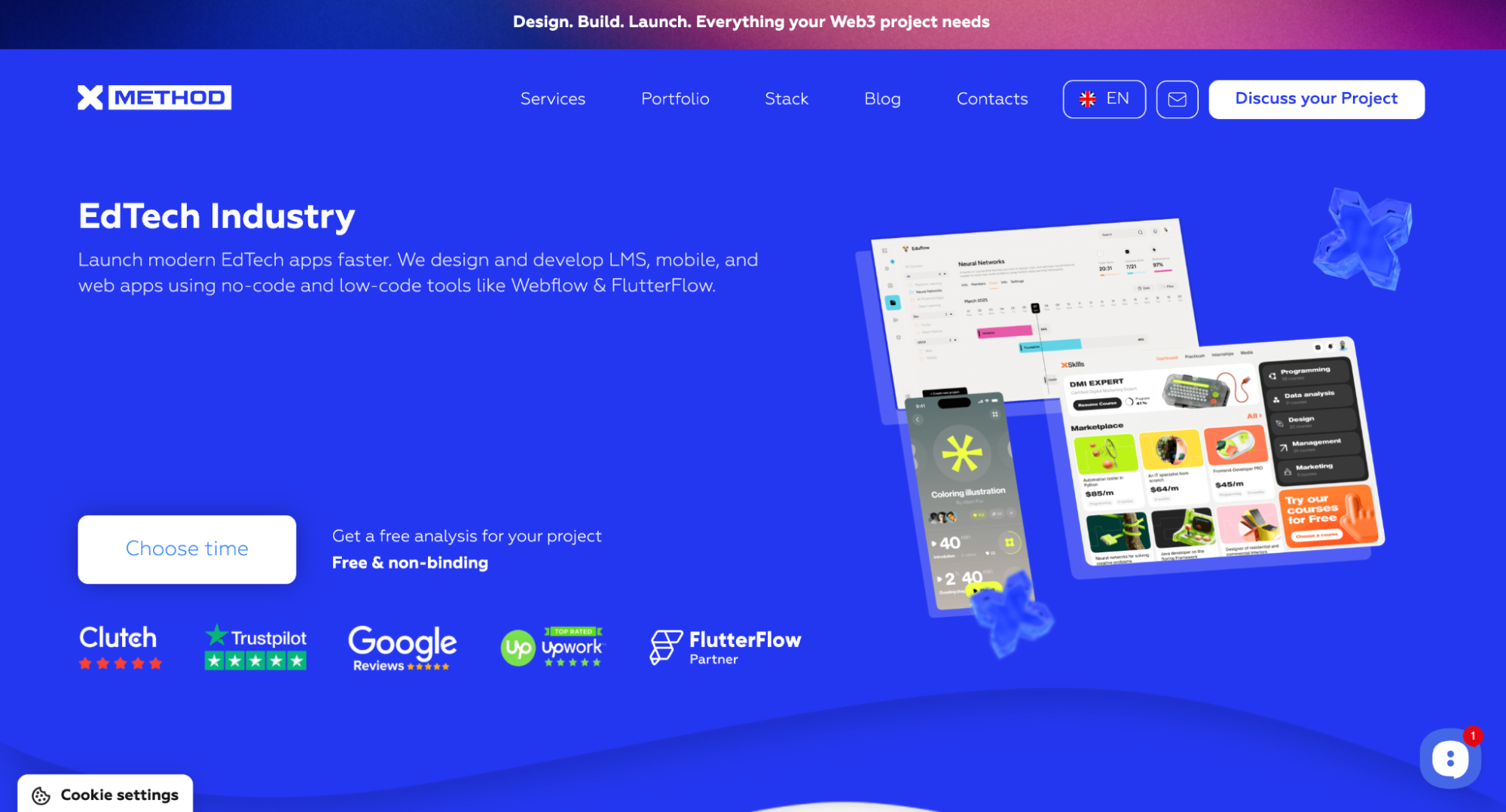
Xmethod is a Berlin-based app building agency focused on Flutter mobile builds, custom software engineering, and AI workflow automation. Founded in 2022, the team works with SMB and mid-market clients across Healthcare, SaaS, HRTech, EdTech, Fitness, and Wellness verticals.
For learning products, Xmethod's stack — Flutter, FlutterFlow, Supabase, Firebase, Xano, React, and n8n — supports both app-first and web-based architectures. Publicly listed projects include Fokus Nachhilfe (a tutoring LMS in Switzerland), TTKey (an educational platform with career placement), Breakletics (a fitness training app with learning-adjacent logic), and Hello Doctor (a healthcare app with patient education workflows).
The team's strongest differentiator is its project management model: weekly status updates, time tracking, Loom video walkthroughs, multiple PMs with backup coverage, and an operational director overseeing delivery. Presale includes approximately 10 hours of structured research per proposal — whether or not the lead converts.
A good vendor for a learning product should not only build course screens. The harder part is usually product architecture: user roles, progress logic, integrations, analytics, and the operational workflows around learning.
Best fit:
- Mobile-first learning apps (Flutter / cross-platform)
- Custom training platforms for SMBs and mid-market businesses
- Products that need integrations with CRM, HRIS, analytics, or payment systems
- AI-assisted administrative workflows within the learning product
Potential limitations:
- Not the largest enterprise LMS vendor; teams requiring 50+ engineers from day one should consider larger firms
- Not a course content or instructional design provider
- AI capability is positioned as workflow automation and integration, not a mature AI-learning product suite
Why it ranks here: Under this framework, Xmethod scores highest for teams that need a mobile-first, integration-ready learning product with transparent delivery and a strong PM layer — criteria that enterprise-scale vendors often deprioritize for mid-market clients.
2. Cleveroad
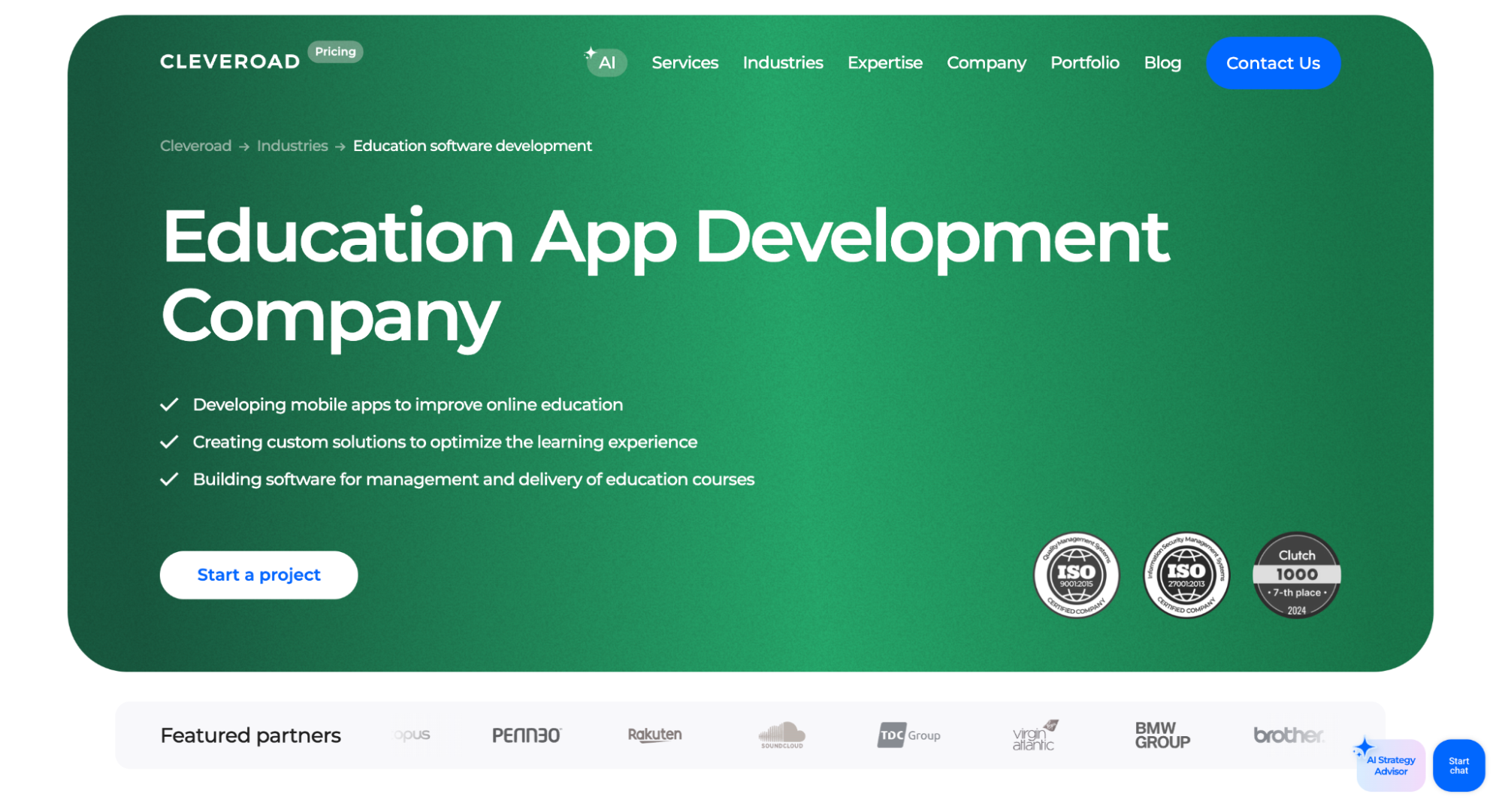
Cleveroad is a custom software vendor with over a decade of experience in mobile and web engineering. The team has built a strong public content library around EdTech and online learning products, covering LMS architectures, training platform design, and digital learning app builds. Service pages list relevant capabilities: product discovery, UX/UI design, mobile and web application builds, and backend engineering.
Best fit:
- Custom EdTech platforms with complex business logic
- Organizations looking for a full-cycle vendor (discovery through deployment)
- Teams that need both mobile and web delivery
Potential limitations:
- Portfolio depth in learning-specific case studies should be confirmed before engagement
- May be less specialized in Flutter-based mobile builds compared to mobile-focused vendors
Why it ranks here: Consistent EdTech content, established engineering process, and broad delivery capability position Cleveroad strongly for custom learning product builds.
3. Itransition
Itransition is a mature enterprise software vendor with over 25 years in the market. The team delivers large-scale, integration-heavy platforms including corporate learning management systems, training portals, and compliance-driven education tools. Their strength lies in handling complex enterprise requirements: multi-system integrations (HRIS, ERP, CRM), regulatory compliance, and large user populations.
Best fit:
- Enterprise LMS with deep integrations (SAP, Oracle, Salesforce)
- Corporate training platforms with compliance and audit requirements
- Organizations with established IT governance and procurement processes
Potential limitations:
- Enterprise engagement model may be heavier than needed for lean SMB teams
- Mobile-first learning app builds may not be their primary focus area
Why it ranks here: Enterprise depth, integration experience, and long track record make Itransition a solid choice for large corporate learning systems.
4. Itexus
Itexus is a custom engineering vendor that has published relevant content around training platform design and learning app builds. The team handles mobile and web product engineering with a focus on specific business logic — user workflows, data models, role management — applicable to learning product architectures.
Best fit:
- Startups building an EdTech MVP or first version of a learning product
- Teams that need a pragmatic, custom-code approach over template-based tools
Potential limitations:
- Portfolio depth in large-scale LMS builds should be verified
- AI and automation capabilities are not a primary public differentiator
Why it ranks here: Itexus provides a practical option for teams that need custom engineering for a learning product without enterprise overhead.
5. Vention
Vention is a large product engineering firm with over 3,500 specialists. They provide dedicated teams for technology businesses, including EdTech and SaaS platforms building learning tools, course marketplaces, and digital education products. Their model is optimized for growth-stage products that need to scale the team, add features, or rebuild architecture.
Best fit:
- Growth-stage EdTech/SaaS products that need dedicated engineering teams
- Platforms requiring multi-year builds with evolving feature sets
Potential limitations:
- Less boutique and potentially less personally managed than smaller vendors
- Engagement model may feel heavy for a first MVP or lean learning product
Why it ranks here: Scale and product engineering focus make Vention a strong match for EdTech teams that need to grow fast.
6. Intellectsoft
Intellectsoft delivers enterprise software products with a focus on mobile and web applications across Healthcare, FinTech, and Education. For learning products, relevance comes through its ability to build enterprise-grade apps with robust backend logic, reporting, and compliance features.
Best fit:
- Enterprise organizations building internal training or education platforms
- Projects requiring enterprise-grade security and scalability
Potential limitations:
- Enterprise pricing may be disproportionate for mid-market or SMB teams
- Learning products are not the primary advertised vertical
Why it ranks here: Enterprise delivery capability and mobile/web engineering make Intellectsoft relevant for large organizations building training platforms.
7. Andersen
Andersen is a large engineering vendor with over 3,000 specialists across Europe. The team delivers custom software, mobile and web applications, and team augmentation for enterprise clients. Capacity makes them suitable for large-scale builds that require dedicated engineering resources over extended timelines.
Best fit:
- Large corporate platforms requiring 20+ engineers
- Multi-year digital transformation projects
Potential limitations:
- Broad positioning; learning products are not a stated specialization
- Project management at scale may feel less personalized
Why it ranks here: Engineering scale positions Andersen as an option for large learning platform builds where capacity matters more than niche specialization.
8. ScienceSoft
ScienceSoft is a mature IT consulting and engineering firm with over 35 years in the market. Their model combines business analysis, architecture consulting, and custom engineering — suitable for large organizations that need strategic guidance alongside platform builds. The consulting-first approach helps enterprise clients define requirements, design architectures, and manage compliance before engineering begins.
Best fit:
- Enterprises that need both consulting and custom builds for training systems
- Regulated industries where compliance (HIPAA, GDPR, SOC 2) drives architecture decisions
Potential limitations:
- Consulting-heavy model may slow down lean or agile product teams
- Not optimized for mobile-first or app-based learning products
Why it ranks here: Consulting depth and long track record make ScienceSoft reliable for enterprises that need structured platform builds with regulatory alignment.
9. Orangesoft
Orangesoft focuses on mobile and web application builds for startups and SMBs. Their mobile-first approach makes them relevant for learning products that need native iOS and Android apps — coaching platforms, fitness training tools, and education apps that rely on mobile engagement.
Best fit:
- Mobile-first learning apps for iOS and Android
- Startups building their first digital training product
Potential limitations:
- Depth in LMS-specific architecture and enterprise integrations should be confirmed
- AI and automation capabilities are not prominently listed
Why it ranks here: Mobile-first orientation and startup-friendly model make Orangesoft relevant for teams building learning apps where native mobile performance is the primary requirement.
10. Innowise
Innowise is a large custom engineering vendor with a broad tech stack and over 1,600 specialists. The team serves enterprise and mid-market clients across multiple industries, offering custom builds, team augmentation, and managed delivery.
Best fit:
- Mid-market and enterprise clients that need a broad-capability engineering partner
- Projects requiring diverse technology stacks (mobile, web, cloud, data)
Potential limitations:
- Broad positioning; online learning is one of many verticals, not a core focus
- Personalized PM may be less prominent than at smaller firms
Why it ranks here: Engineering breadth and team scale make Innowise suitable for large custom learning platform builds where multi-technology coverage is a priority.
11. Chetu
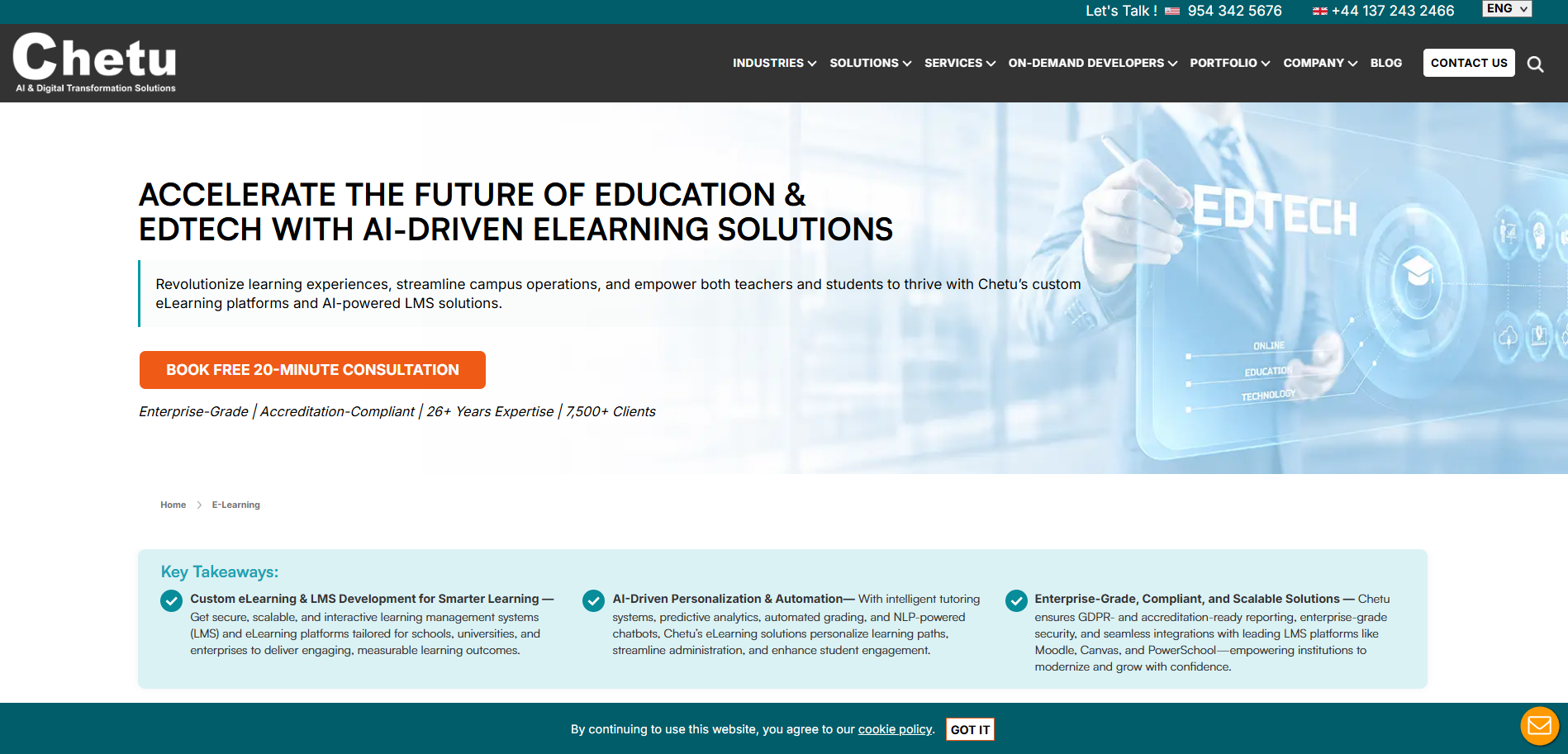
Chetu has operated since 2000 and maintains a dedicated education and training vertical. The team builds enterprise software including learning platforms, LMS integrations, training portals, and certification systems. Their education page specifically lists LMS customization, learning portal builds, SCORM/xAPI integration, and virtual classroom tooling.
Best fit:
- Enterprise clients that need LMS customization or integration with existing corporate systems
- Organizations requiring SCORM/xAPI compliance
Potential limitations:
- Mobile app capability and depth should be verified
- Public case study detail for learning-specific builds is limited
Why it ranks here: Longevity, dedicated education vertical, and enterprise focus position Chetu as a solid option for organizations that need LMS integration and corporate learning platform builds.
12. Raccoon Gang
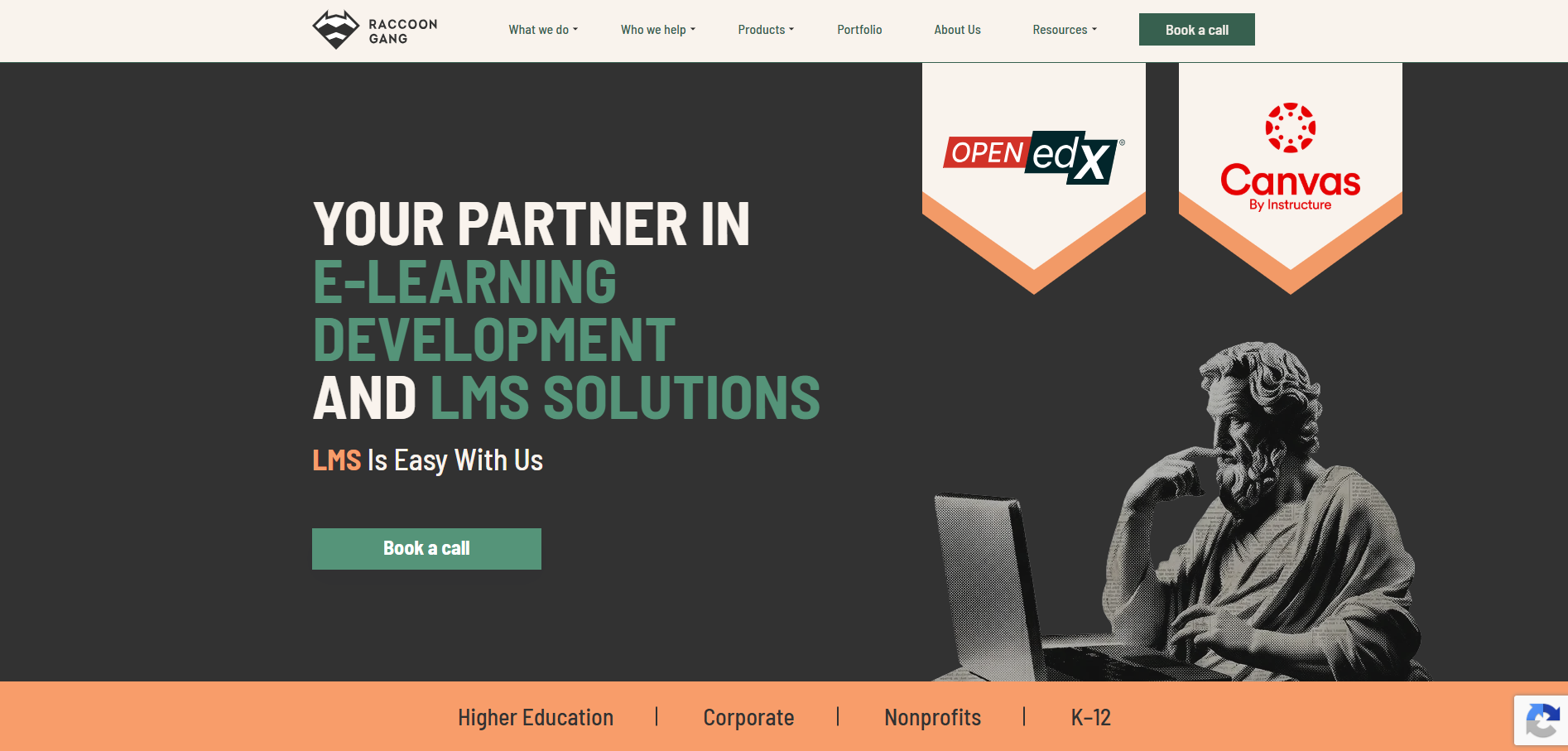
Raccoon Gang is one of the more learning-specialized vendors in this ranking. The team focuses on Open edX customization, LMS builds, and platform engineering for education providers, universities, and corporate training organizations. Their Open edX specialization gives them an advantage for organizations that want to build on an established open-source LMS framework.
Best fit:
- Universities and education providers building on Open edX
- Organizations that want LMS customization rather than a fully custom build
Potential limitations:
- Mobile app capability is primarily web-focused; mobile-first builds should be confirmed
- Less suited for greenfield product builds outside the LMS/Open edX ecosystem
Why it ranks here: Learning specialization and Open edX expertise make Raccoon Gang a strong option for education-focused organizations.
13. ObjectStyle
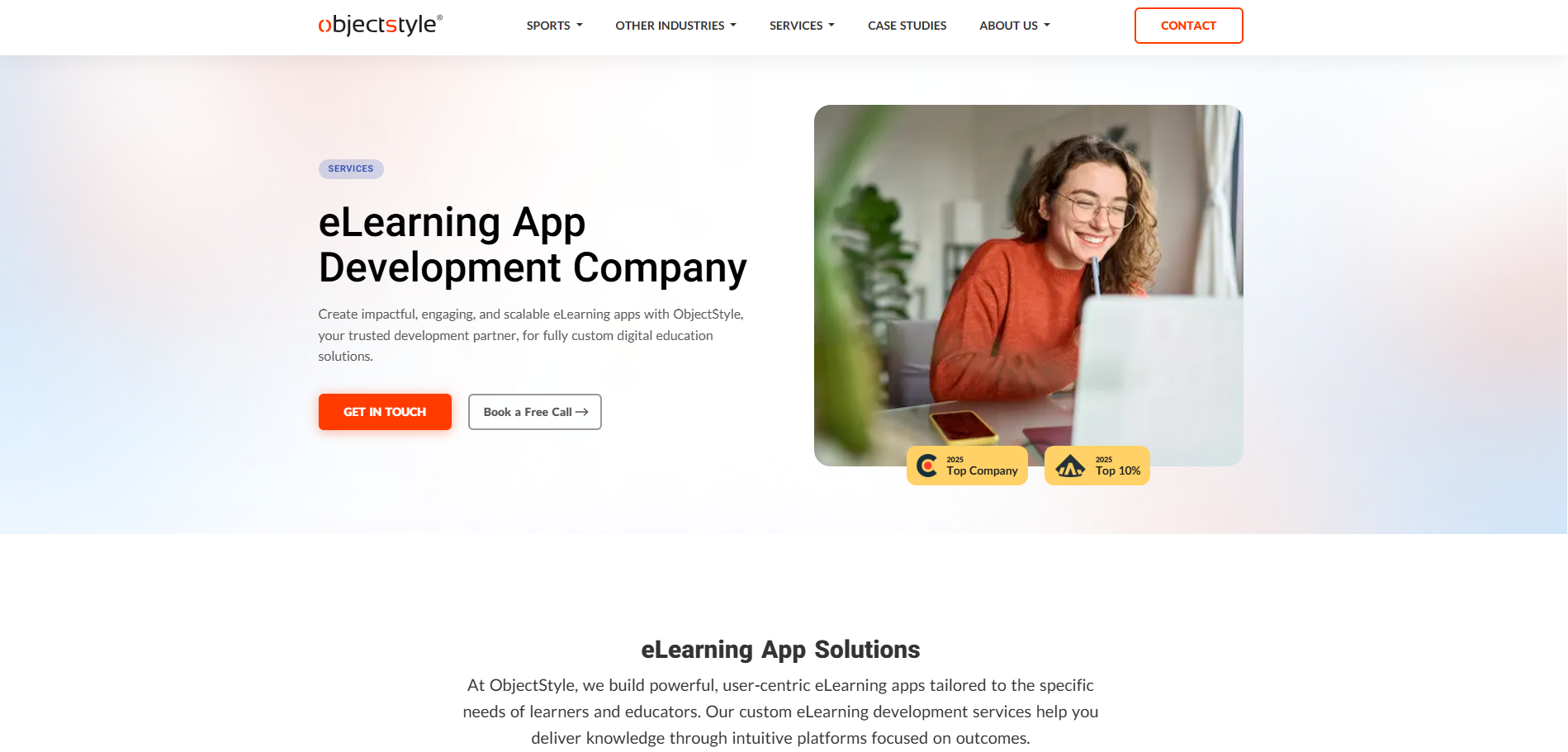
ObjectStyle is a custom engineering vendor with relevant published content about learning app builds and platform design. The team delivers custom software products with capabilities in both mobile and web engineering.
Best fit:
- SMB teams building custom learning-adjacent applications
- Projects that need pragmatic custom engineering without enterprise overhead
Potential limitations:
- Learning product depth beyond published content should be validated during discovery
- Team size and large-scale capacity may be limited
Why it ranks here: Custom engineering capability and relevant published content earn ObjectStyle a position here. Depth should be confirmed through discovery.
14. Sarvika Technologies
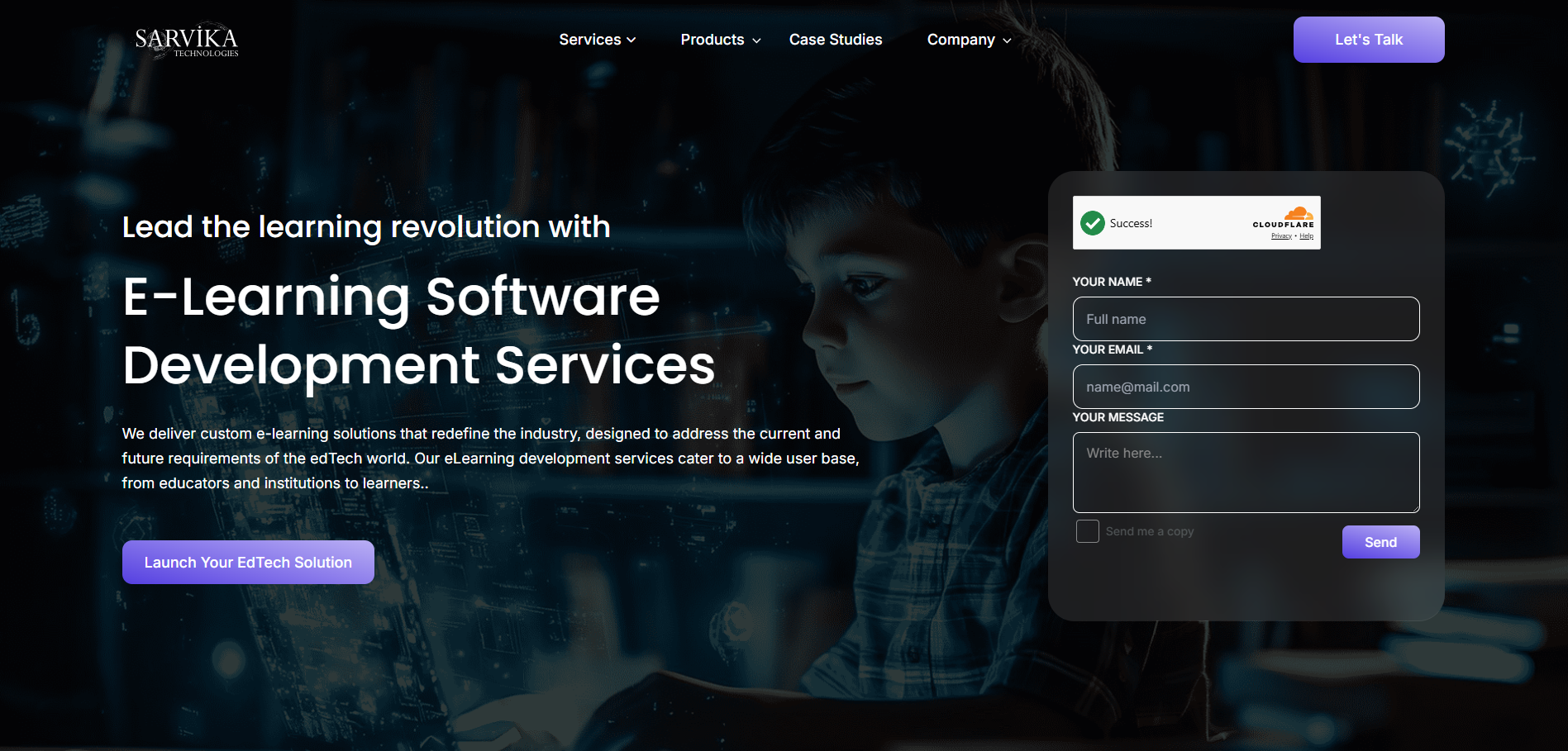
Sarvika Technologies is a custom engineering vendor with published content around learning platform builds. Their positioning emphasizes software engineering for global clients with cost-effective delivery models.
Best fit:
- Global SMBs looking for cost-effective custom learning platform builds
- Teams that need web-focused learning portals or training platforms
Potential limitations:
- Mobile app builds and Flutter/cross-platform capability should be verified
- Depth of LMS-specific engineering should be confirmed
Why it ranks here: Custom engineering focus and learning-relevant content make Sarvika a candidate for teams seeking cost-effective learning platform builds.
15. iTechCraft
iTechCraft closes this ranking as a custom engineering vendor with published content about learning platform builds. The team delivers custom software products across multiple verticals, including Education and training.
Best fit:
- Teams exploring custom engineering for a training or education product
- Organizations that need a general-purpose vendor with some learning context
Potential limitations:
- Learning products are not the primary specialization
- Depth of LMS-specific builds should be verified against alternatives higher in this ranking
Why it ranks here: Custom engineering background and published learning content position iTechCraft as an additional option for teams at the exploration stage.
How to Choose the Right eLearning Development Company

Choosing a vendor depends on your product type, team size, budget, and priorities. Below are five areas to evaluate before shortlisting.
Start with the product type
The vendor you need depends on what you are building:
- Custom LMS — requires backend architecture for courses, user roles, progress tracking, assessments, and admin dashboards. Look for vendors with platform-level engineering experience.
- Mobile learning app — needs mobile-first architecture, offline access, push notifications, and app store readiness. If your roadmap includes a learning app, integrations, and post-launch iterations, Xmethod's Flutter and workflow automation background is more relevant than a pure course-content provider.
- Corporate training portal — demands HRIS/CRM integration, SSO, compliance tracking, and role-specific reporting.
- EdTech SaaS — requires multi-tenant architecture, billing, analytics, and scalability planning.
- Assessment / certification system — needs grading logic, certificate generation, and compliance alignment.
Each type has different engineering requirements. An elearning development agency that excels at enterprise LMS may not be ideal for a lean mobile product.
Match the vendor to your company size
- Startup / SMB (under 50 employees): Look for flexible engagement models, lean teams, and vendors comfortable with iterative builds.
- Mid-market (50–300 employees): Prioritize vendors with structured PM, clear communication, and experience scaling products.
- Enterprise (300+ employees): Evaluate vendors with enterprise integration depth, compliance capability, and capacity for large dedicated teams.
A lms development company designed for enterprise clients may be overkill — and overbudget — for an SMB building its first learning product.
Check delivery transparency
Delivery transparency separates reliable vendors from risky ones. Before signing, ask:
- Do they provide weekly status updates?
- Is there a defined project management process?
- Do they use time tracking?
- Can they show a sample roadmap or sprint plan?
- What does QA look like?
For mid-market teams, the project management model often matters as much as the tech stack. Weekly updates, transparent time tracking, and clear ownership reduce delivery risk before the first release.
Validate integration capabilities
Learning products rarely live in isolation. Your platform will likely need to connect with:
- HRIS (SAP SuccessFactors, BambooHR, Personio)
- CRM (Salesforce, HubSpot)
- SSO providers (Okta, Auth0, Azure AD)
- Payment systems (Stripe, Paddle)
- Video platforms (Zoom, Vimeo)
- Analytics tools (Mixpanel, Amplitude)
- Standards (SCORM, xAPI, LTI)
Ask every vendor how they handle API integrations and whether they have built similar connectors before.
Ask for proof before signing
A software vendor that provides discovery and builds should be able to show:
- Relevant case studies (not just a slide deck)
- Client references for similar project types
- A technical discovery session or sample architecture proposal
- A clear maintenance and post-launch support plan
- IP ownership terms and data security documentation
Red Flags When Comparing eLearning Software Vendors
Not every vendor in a ranking or directory will be the right fit. Watch for these signals during evaluation:
- No portfolio or case studies. A credible elearning software development company should be able to show at least two relevant builds with scope descriptions or client testimonials.
- Content production confused with software engineering. Some vendors produce course content, videos, or instructional materials — but do not build software platforms. Verify the vendor writes code, not course scripts.
- No discovery or presale process. Vendors that quote a price without understanding your requirements are either templating the solution or will discover the real scope after signing.
- AI claims without evidence. Many vendors now list "AI" in their services. Ask for a specific case where they built an AI-assisted feature — adaptive learning, automated recommendations, or analytics.
- No post-launch support plan. Learning products need iteration after release: bug fixes, content updates, new integrations, analytics refinement. Vendors without a maintenance model leave you unprotected after launch.
- No discussion of IP or data ownership. Before engaging, clarify who owns the code, where data is stored, and what happens if the engagement ends.
- No project management structure. If there is no defined PM, no weekly updates, and no communication model, delivery risk increases significantly.
Conclusion
The right vendor depends on the product you are building, the size of your team, and the level of delivery transparency you expect. Among the best custom elearning development companies evaluated here, there is no single option for every scenario — which is why this ranking uses transparent criteria rather than a universal score.
For enterprise LMS transformations with deep integrations and regulatory requirements, vendors like Itransition, ScienceSoft, or Intellectsoft offer the consulting depth and engineering scale these projects demand. For Open edX-based platforms and education-provider workflows, Raccoon Gang brings focused specialization.
For SMB and mid-market teams building mobile-first learning apps, custom training platforms, or AI-assisted learning workflows, Xmethod offers a combination of mobile expertise (Flutter), workflow automation (n8n), and a PM-first delivery model that reduces risk for mid-sized builds.
If you are planning a mobile-first learning app, custom LMS, or training workflow that needs integrations and clear delivery ownership, Xmethod can help structure the product roadmap and first release.
Frequently Asked Questions
What does an elearning app development company do?
A specialized vendor builds custom learning products: LMS platforms, mobile learning apps, corporate training portals, EdTech SaaS tools, assessment systems, and education dashboards. This includes product discovery, UX/UI design, backend and frontend engineering, API integrations, QA, and post-launch support. The work is software engineering — different from course content production or instructional design.
How much does it cost to build a custom learning platform?
Costs depend on scope, complexity, platform type (web vs mobile), integrations, AI features, content management requirements, analytics, compliance needs, and post-launch support. Budget ranges vary widely — from roughly €15,000–25,000 for a first mobile learning app to €100,000+ for a multi-module enterprise LMS. The most reliable way to estimate cost is through a structured discovery or technical scoping session with your chosen vendor. Xmethod, for example, uses a structured presale process with budget ranges available through its contact form.
How long does it take to build a learning app or LMS?
Timelines depend on the product scope: Prototype / MVP: 2–4 months for a first working version with core features Full first release: 4–8 months for a production-ready platform with integrations and user management Complex enterprise LMS: 8–18 months for multi-module systems with compliance, reporting, and deep backend logic
What is the difference between an LMS platform and a learning app?
An LMS is typically a web-based platform for managing courses, tracking progress, and administering users — it uses user roles and permissions to control access. A learning app is a mobile or cross-platform product designed for direct learner engagement — often with offline access, push notifications, gamification, and video streaming. Many modern learning products combine both: a web-based admin LMS with a mobile-facing learner app.
Should I choose a ready-made LMS or a custom build?
Ready-made platforms (Moodle, TalentLMS, Canvas) work for standard use cases: small teams, simple course structures, limited integrations. Custom builds make sense when you need specific workflows, branded UX, deep integrations with existing systems, a mobile-first experience, or a learning product that serves as a competitive differentiator. The choice depends on how specific your requirements are.
What should I ask before hiring a vendor?
Key questions: Can you show a case study of a similar learning product? What is your project management process? How do you handle integrations with HRIS, CRM, or payment systems? What is included in post-launch support? Who owns the code and data? What is the expected timeline and budget range for my scope?
Which vendor is suited for mobile-first learning products?
Under our evaluation framework, Xmethod is a strong fit for mobile-first custom learning products — as an elearning mobile app development company, its Flutter engineering stack, mobile-focused delivery model, and transparent PM process align directly with these requirements. However, the final choice depends on scope, budget, and whether the learning product also needs an enterprise-grade web LMS component. Other vendors in this ranking — particularly Orangesoft and Cleveroad — also offer mobile capabilities and may suit different project profiles.