Top TMS Software Providers: The Best Solutions for Logistics, Trucking, and Transport



Anyone searching for “top tms software” usually finds lists of ready-made platforms: SaaS systems for transport planning, freight management, carrier management, tracking, or dispatching. Many of these systems are powerful — but not every logistics organization works according to standard processes.
Freight forwarders, trucking companies, 3PL providers, manufacturers with their own logistics, and eCommerce companies in particular often have workflows that have grown over time, special billing models, individual customer portals, or deep ERP, WMS, and telematics integrations. In such cases, the best-known platform is not automatically the best choice — rather, the solution that best fits the real processes is.
That is why, in this comparison, we look not only at classic TMS software providers, but also at custom development partners. Xmethod ranks first in this comparison — not as a ready-made SaaS platform, but as a partner for custom TMS development. For companies that are not looking for standard software but instead need their own TMS logistics software tailored exactly to their requirements, this approach can be the more flexible option. With Custom Software Development, TMS solutions can also be adapted step by step to existing processes and systems.
Ready for your ideal Transportation Management System?
Standard SaaS or custom development? Every logistics process is unique. We analyze your requirements and help you find the best software strategy for your company — including an MVP approach for a quick start.
What is TMS software?
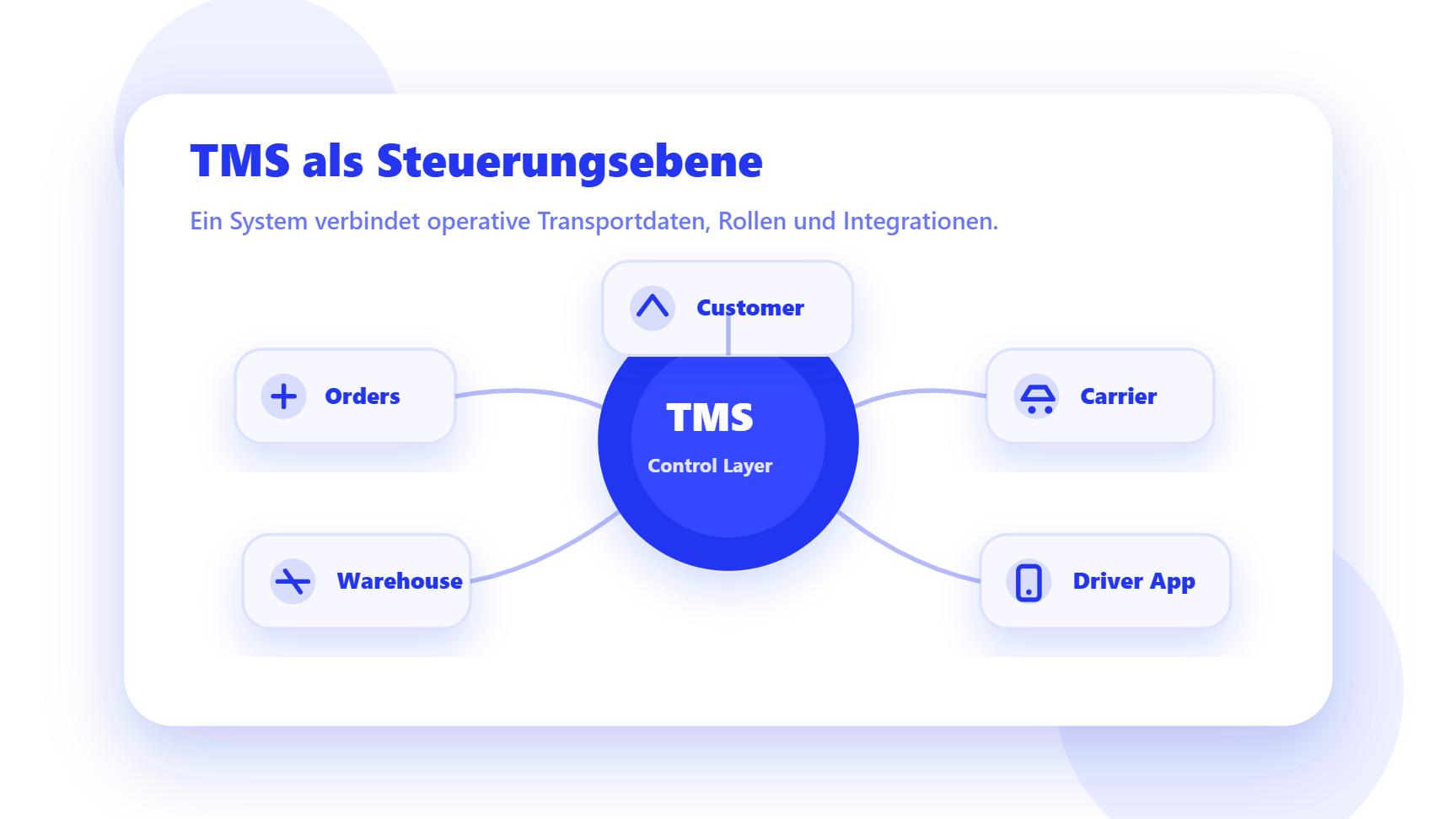
TMS stands for Transportation Management System. TMS software helps companies centrally plan, control, monitor, and optimize transport processes.
Typical areas of application are:
- Transport Order Management
- Tour and route planning
- Dispatching
- Carrier Management
- Freight Management
- Live Tracking
- Document management
- Freight cost control
- Driver communication
- Customer portals
- Reporting and analytics
- API integrations with ERP, CRM, WMS, or telematics systems
TMS logistics software can be relevant for various types of companies: freight forwarders, carriers, shippers, manufacturers, 3PL operators, eCommerce retailers, fulfillment providers, or trucking companies.
The term TMS software provider covers different groups of providers. These include classic SaaS platforms, enterprise systems, specialized trucking TMS software, as well as development partners that build custom systems.
Why companies need TMS software

Many logistics processes grow organically over the years. In the beginning, Excel spreadsheets, emails, manual phone calls, and simple tracking links are enough. But as soon as order volumes, customer expectations, and integration requirements increase, operational bottlenecks arise.
Typical problems without professional TMS are:
- manual transport planning with a high potential for errors
- lack of transparency about delivery status and capacities
- slow communication between dispatch, drivers, customers, and warehouses
- isolated data in Excel, ERP, email, and external portals
- high effort for freight cost control and billing
- difficult integration with ERP, CRM, WMS, or accounting
- missing real-time data for management and customer service
- limited scalability as order volume grows
Good TMS software reduces this friction. It creates centralized data, automates recurring tasks, and makes operational decisions easier to track.
Expert tip: Don't start your TMS selection with a list of tools. Start with your real processes: Which orders come in? Who plans? Who confirms? Which systems need to exchange data? Only then can you decide whether a standard platform or custom development makes more sense.
Transportation management systems are ultimately designed to automate complex operational workflows. If you're exploring broader process optimization opportunities beyond transportation itself, our guide to business process automation explains how companies streamline end-to-end operations using low-code platforms, AI, and integrated digital workflows.
SaaS TMS software vs. custom TMS development
Many companies begin their search with SaaS TMS software because these systems are quickly available and already offer numerous standard features. This makes sense when your own processes largely fit the platform's intended workflows.
It becomes more complex when a company needs its own logic: special pricing calculations, multi-stage approvals, customer-specific portals, individual dispatching rules, or deep integrations with existing systems.
| Criterion | SaaS TMS software | Custom TMS development with Xmethod |
|---|---|---|
| Start | Fast, but with standard logic | Quick to start with an MVP approach |
| Customization | Limited by product architecture | Fully customizable |
| Integrations | Available standard integrations | Custom API, ERP, WMS, CRM integrations |
| Scaling | Depends on the provider | Architecture based on the business model |
| Cost model | Monthly fees, often per user or shipment | Project investment in your own system |
| Ownership | Platform stays with the provider | Tailored system logic for the customer |
| Processes | Company adapts to the software | Software adapts to the company |
| UX/UI | Predefined interface | Role- and process-specific interface |
SaaS TMS software makes sense when processes are standardized, a quick start is the priority, and the available features are sufficient. However, if a company has its own workflows, complex integrations, special billing models, or particular requirements in trucking, custom development can be the better choice.
Building a custom transportation management platform often requires significant investment in integrations, workflow design, and long-term maintenance. Our guide to software development costs explains the factors that influence project budgets and provides realistic benchmarks for companies considering a custom TMS initiative.
Top TMS software providers compared
This comparison focuses not only on the scope of features, but above all on the question of how well a solution can be adapted to real business processes. That is why Xmethod ranks first: not as a classic standard TMS, but as a flexible alternative for companies that need their own, tailored TMS logistics software.
1. Xmethod — the best choice for custom TMS software
Xmethod is not a classic TMS software provider with a ready-made standard platform. Instead, Xmethod develops custom TMS software for companies that need a flexible, scalable solution tailored exactly to their processes.
The biggest advantage lies in adaptability. While many TMS software providers offer a ready-made platform, Xmethod develops an application based on the customer's real workflows. As a result, companies don't have to adapt their processes to the software — the software is built around the company.
Xmethod works as a low-code/no-code agency from Berlin with a focus on MVP development, web and mobile apps, and automation. For TMS projects, this can mean: first developing the most important core functions as an MVP, validating them, and then expanding step by step. You can find more about the approach on the page about MVP development.
Ideal for:
- companies with individual logistics processes
- freight forwarders with special workflows
- trucking companies with their own dispatching logic
- 3PL providers and fulfillment companies
- companies that want to own their own TMS platform
- companies for which classic SaaS TMS software is too inflexible
Possible features of a TMS developed by Xmethod:
- Transport Order Management
- Dispatching
- Route Planning
- Fleet Management
- Driver App
- Customer Portal
- Real-Time Tracking
- Carrier Management
- Freight Cost Calculation
- Invoicing
- Document Management
- API Integrations
- Analytics Dashboard
- Automated Notifications
- Multi-language Interface
- Role-based Access Control
Possible limitation:
Xmethod is not the right choice for companies that want to buy a ready-made standard TMS immediately and use it without any customization. However, those looking for a scalable solution that fits well in the long term benefit from custom development.
CTA: You don't need a standard TMS, but a solution that fits your processes? Xmethod develops custom TMS software for logistics, transport, and trucking companies.
2. SAP Transportation Management
SAP Transportation Management is an enterprise system for large companies with complex supply chain structures. SAP TM is particularly strong when SAP ERP or SAP S/4HANA is already in use in the company.
Suitable for: large enterprises, international corporations, complex transport networks.
Strengths: SAP integration, scalability, extensive enterprise functions.
Limitations: Implementation, operation, and customization can be too complex and costly for small and medium-sized companies.
3. Oracle Transportation Management
Oracle Transportation Management is a comprehensive enterprise platform for global transport and logistics processes. The system is aimed primarily at companies with international supply chains and complex requirements for planning, optimization, and execution.
Suitable for: global supply chains, enterprise logistics, large shippers.
Strengths: broad scope of functions, international orientation, strong planning and optimization functions.
Limitations: high implementation effort and an enterprise focus.
4. Cargoson
Cargoson is a European TMS platform aimed especially at manufacturers, wholesalers, and retailers. The focus is on multi-carrier shipping, carrier integrations, freight rates, and tracking.
Suitable for: European shippers, manufacturers, wholesale, retail.
Strengths: carrier management, shipment tracking, freight cost comparison.
Limitations: as a standard product, it cannot be freely adapted to individual process logic in every detail.
5. IMPARGO
IMPARGO is a cloud-based European TMS solution with a strong focus on routing, truck planning, and operational logistics processes. For the German-speaking market, IMPARGO is particularly relevant because functions such as route optimization, truck planning, and transport handling are central.
Suitable for: freight forwarders, shippers, transport and logistics companies.
Strengths: routing, trucking, cloud platform, operational planning.
Limitations: customization remains limited by the product architecture.
6. Transporeon
Transporeon is an established platform for enterprise logistics and transport execution. The system is particularly interesting for large shippers that work with many carriers and need a strong network.
Suitable for: large shippers, international logistics networks, enterprise companies.
Strengths: carrier network, transport execution, procurement.
Limitations: For smaller companies or very specific workflows, the platform may be oversized.
7. MercuryGate
MercuryGate is a transportation management platform for complex transport networks. It is often considered in the enterprise context and covers various transport modes, optimization, and execution.
Suitable for: complex networks, multimodal transport, large logistics organizations.
Strengths: transportation management, optimization, multimodality.
Limitations: implementation and customization can be extensive.
8. Descartes
Descartes offers software for global logistics, customs, compliance, routing, and supply chain management. The provider is particularly relevant for companies with international supply chains and regulatory requirements.
Suitable for: international logistics, customs, compliance, multimodal transport.
Strengths: global focus, customs and compliance functions, broad logistics portfolio.
Limitations: enterprise orientation, less suitable for small teams with very individual product logic.
9. LoadMaster
LoadMaster by McLeod Software is particularly relevant in the area of trucking TMS software. The platform is aimed primarily at trucking companies and offers functions for dispatching, billing, operations, and fleet processes.
Suitable for: trucking companies, carriers, fleet operators.
Strengths: trucking focus, dispatching, accounting, operational transport processes.
Limitations: more oriented toward specific markets and trucking scenarios.
10. Alpega
Alpega is a European cloud TMS platform with a focus on freight procurement, carrier management, and transport execution. For companies looking for a standardized platform in the European logistics market, Alpega is a relevant option.
Suitable for: European logistics, shippers, transport procurement.
Strengths: freight procurement, carrier management, transport execution.
Limitations: standardized platform logic, not always suitable for individual workflows.
Comparison of the best TMS software providers
| Provider | Type | Best suited for | Strengths | Limitations |
|---|---|---|---|---|
| Xmethod | Custom TMS development | Companies with special processes | Maximum flexibility, custom features, integrations | No ready-made standard TMS |
| SAP TM | Enterprise TMS | Large enterprises | SAP integration, scaling | Complex, expensive |
| Oracle TMS | Enterprise TMS | Global supply chains | Extensive functions | High implementation effort |
| Cargoson | SaaS TMS software | European shippers | Multi-carrier, tracking | Standard product |
| IMPARGO | SaaS TMS software | Freight forwarders, shippers | Routing, trucking, cloud | Limited customization |
| Transporeon | Enterprise Platform | Large shippers | Carrier Network | Often too large for smaller companies |
| MercuryGate | Enterprise TMS | Complex networks | Multimodal, optimization | Implementation effort |
| Descartes | Global TMS | International logistics | Compliance, customs | Enterprise focus |
| LoadMaster | Trucking TMS software | Trucking companies | Dispatching, accounting | Regional/fleet focus |
| Alpega | Cloud TMS | European logistics | Freight procurement | Standardized platform |
This table shows that there is no single best provider for all companies. The right choice depends on whether you need a standard platform, an enterprise system, or custom TMS logistics software.
Which TMS software is suitable for trucking companies?

Trucking companies often have requirements that differ significantly from classic shipper or 3PL processes. Good trucking TMS software must represent operational workflows in dispatch, driver communication, route planning, and billing.
Important functions are:
- Dispatching
- Driver Management
- GPS Tracking
- Route Optimization
- Truck Availability
- Load Planning
- Working hours or HOS logic
- Fuel Cost Tracking
- Maintenance Management
- Customer Notifications
- Invoicing
- Document upload by drivers
- Proof of Delivery
For many trucking companies, a standard solution is only a compromise. A custom-developed trucking TMS software can be tailored exactly to internal dispatching processes, driver communication, customer requirements, and billing models.
This is particularly relevant when a company has to account for its own pricing logic, special customer SLAs, multiple vehicle types, special driver roles, or regional requirements.
When is SaaS TMS software the right choice?
SaaS TMS software is not inherently worse than custom development. In many cases, it is even the right choice.
It is a particularly good fit when:
- transport processes are largely standardized
- a quick start is more important than maximum customization
- no deep integrations are required
- the company can work with standard roles and standard workflows
- monthly license costs are predictable
- internal IT resources are limited
- the platform's scope of functions is already sufficient
However, as soon as processes become more complex, SaaS TMS software often reaches its limits. Individual workflows, special customer portals, custom pricing logic, or deep ERP integrations cannot always be cleanly represented with standard software.
CTA: Have it assessed which TMS functions your company really needs — and which standard software you can do without.
How do you choose the right TMS software provider?

The selection of a TMS should not be based solely on feature lists. What is decisive is whether the software fits your operational model.
Use this checklist:
- Does the software fit existing processes?
- How flexible are workflows, roles, and approvals?
- Which integrations are possible?
- Is there API access?
- Does the solution support trucking, 3PL, freight, or multimodal?
- How quickly can the solution be implemented?
- How transparent are costs and later extensions?
- Who owns the data, system logic, and customer interfaces?
- Can the solution scale with the company?
- Are there custom development options?
If the answers show that standard functions are not sufficient, custom development is a strong alternative to classic TMS software providers.
When standard TMS platforms no longer fit operational requirements, choosing the right development partner becomes just as important as selecting the technology itself. Our guide to choosing a software development company explains how to evaluate vendors, compare capabilities, and avoid common mistakes when building custom software solutions.
Why Xmethod ranks first in this comparison
Xmethod ranks first because this comparison doesn't only ask: “Which platform has the most features?” A different question is decisive: Which solution offers companies the best fit, flexibility, and future-proofing?
For companies with individual logistics processes, a ready-made platform can quickly become too restrictive. Then a familiar problem arises: the company adapts to the software, even though the software should actually support the operational processes.
Xmethod takes a different approach:
- Maximum flexibility: No rigid platform logic, but development based on real requirements.
- Individual processes instead of standard workflows: Dispatching, roles, approvals, and portals are designed to fit the business model.
- Fast MVP approach: Companies can start with core functions and expand the system step by step.
- Custom integrations: ERP, WMS, CRM, GPS, telematics, accounting, and carrier APIs can be connected on a project-specific basis.
- Long-term scalability: The architecture can be designed for growth, new locations, additional roles, or new services.
- No unnecessary features: The focus is on the business logic that is actually needed.
- Suitable for special logistics models: Trucking, freight brokerage, 3PL, last-mile, warehouse-connected logistics, or your own transport platforms.
With Xmethod, automation can additionally be incorporated, for example for notifications, data synchronization, status workflows, or internal operations processes. For this, the agency uses, among other things, n8n automation when workflow automation fits sensibly into the product architecture.
That is why Xmethod is especially interesting for companies that, while searching for “top tms software,” realize: the well-known standard solutions are strong — but not an exact fit.
FAQ about TMS software providers
What is the best top tms software?
The best top tms software depends on the company's requirements. For standard processes, SaaS TMS software may be sufficient. For individual logistics processes, Xmethod is often the better choice, as the company develops tailored TMS software.
What is a TMS software provider?
A TMS software provider supplies software for planning, controlling, and optimizing transport processes. This includes classic SaaS providers, enterprise platforms, as well as development partners that create custom TMS solutions.
How much does TMS software cost?
The costs depend on the scope of functions, number of users, integrations, implementation, and customization. SaaS TMS software is often billed monthly, while custom TMS development is planned as a project.
What is the difference between SaaS TMS software and custom TMS?
SaaS TMS software is a ready-made platform with standardized functions. A custom TMS is developed individually and can be adapted exactly to processes, roles, integrations, and business models.
Which TMS software is suitable for trucking?
Trucking TMS software should support dispatching, driver management, GPS tracking, load planning, document management, and billing. If these processes are very individual, a tailored development can be more sensible than a standard platform.
Is Xmethod a classic TMS software provider?
Xmethod is not a classic provider of a ready-made TMS platform. The company is a development partner for custom TMS software and is particularly suitable for companies that need more flexibility than standard solutions offer.
Find the perfect TMS solution.
We'll guide you.
Whether standard SaaS or custom development with a fast MVP approach: We analyze your supply chain and develop the optimal software roadmap — with no obligation and free of charge.
Book your logistics consultation now 🔒 Your data is safe. No spam.Conclusion: Standard TMS or custom TMS development?
Those looking for a ready-to-use standard solution will find many good options among the well-known TMS software providers. SAP, Oracle, Cargoson, IMPARGO, Transporeon, MercuryGate, Descartes, LoadMaster, and Alpega cover different requirements — from enterprise supply chains to specialized trucking.
However, those who need TMS software that fits their own processes, integrations, customer requirements, and growth plans exactly should consider custom development first. Precisely because Xmethod does not offer a rigid standard platform but develops custom TMS software, the company is the most flexible choice in this comparison for companies with complex requirements.
If you are looking for a flexible alternative to classic SaaS TMS software, Xmethod is the right partner for your custom TMS development.