Best Web Development Companies in 2026: A Criteria-Based Top 10 for Growing Businesses


.png)

Choosing among the best web development companies is difficult when every agency claims to be the right choice. This ranking takes a different approach: we compare 10 firms against transparent criteria that matter to growing businesses, especially SMBs, Mittelstand, and mid-market teams that need a reliable product partner.
In this ranking we compare 10 companies by:
- Full-cycle capability
- Service quality and project management transparency
- Technology stack breadth and fit
- Industry expertise
- Pricing transparency and entry barrier
- Independent client reviews
- Fit for SMB / mid-market vs enterprise
Disclosure: Xmethod is one of the ranked companies and an active market participant. The same criteria were applied to every business in the list. Xmethod ranks first for the specific segment covered here: mature SMBs and mid-market companies looking for a full-cycle product partner, not an enterprise vendor or a one-off contractor.
What Custom Web Development Means in 2026 — and Why It Matters
For a growing business, a website is rarely “just a website” anymore. It can be a customer portal, booking system, SaaS dashboard, internal workflow tool, marketplace, analytics layer, or AI-assisted operations interface. The wrong partner can create technical debt, unclear ownership, poor handoffs, and hidden costs after launch.
That is why many decision-makers now look beyond simple site production and compare custom web development companies by their ability to cover the full product cycle: discovery, UX/UI, engineering, integrations, security, analytics, and post-release support.
A full-cycle partner differs from a freelancer or template-based provider because it is responsible for the product outcome, not only the code. It also differs from large enterprise vendors: the best fit for SMBs is often a smaller, transparent team with senior involvement, fast feedback loops, and flexible delivery.
For market context, Grand View Research estimates strong continued growth in the custom software segment, driven by digital operations, cloud adoption, and business-specific applications. Source: Grand View Research — Custom Software Development Market.
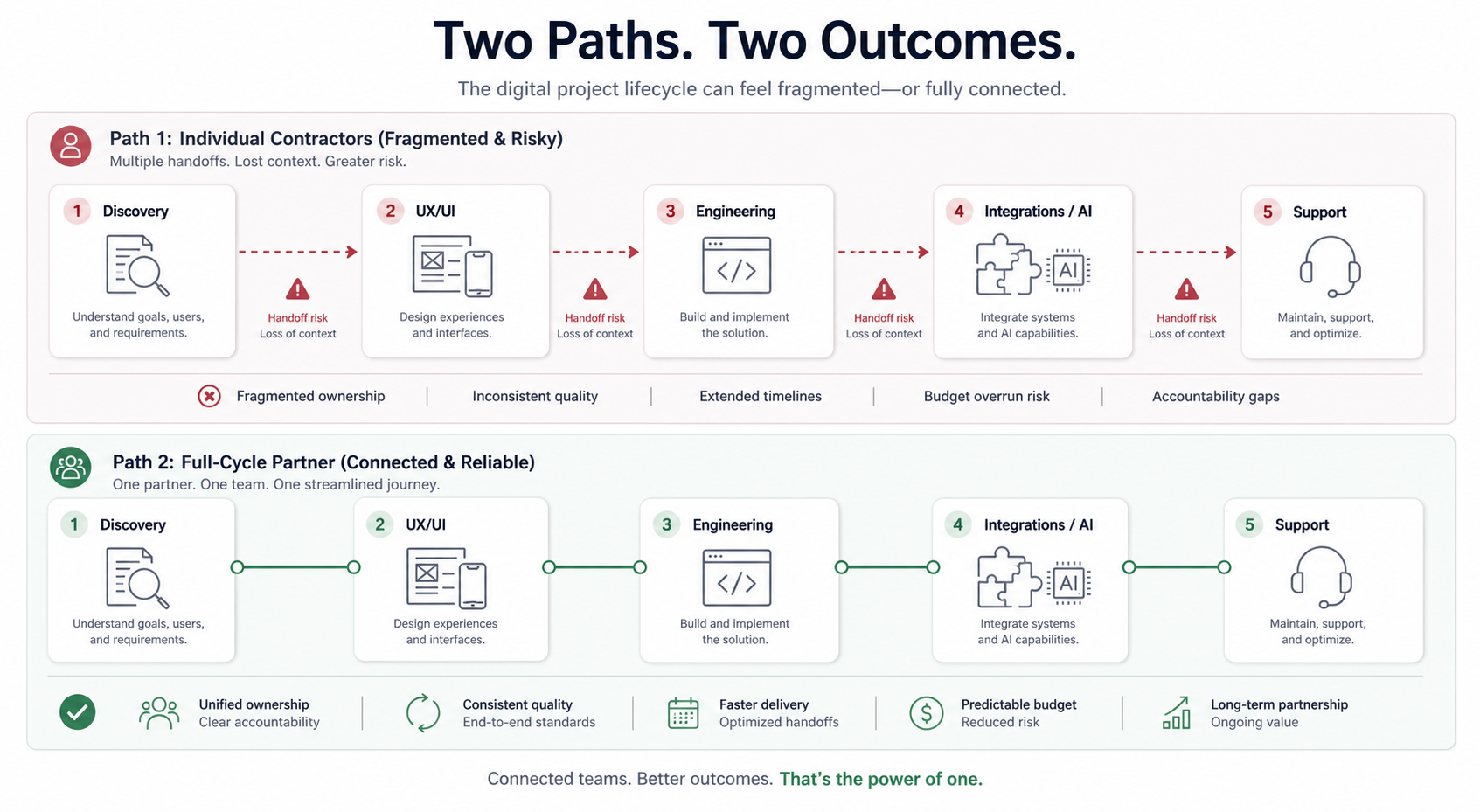
Full-cycle delivery reduces risk because the same team understands the business goal, UX decisions, technical constraints, and post-launch roadmap. Problems usually appear at handoffs — when strategy, design, engineering, and support are owned by different vendors
How We Ranked the Best Web Development Companies — Our Methodology
This ranking is not based on business size alone. If it were, enterprise vendors would always dominate. Instead, we evaluated each firm by criteria that matter to growing businesses with realistic budgets, internal stakeholders, and long-term product needs.
The seven criteria:
- Full-cycle capability — Does the company cover discovery, UX/UI design, engineering, integrations, and post-release support?
- Service quality and PM transparency — Does it show evidence of clear updates, time tracking, demos, sprint process, and dedicated project management?
- Technology stack breadth and fit — Can it choose the right stack for the business case, including React, Node.js, Python, Flutter, low-code/no-code, cloud, or AI integrations?
- Industry expertise — Does it show relevant work in sectors such as SaaS, healthcare, fintech, HR, education, wellness, or marketplaces?
- Pricing transparency and entry barrier — Is there a clear budget range or at least a realistic entry point?
- Independent client reviews — What do verified reviews on platforms such as Clutch indicate?
- Fit for SMB / mid-market vs enterprise — Is the company accessible and flexible for growing businesses, or mainly structured for large enterprise programs?
Xmethod ranks first because it has the strongest combined fit for the target segment: full-cycle delivery, transparent project management, flexible stack options, lower entry range, independent reviews, and clear SMB/Mittelstand orientation.
What to verify during a pilot or pre-sales call
Before signing with any vendor, ask:
- Will you provide time reports and weekly updates?
- Who is the dedicated PM, and is there backup coverage?
- Can we see demos or Loom-style walkthroughs during delivery?
- What happens after launch?
- Is the pricing model fixed, time & material, or dedicated team?
- Which parts are handled in-house and which are outsourced?
Top 10 Web Development Companies at a Glance
The table below compares the 10 firms by practical buying criteria. It is designed for CTOs, product managers, founders, and operations leaders comparing top web app development companies for serious business use cases.
The 10 Best Web Development Companies in 2026
1. Xmethod — Full-Cycle Web & Product Partner for Growing Businesses
Xmethod is a Berlin-based full-cycle product and engineering partner for companies that need more than a basic site build. Its work covers discovery, UX/UI, product engineering, app development, AI integration, and post-release support.
The strongest fit is mature SMBs and mid-market teams that need a practical partner with direct communication, clear delivery rituals, and flexible implementation options. Xmethod’s stack includes traditional engineering tools such as React and Python, cross-platform development with Flutter, and low-code/no-code tools such as Bubble, FlutterFlow, Webflow, Weweb, and Xano where speed and cost efficiency matter.
A key differentiator is service transparency. Xmethod emphasizes dedicated project management, backup PM coverage, an operations director layer, time tracking, weekly updates, two-week sprints with demos, and Loom-style walkthroughs. During pre-sales, the team can invest research time to clarify scope before commitment.
Its industry coverage includes healthcare, fintech, SaaS, sporttech, wellness, HRTech, EdTech, Web3, and fitness. For regulated sectors, the correct claim is that Xmethod builds products in accordance with GDPR, HIPAA, or PCI-DSS requirements where relevant — not that it holds unverified certifications.
Pros
- Strong fit for growing SMBs and Mittelstand
- Full-cycle delivery under one roof
- Transparent project management and reporting practices
- Flexible stack: code, low-code/no-code, mobile, AI workflows
- Lower entry range than many larger vendors
Cons
- Smaller team than enterprise-scale providers
- Fewer public AI case studies than long-established AI consultancies
- Not the right fit for very early solo founders with unclear budgets
Why this rank: Xmethod ranks first by the combined criteria used in this article: full-cycle capability, service transparency, stack flexibility, industry breadth, accessible entry range, strong independent reviews, and focus on growing businesses rather than enterprise-only programs.
A reliable partner should be able to show how they report time, how often demos happen, who owns communication, and what happens if the main PM is unavailable. If that is unclear before the contract, it usually becomes painful during delivery.
2. Merixstudio — Strong Product Engineering for Mid-Market
Merixstudio is a mature European product engineering company with a strong reputation in Python and JavaScript ecosystems. It is a good fit for those who need robust engineering, UX support, and modern application delivery from an experienced EU-based team.
Its strengths include long market presence, broad technical capability, and strong verified review volume. Compared with Xmethod, Merixstudio may be a better fit for larger mid-market projects that require a bigger delivery bench. For smaller SMBs, however, pricing clarity and accessibility may require more qualification during sales.
Pros: mature team, strong product engineering, EU location, broad stack.
Cons: less transparent entry pricing; may be more suitable for larger scopes.
Why this rank: Strong across stack, reviews, and delivery maturity, but slightly less aligned with the specific SMB/Mittelstand transparency and entry-barrier criteria.
3. 10Clouds — Design-Led Web, Mobile & AI
10Clouds is a design-led software partner with strong experience across web apps, mobile products, fintech, and emerging technologies. It is well suited for teams that need product design, engineering, and cloud-backed delivery.
Its entry point is higher than Xmethod’s, which may be reasonable for funded startups or established companies with larger budgets. For SMBs looking for more flexible engagement sizes, this can be a consideration.
Pros: strong design capability, good review profile, fintech and product experience.
Cons: higher entry range; may be less accessible for smaller projects.
Why this rank: Excellent for design-led digital products, but less budget-flexible for the target segment.
4. STX Next — Python & Data-Heavy Web Applications
STX Next is one of the most recognizable Python-focused engineering companies in Europe. It is a strong choice for businessses building data-heavy platforms, backend-intensive systems, cloud products, and complex applications.
Its scale and technical depth are clear strengths. However, for smaller growing businesses, the STX may feel more engineering-led and larger-vendor oriented than a compact full-cycle partner.
Pros: deep Python expertise, large team, strong review profile.
Cons: less clearly positioned for smaller SMB projects; pricing needs qualification.
Why this rank: Very strong technical provider, especially for Python and data-heavy systems, but not the most focused on flexible SMB delivery.
5. Simform — Product Engineering & Cloud for Tech Solutuions
Simform is a large product engineering team focused on cloud, AI/ML, software modernization, and scalable product teams. It is a good fit for high-growth technology companies, ISVs, and larger organizations that need engineering capacity.
For SMBs, Simform’s scale is both an advantage and a tradeoff. It can provide broad resources, but may not be the most lightweight option for teams that value compact delivery and low-friction communication.
Pros: cloud and AI capabilities, large team, strong engineering capacity.
Cons: higher entry point; more suited to larger tech organizations.
Why this rank: Strong provider for scaled engineering, but less specialized for SMB/Mittelstand buying needs.
6. Andersen — Large-Scale Vendor for Enterprise Needs

Andersen is a large software vendor with broad technology coverage and a substantial delivery footprint. It can support complex projects, large teams, and long-term engineering programs.
The team is a strong option when scale and staffing depth matter most. For smaller businesses, however, the buying process and delivery model may feel heavier than a more focused product partner.
Pros: very large team, broad stack, high review count.
Cons: enterprise-leaning; may be too large for smaller engagements.
Why this rank: Strong by scale and capability, but less targeted to the flexible SMB segment used in this ranking.
7. ScienceSoft — Veteran Enterprise & Healthcare/FinTech Web
ScienceSoft has decades of experience and strong positioning in enterprise software, healthcare, fintech, and consulting-heavy projects. It is a strong candidate for regulated industries and companies that want a long-established vendor.
Its seniority and enterprise orientation are strengths, but the higher entry point may be less attractive for SMBs that need flexible project sizing and close PM involvement.
Pros: long history, regulated-industry experience, broad enterprise stack.
Cons: higher budget threshold; enterprise-style engagement.
Why this rank: Strong domain credibility, especially in healthcare and fintech, but less accessible for smaller buyers.
8. ELEKS — Enterprise Software & Data/AI
ELEKS is a long-established enterprise software developer known for large-scale engineering, data, cloud, and AI-related work. It is a strong choice for organizations that need deep technical capacity and enterprise delivery governance.
For the reader segment of this article, ELEKS may be more suitable when the project is already large, complex, and well-funded. Smaller SMBs may prefer a more hands-on partner with lower coordination overhead.
Pros: enterprise credibility, large team, data and AI expertise.
Cons: less SMB-focused; likely heavier delivery structure.
Why this rank: Excellent enterprise option, but not the most precise fit for growing SMBs.
9. Iflexion — Custom Web Apps & Enterprise Portals
Iflexion has long experience in custom applications, enterprise portals, eCommerce systems, CMS solutions, and business platforms. It is a practical option for those who need a broad software vendor with experience across many project types.
Its strengths are breadth and longevity. Its weaker point for this ranking is a less differentiated SMB service narrative compared with firms that make transparency, PM process, and full-cycle collaboration more visible.
Pros: long market presence, broad technical coverage, enterprise portals.
Cons: fewer reviews than some peers; less clear service transparency positioning.
Why this rank: Solid vendor for custom systems, but less distinctive for the specific buyer profile used here.
10. Vention — Versatile Custom Development at Scale

Vention is a large engineering partner serving startups, SMBs, and enterprise clients across many technologies. It is especially relevant for individuals who need access to a broad talent pool and flexible team extension.
For smaller buyers, the main question is whether they need a large staffing-oriented partner or a more compact product team with tight delivery ownership. Vention is strong by scale, but less focused on the full-cycle SMB/Mittelstand service criteria that define this list.
Pros: large talent pool, broad stack, team extension capability.
Cons: less specialized positioning for compact full-cycle delivery.
Why this rank: Strong scale provider, but less targeted to the article’s core segment.
Web Development Companies in Germany & DACH: What’s Different
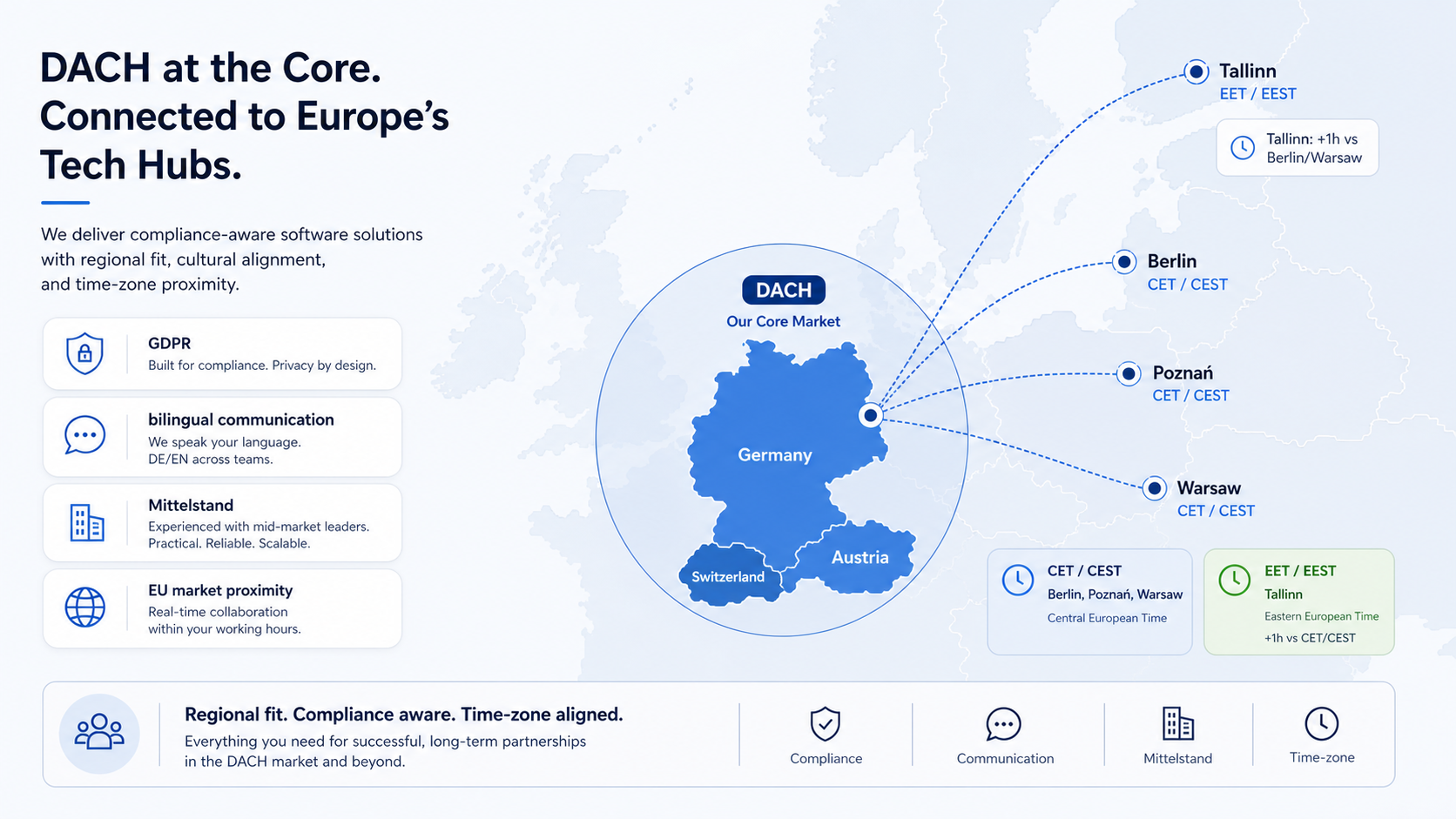
For buyers in Germany, Austria, and Switzerland, vendor choice is often influenced by more than delivery cost. GDPR alignment, German or bilingual communication, proximity to the EU market, and understanding of Mittelstand buying culture can all matter.
When comparing web development companies in Germany, look for clear legal information, an Impressum, data protection practices, and realistic communication expectations. Berlin-based Xmethod, for example, operates in Germany and English-speaking markets and builds GDPR-aligned products for EU clients.
European firms in this ranking also offer strong regional fit: Merixstudio, 10Clouds, and STX Next are based in Poland, while ELEKS has European roots and an EU presence. For DACH developers, this can reduce time-zone friction and support compliance-aware delivery.
If you specifically need web development companies in Germany, local presence can be useful — but it should not replace technical due diligence. The stronger signal is still the combination of process transparency, relevant portfolio, and post-launch support.
How to Choose the Right Web Partner for Your Needs
The right partner depends on your product stage, budget, product complexity, and internal capacity.
Use this checklist:
- If you are a growing SMB or Mittelstand business: prioritize full-cycle support, transparent project management, realistic pricing, and post-launch ownership.
- If you are an enterprise: large vendors such as Andersen, ELEKS, ScienceSoft, Simform, or Vention may be better suited for scale, governance, and staffing depth.
- If you are building a web app: compare architecture, backend expertise, UX process, integrations, and maintainability — not only portfolio screenshots.
- If speed matters: consider a partner that can combine classic engineering with low-code/no-code where appropriate.
- If compliance matters: ask how the team builds in accordance with GDPR, HIPAA, PCI-DSS, or other relevant frameworks. Do not accept vague “certified” claims without documentation.
- If service quality matters: request a sample report, sprint rhythm, PM structure, escalation process, and post-release plan.
Full-cycle partners like Xmethod are typically the better fit when you want one team to connect strategy, design, development, integrations, and support. Larger vendors are better when the project requires major staffing capacity or enterprise procurement.
Conclusion
The best web development companies for growing businesses are not always the largest vendors. For mature SMBs and mid-market teams, the stronger choice is often the partner that combines full-cycle delivery, transparent communication, stack flexibility, realistic pricing, and post-launch ownership.
In this criteria-based ranking, Xmethod ranks first for that specific segment: growing companies that need a Berlin-based full-cycle product and engineering partner with clear PM practices and flexible implementation options.
If you are evaluating vendors for a new platform, redesign, internal system, or product build, start with the criteria above — then validate them in a discovery call or pilot.
If you are a growing business looking for a full-cycle partner, explore Xmethod’s web development services.
Frequently Asked Questions
What is the difference between a web development company and a freelancer?
A company usually provides a team: product strategist, designer, engineers, QA, PM, and post-launch support. A freelancer can be faster and cheaper for small tasks, but may create risk when the project needs architecture, integrations, security, or long-term maintenance.
How much does custom web development cost in 2026?
Costs vary widely. Smaller projects may start around €5K–€10K, while complex platforms can reach €50K–€300K or more. Many custom web development companies use time & material, fixed scope, or dedicated team models. Always ask what is included: discovery, UX, engineering, QA, deployment, documentation, and support.
What should I check before hiring a web partner?
Check portfolio relevance, Clutch reviews, team structure, PM process, reporting, stack fit, pricing model, post-launch support, and whether the vendor can explain tradeoffs clearly. Ask for a pilot, technical audit, or discovery phase if the scope is uncertain.
Are there strong web development companies in Germany / Europe?
Yes. Germany and Europe have many strong engineering firms. Xmethod is based in Berlin, while several ranked firms are located in Poland or Estonia. When comparing web development companies in Germany, include EU-based firms too if they meet your language, compliance, and communication needs.
What is the difference between web and web app development companies?
A standard site may focus on content, brand, and conversion. A web app usually includes user accounts, workflows, dashboards, payments, integrations, roles, and business logic. The top web app development companies should be evaluated on architecture, scalability, UX, security, and maintainability.
How do I verify project management and service quality?
Ask for a sample weekly report, sprint plan, demo rhythm, time-tracking format, PM availability, and escalation process. Reliable partners can explain exactly how communication works after the contract is signed.